
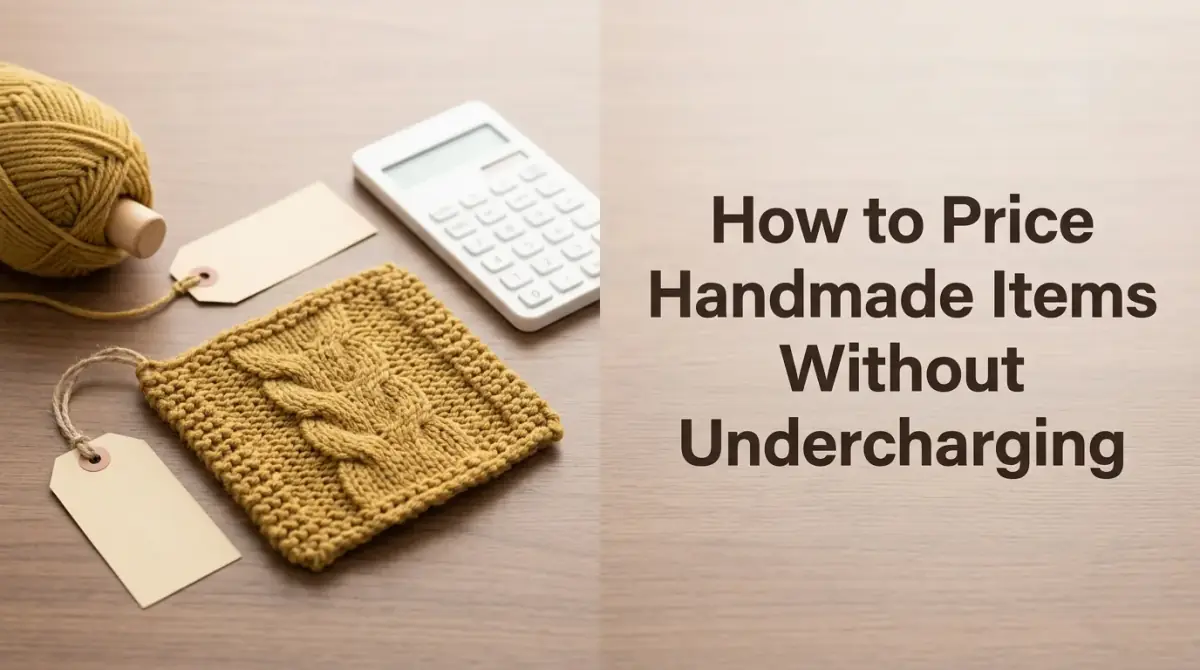
The short answer
Most makers undercharge and burn out. Learn how to price handmade items so materials, time, and skill all get paid for, without scaring the right buyers away.
- Count every material, down to the thread, glue, and packaging.
- Pay yourself a real hourly rate for the time you put in.
- Fold in overhead like tools, fees, and workspace costs.
- Add a margin so you can restock and grow.
- Price with confidence, because undercharging helps no one.
To price handmade items fairly, add up your materials, pay yourself an honest rate for your time, cover your overhead, and then add a margin so your craft can grow instead of just breaking even. The reason so many makers struggle with how to price handmade items is that they charge for the materials and quietly forget the hours, the skill, and the wear on their tools. When you leave your own time out, you are basically paying customers to take your work.
Charging what your work is worth is not arrogance. It is what keeps a hobby from turning into an exhausting, unpaid second job.
Here is the short version before we dig in:
- Count every material, down to the thread, glue, and packaging.
- Pay yourself a real hourly rate for the time you put in.
- Fold in overhead like tools, fees, and workspace costs.
- Add a margin so you can restock and grow.
- Price with confidence, because undercharging helps no one.
How to price handmade items without burning out
Most crafters price too low, and it usually comes from a good place. You love making things, you worry about scaring buyers off, and you compare yourself to mass-produced items that were never made by hand. So you shave the price down until it feels safe.
The problem is that a price that ignores your time is not sustainable. You end up busy, tired, and barely breaking even, which is the fastest route to burning out and quitting. Fair pricing keeps the joy in your craft, because the work finally pays you back for the care you put in.
Add up your materials and supplies
Start with the part that is easiest to measure: everything you physically use. Be thorough, because small items add up faster than most makers expect.
- The main materials, like yarn, fabric, wood, beads, or clay.
- The small extras, such as thread, glue, findings, and finishes.
- Packaging, tags, and anything that ships with the item.
- A share of supplies you buy in bulk, split across each piece.
Work out the real cost per item, not per shopping trip. If a spool of thread makes twenty items, only a fraction of its cost belongs to each one, but that fraction still counts and should be in your price.
Charge for your time like it counts
This is where most makers lose money, so it deserves real attention. Your time is a genuine cost, and learning to charge for your time is the difference between a paying craft and an expensive hobby.
Decide on an hourly rate that reflects your skill, then track how long a piece actually takes from start to finish. Include the fiddly parts people forget, like prepping materials, finishing, photographing, and packing. A piece that feels quick often eats far more time than you think once you add it all up.
If a fair hourly rate makes the price feel high, that is important information, not a reason to work for pennies. It may mean the item is too time-heavy to sell cheaply, and that is worth knowing before you make a hundred of them.
Do not forget overhead and hidden costs
Beyond materials and time, running a craft business carries costs that hide in the background. If you ignore them, they eat into whatever profit you thought you had.
Overhead can include selling fees, payment processing, marketing, tool maintenance, and a share of your workspace and utilities. None of these belong to a single item, yet together they are real. A simple approach is to add a small percentage on top of your materials-and-time total to cover them, so no sale is quietly running at a loss.
A formula for pricing handmade crafts
A repeatable formula takes the emotion out of the moment and keeps your prices consistent. One reliable approach to pricing handmade crafts looks like this:
- Add your material cost per item.
- Add your labor: hours multiplied by your hourly rate.
- Add a share of overhead to cover fees and running costs.
- Add a profit margin so the business can grow, not just survive.
The margin at the end is easy to skip, but it matters. It funds new supplies, better tools, and the occasional mistake, so your craft can improve rather than stand still. Think of it as the money that lets you keep making.
How to price crochet items and other time-heavy crafts
Some crafts eat hours, and pricing them fairly takes extra honesty. Figuring out how to price crochet items, hand-knits, or detailed pieces is really a lesson in respecting slow work.
A large crocheted blanket might take many hours, so an honest price can feel surprisingly high next to a factory-made version. That is normal. You are not selling the same thing. You are selling something made by hand, one stitch at a time, that no machine produced.
For very time-heavy items, a few adjustments help. You can streamline your process, offer smaller or simpler versions at friendlier prices, or focus on designs where the time genuinely matches the price people will pay. What you should not do is pretend the hours did not happen.
Pricing without scaring buyers away
Fair pricing and approachable pricing can absolutely coexist. The goal is not the highest possible number, but a price that pays you and still feels worth it to the right buyer.
A few things make a fair price easier to accept:
- Show the quality with clear photos and honest, specific descriptions.
- Tell the story of the materials and the care behind each piece.
- Offer a range, from small affordable items to premium ones.
- Sell to people who value handmade work, not bargain hunters.
The right customer is not looking for the cheapest option. They want something made with skill and care, and they are usually happy to pay for it when the value is clear. In other words, the fix for slow sales is rarely a lower price. It is usually a clearer story about why the work is worth what you ask.
The bottom line
Knowing how to price handmade items comes down to counting materials, paying yourself for your time, covering overhead, and adding a margin so your craft can grow. Business and tax rules vary by location, so treat this as general information rather than financial advice and check what applies where you sell. Price with honesty and a little confidence, and your handmade work will finally reward the hours you pour into it.


Comments
0 total