
The short answer
A business plan does not need forty pages. Learn how to write a business plan on a single page that clarifies your idea and guides the decisions that matter.
- A one-page plan captures your whole idea at a glance.
- It answers what, who, how, and how much.
- Clarity matters more than length or polish.
- A short plan is easy to update as you learn.
- The goal is better decisions, not a thick document.
To write a simple one-page business plan, you answer a handful of core questions clearly: what you sell, who you sell it to, how you reach them, and how the numbers work. Learning how to write a business plan this way strips out the fluff and leaves only the decisions that actually guide your business. A single page forces clarity, because you cannot hide a vague idea behind forty pages of filler.
A short plan is not a lesser plan. Often it is the more honest one, since every line has to earn its place on the page.
Here is the short version before we dig in:
- A one-page plan captures your whole idea at a glance.
- It answers what, who, how, and how much.
- Clarity matters more than length or polish.
- A short plan is easy to update as you learn.
- The goal is better decisions, not a thick document.
Why a one-page business plan works
A traditional business plan can run for dozens of pages, and much of it goes unread. A one page business plan does the opposite by forcing you to distill your idea down to its essentials.
When everything fits on a single page, you can see the whole business at once and spot gaps quickly. It is easier to write, easier to share, and far easier to revisit when something changes. For most small and early-stage businesses, that speed and clarity are worth more than a long document that sits in a drawer.
Short also means used. A plan you actually look at each month shapes real decisions, while a long one often gets written once and then forgotten.
How to write a business plan on a single page
The trick to fitting a plan on one page is to treat each section as a single clear answer rather than an essay. Work through these questions in order:
- What problem does your business solve, and for whom?
- What exactly do you sell, and what makes it worth choosing?
- Who are your customers, and how will you reach them?
- What will you charge, and what are your main costs?
- What does success look like in the next few months?
Answer each in a sentence or two. If a section grows long, you are probably overcomplicating it, so trim it back to the core point. The discipline of keeping it short is where the value lives.
The core sections of a one page business plan
A useful one-page plan usually covers a few essential areas. Think of each as a small box on the page with a short, direct answer inside.
Problem and solution
State the problem your customers face and how your product or service solves it. This is the heart of the plan, so make it concrete.
Customers and market
Describe who your ideal customer is and roughly how many of them exist. A clear picture of one real customer beats a vague claim about everyone.
Marketing and sales
Explain how people will find you and why they will buy. Name the one or two channels you will actually use.
Money
Note your pricing, your main costs, and how the business makes a profit. Keep the numbers simple but honest.
A simple business plan template you can copy
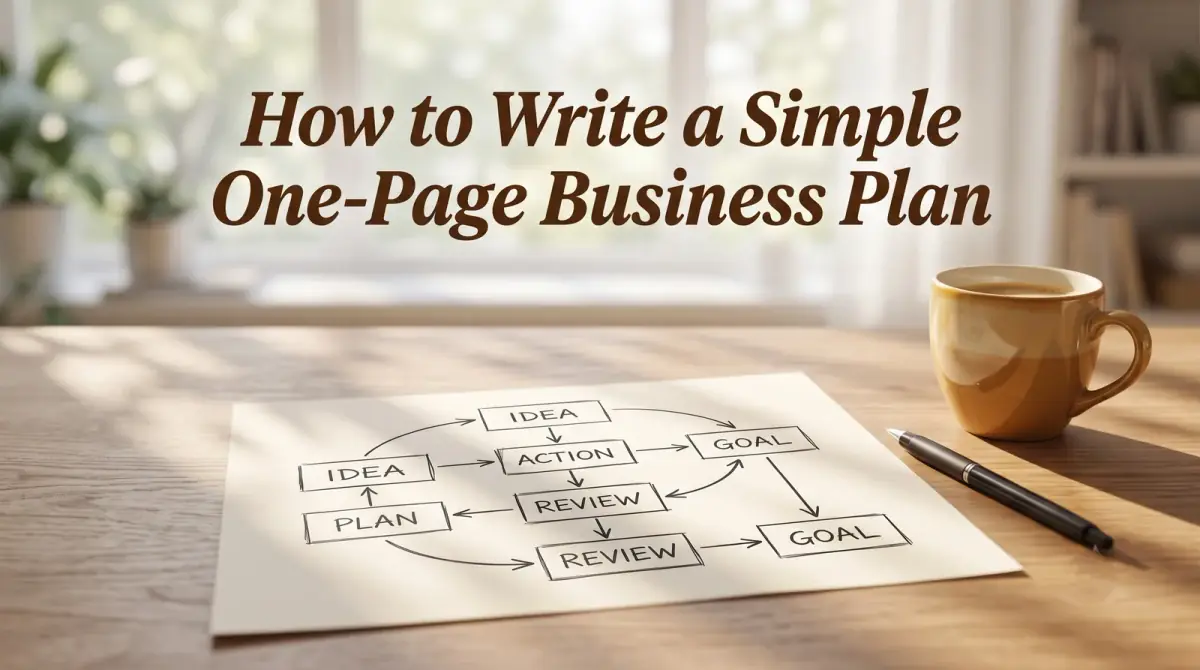
You do not need special software to start. A simple business plan template can be a single page with a short heading for each section and a line or two beneath it. Set it up like this:
- Purpose: the problem you solve in one sentence.
- Offer: what you sell and why it stands out.
- Customers: who buys and where to find them.
- Marketing: how you will reach those customers.
- Pricing and costs: what you charge and what you spend.
- Goals: what you want to achieve in the next few months.
Fill in each line with a plain answer and you have a working plan. Because it is so simple, you can rewrite it in minutes whenever your thinking sharpens.
Business plan for beginners: mistakes to avoid
A good business plan for beginners is honest and specific, yet a few common errors weaken early plans. Watch out for these:
- Claiming everyone is your customer instead of naming a clear group.
- Being vague about how you will actually reach people.
- Ignoring costs or guessing at numbers you never check.
- Writing to impress rather than to guide real decisions.
- Finishing the plan and never looking at it again.
The point of the plan is to help you think clearly and act wisely. If it does that, it is doing its job, no matter how plain it looks.
How to keep your plan useful over time
A business plan is a living tool, not a one-time assignment. Your first version is a set of educated guesses, and reality will soon teach you which ones were right.
Revisit the page every month or two and update anything that has changed: a new customer insight, a better channel, or a clearer sense of your costs. Because it is only one page, editing takes minutes rather than hours, so you will actually do it. Over time, the plan becomes a record of what you have learned as much as a map of where you are headed.
This is general guidance rather than financial, legal, or tax advice, so check the requirements where you operate and consider speaking with a qualified professional about your specific numbers.
Turn your one-page plan into action
A plan only matters if it changes what you do next. Once your page is filled in, pull one or two clear actions from it and start there rather than admiring the finished document.
For example, if your plan names a marketing channel, your first task is simply to try it this week. If it highlights an unclear cost, go and find the real number. Because the plan is short, the next step is usually obvious, and that momentum is exactly what a one-page plan is built to create.
The bottom line
Knowing how to write a business plan on a single page is about clarity, not length. Answer what you sell, who buys it, how you reach them, and how the money works, then keep the page short enough to actually use. Every business is different, so revisit your plan as you learn, and let that one honest page guide the decisions that move your business forward.



Comments
0 total