
The short answer
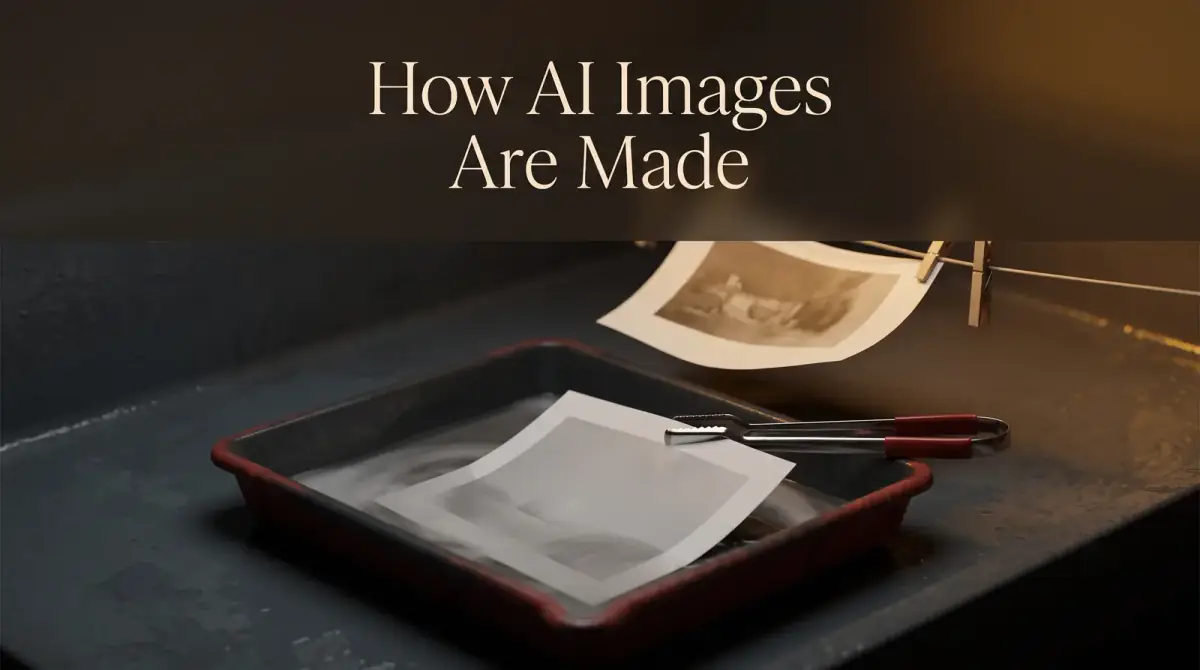
AI image tools do not search for pictures or paste them together. They start with visual noise and remove it step by step until an image appears. Here is how.
- Counting is unreliable. Asking for exactly six objects often produces five or seven.
- Negation is weak. Saying no hat can still summon a hat, because the word activates the concept.
- Relationships between objects blur. Which thing is on top of which is easily scrambled.
- Consistency across images is hard without extra tooling, since each generation is independent.
An AI image generator does not search a library of pictures or stitch existing ones together. It begins with a rectangle of random visual static and removes that static in stages, guided by your words, until a coherent image emerges. Nothing is retrieved. The picture is constructed from scratch each time.
That process is called diffusion, and it sounds implausible until you see how the system learned to do it. The training method is the key to the whole thing.
Learning by watching pictures get destroyed
The training runs an experiment in reverse. Take a real photograph and add a small amount of random noise. Add a bit more. Keep going through many steps until the original is gone and only static remains.
Now show the model a noisy version at some stage and ask it to predict the noise that was added. It guesses, gets corrected, and adjusts. Repeat across an enormous number of images and noise levels.
What the model ends up learning is a very general skill: given a messy image, estimate what part of the mess is noise. And a system that can reliably subtract noise can be run backwards. Start from pure static, ask what noise to remove, remove it, and repeat. After enough passes, something that was never a photograph resolves into an image.
Where your words come in
Left alone, that process produces a plausible but arbitrary picture. The prompt steers it.
During training, images arrive paired with text descriptions scraped from the web, usually captions and alternative text. A second component learns to place images and text descriptions into the same mathematical space, so that a photo of a dog on a beach and the phrase a dog on a beach land near each other.
Your prompt is converted into a position in that space. At every denoising step, the model is nudged toward removing noise in a way that moves the emerging image closer to that position. The picture is being pulled toward your description a little at a time.
This explains a common frustration. The prompt is a direction of travel, not a specification. There is no stage where the system checks whether your requirements were met.
Why the same prompt gives different pictures
Each generation starts from a different patch of random noise, identified by a number called a seed. Different seed, different starting point, different destination even with identical wording.
Most tools let you fix the seed. Doing so is the difference between rolling the dice again and making a small adjustment to a picture you already like. If you want to iterate rather than gamble, that is the setting to find.
Why hands and text go wrong
The classic failures follow directly from the mechanism.
Hands are hard because they appear in training images in an enormous variety of positions, angles, and states of occlusion. The model learns a strong sense of what hand-ish looks like without learning the underlying constraint that there are five fingers arranged in a fixed way. It is matching appearance, not anatomy.
Text is hard for a related reason. The model has learned what writing looks like as a visual texture. Producing genuine letters requires treating characters as discrete symbols in a specific order, which is a different kind of task. Newer systems have improved at this noticeably, but the underlying tension has not gone away.
- Counting is unreliable. Asking for exactly six objects often produces five or seven.
- Negation is weak. Saying no hat can still summon a hat, because the word activates the concept.
- Relationships between objects blur. Which thing is on top of which is easily scrambled.
- Consistency across images is hard without extra tooling, since each generation is independent.
Writing prompts that work better
Since the prompt is a direction, the useful move is describing the finished image rather than issuing instructions.
Concrete visual nouns and adjectives carry more weight than abstract intentions. Professional is vague. Soft window light, plain grey background, shallow depth of field gives the process something to move toward.
Naming the medium helps a lot, because it activates a whole cluster of associated qualities. Oil painting, pencil sketch, 35mm film photograph, technical diagram. So does specifying the framing: close-up, wide shot, overhead view.
And it is usually faster to iterate than to write one perfect prompt. Generate, see what came out, adjust the part that missed, lock the seed when something is close.
The training data question
Most well-known generators were trained on very large collections of images scraped from the open web. Photographers, illustrators, and designers whose work was included generally did not agree to it and were not asked.
The disagreement is real and unresolved. One argument holds that learning statistical patterns from public images is comparable to a person studying existing art, and that the output is new rather than copied. Another holds that ingesting millions of works to build a commercial product that competes with those same creators is a different situation entirely, whatever the technical mechanism.
Courts in several countries are working through versions of this question and have not settled it. Separately, some providers now offer models trained only on licensed or owned material, which sidesteps the argument for anyone who needs certainty.
On the narrower question of copying: these systems do not normally store or reproduce their training images. Researchers have shown that near-duplicates can sometimes be coaxed out, particularly for images that appeared many times in the data, but that is an edge case rather than how the system usually behaves.
Practical things worth knowing
A few points matter if you plan to use these tools for anything beyond curiosity.
- Rights vary by service. What you may do with an output depends on the provider terms and on your local law. Commercial use in particular is worth checking rather than assuming.
- Copyright status is unsettled. In some jurisdictions, work generated without meaningful human authorship may not be protectable at all.
- Likenesses carry separate risks. Generating recognisable real people raises issues that have nothing to do with copyright.
- Bias is inherited. If the training images skewed in some direction, outputs will too, often in ways that are invisible until you look for them.
- Detection is unreliable. Provenance metadata attached at creation is more dependable than any tool claiming to identify AI images after the fact.
The mental model that serves you best is this: a system that has absorbed the statistical texture of a vast number of captioned images, and can reconstruct something plausible from noise when pointed in a direction. Powerful, genuinely useful, and confidently wrong in specific and predictable ways.

Comments
0 total