
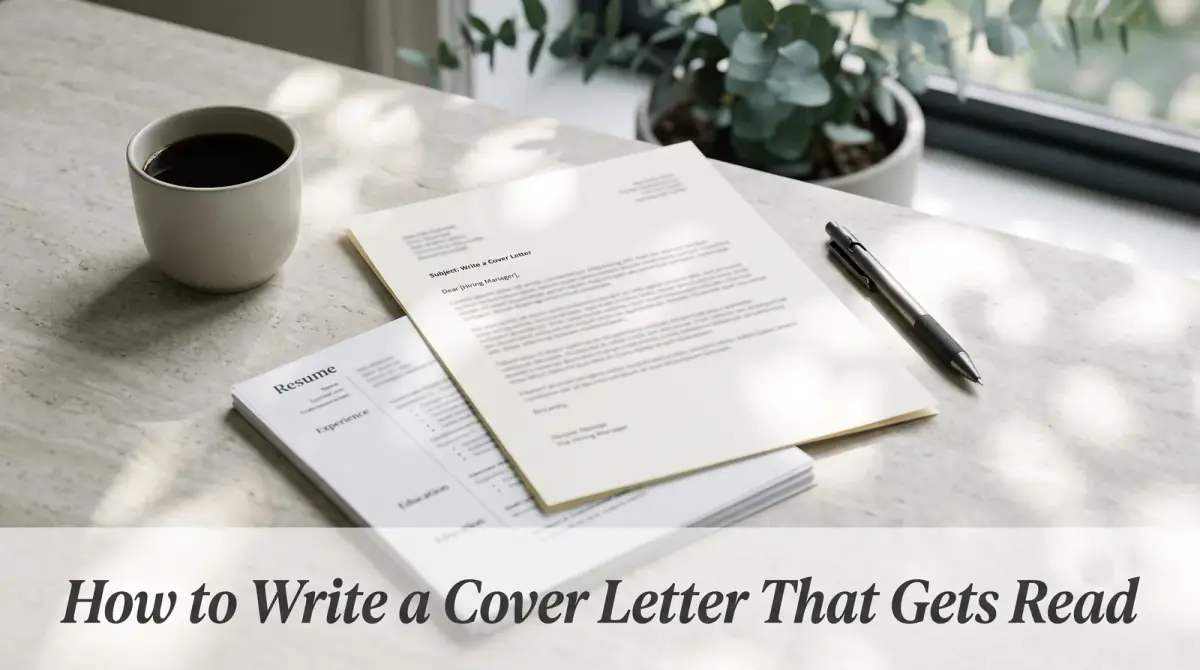
The short answer
Recruiters skim most cover letters in seconds. Learn how to write a cover letter that hooks fast, stays under a page, and makes them want to meet you.
- Open with a specific hook, not a generic greeting.
- Keep the whole letter under a page and easy to skim.
- Match your examples to the role's actual needs.
- Show genuine interest without slipping into flattery.
- Close with a confident, low-pressure next step.
To write a cover letter that actually gets read, lead with a specific hook, keep the whole thing under a page, and tie your experience directly to the role in front of you. The real secret to how to write a cover letter is not clever phrasing but relevance and brevity. A recruiter often skims dozens of applications at once, so the letters that survive are the ones that make their point fast and prove you understand the job.
Think of your letter as a short, confident conversation rather than a formal essay. You are answering one quiet question in the reader's mind: why should I spend more time on you?
Here is the short version before we get into the detail:
- Open with a specific hook, not a generic greeting.
- Keep the whole letter under a page and easy to skim.
- Match your examples to the role's actual needs.
- Show genuine interest without slipping into flattery.
- Close with a confident, low-pressure next step.
Why most cover letters get ignored
Most cover letters fail for the same reasons. They open with a tired line like "I am writing to apply for the position," repeat the resume word for word, and read as though the same letter went to fifty companies. None of that gives a reader a reason to keep going.
Recruiters and hiring managers are busy, and they read quickly. When a letter is long, vague, or clearly generic, it is easy to set aside. However, when a letter feels written for one specific role, it earns a few more seconds of attention, and those seconds are often all you need.
How to write a cover letter that hooks fast
The first sentence does the heavy lifting. Instead of announcing that you are applying, which the reader already knows, open with something that signals fit or energy. A strong hook might name a specific challenge the company faces, a result you are proud of, or a genuine reason this role caught your eye.
For example, "I helped a small support team cut response times in half, and I would love to bring that same focus to your customers" says more in one line than three paragraphs of throat-clearing. Because the opening sets the tone, it is worth rewriting several times until it feels sharp and true.
Quick tests for a strong opening
- Could this line only have been written for this job?
- Does it point to a result or a specific interest?
- Would a busy reader want to know what comes next?
A cover letter structure that keeps readers moving
A clear cover letter structure makes your letter easy to follow and hard to put down. You do not need anything fancy, just a simple flow that builds from hook to fit to close.
A reliable shape looks like this:
- The hook: one or two sentences that grab attention and signal fit.
- The proof: a short paragraph connecting your experience to the role.
- The fit: a few lines on why this company and team appeal to you.
- The close: a confident sentence inviting the next step.
Keep each section tight. Three to four short paragraphs is plenty, and white space on the page makes the whole letter feel lighter and more inviting to read.
Cover letter tips for the middle paragraphs
The middle is where many letters sag. This is your chance to show, not just claim, that you can do the work, so lean on specifics. Pull one or two achievements that map neatly onto what the job needs, and describe the result you produced rather than listing duties.
A few cover letter tips make this section stronger. Use numbers where you honestly can, because a concrete outcome is more convincing than an adjective. Mirror the language of the job description so the reader sees the match at a glance. And resist the urge to explain your entire career, since the letter only needs to prove you are worth a conversation.
Above all, keep the focus on the employer's needs. Every sentence should quietly answer the question, how does this help them?
Learn from cover letter examples without copying them
Good cover letter examples are useful for spotting patterns, not for lifting text. When you read a strong sample, notice how it opens, how it moves from proof to fit, and how it sounds confident without bragging. Those are the pieces worth borrowing.
Copying a template word for word backfires, because recruiters have seen the popular ones many times. Instead, study the rhythm and structure, then write in your own voice. Your letter should sound like a real person who is genuinely interested, not a form filled in from a script.
Mistakes that get you skimmed and forgotten
Even a well-meaning letter can trip over avoidable errors. Watching for these keeps your letter in the yes pile:
- Making it about you only: frame your value around their needs.
- Repeating the resume: add context and results, not a summary.
- Going too long: anything past one page loses attention.
- Being too formal: stiff, robotic wording feels distant.
- Skipping the proofread: small typos suggest carelessness.
None of these are hard to fix. A quick reread with fresh eyes, ideally after a short break, catches most of them before you send.
A quick checklist before you hit send
Before the letter goes out, run through a short mental checklist. Is the opening specific to this role? Does the middle prove your fit with real examples? Is it under a page and easy to skim? Does the close invite a next step without sounding needy?
It also helps to read the letter aloud. If any sentence makes you stumble or sounds like corporate filler, rewrite it in plainer words. A letter that sounds natural when spoken almost always reads well too.
Match every letter to the job description
A generic letter announces itself instantly, so the single biggest upgrade you can make is tailoring each one to the specific posting. Read the job description slowly and note the words the employer repeats, since those signal what they care about most. Then weave that same language into your letter wherever it honestly fits.
This does not mean rewriting from scratch every time. Keep a strong base version, then adjust the hook, swap in the most relevant example, and mirror the role's priorities. Because a tailored letter proves you actually read the posting, it quietly separates you from the many applicants who clearly did not.
Tailoring also helps with automated screening, where matching the posting's key terms can keep your application moving forward. Even so, write for the human first, because a real person usually makes the final call.
The bottom line
Learning how to write a cover letter that gets read is really about respect for the reader's time. Hook them fast, prove your fit with specifics, keep it short, and close with quiet confidence. Results vary from role to role, but a letter that feels written for one job, in a real human voice, will always stand out from the pile of forgettable ones.

Comments
0 total