
The short answer
What is AI slop? Learn what the term means, why low-quality AI content is flooding the internet, and simple ways to spot mass-produced filler in feeds and search.
- AI slop is cheap, low-effort content made by AI at scale.
- It spreads because it is fast to make and can earn money from clicks.
- It often feels generic, padded, and strangely empty.
- You can learn to spot it with a few simple tells.
- The tools are not the problem. Lazy, high-volume use is.
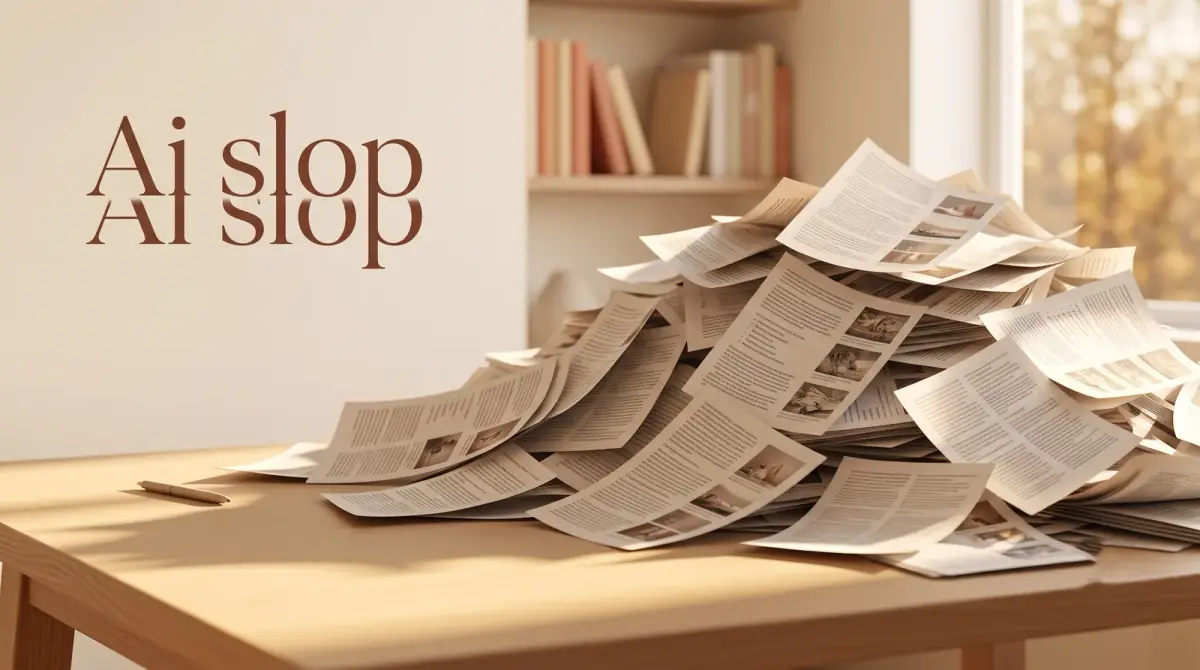
AI slop is a nickname for low-quality, mass-produced content churned out by AI with little human care. Think of generic articles, odd images, and filler videos made fast and cheap, mostly to grab clicks rather than to help anyone. So what is AI slop, in plain terms? It is the digital equivalent of junk mail, and it is spreading fast across the internet.
The word slop says it all. It suggests something poured out in bulk, low in value, and not really meant for you. This guide explains where it comes from and how to spot it.
Key takeaways:
- AI slop is cheap, low-effort content made by AI at scale.
- It spreads because it is fast to make and can earn money from clicks.
- It often feels generic, padded, and strangely empty.
- You can learn to spot it with a few simple tells.
- The tools are not the problem. Lazy, high-volume use is.
What is AI slop, exactly?
What is AI slop when you break it down? It is content generated in bulk with almost no human review, then dumped online to fill space and chase attention. The goal is not quality. The goal is quantity.
You will find it as text, images, audio, and video. A site might publish dozens of near-identical articles a day. A feed might fill with strange, over-smooth pictures. A channel might post endless clips that say nothing new.
The key trait is emptiness. The content looks finished on the surface, but there is no real insight, experience, or point behind it. It exists to be posted, not to be read.
Why the internet is filling up with it
AI slop spreads for one simple reason: it is cheap and fast to make. A person can now produce in minutes what used to take hours, so the volume explodes.
Money drives a lot of it. Many websites earn from ads, so more pages can mean more income, even if each page is weak. That reward pushes people to publish as much as possible, quality aside.
Attention drives the rest. Social feeds reward anything that stops the scroll, so eye-catching but hollow posts spread well. When making content costs almost nothing, flooding the zone becomes a strategy.
There is also a quieter cause. As more slop gets published, it can end up in the data future tools learn from, which risks a slow drop in overall quality. That worry is real, though how badly it plays out is still uncertain.
Why AI writing is bad when it is done lazily
To be fair, AI writing is not always bad. Used with care, it can help draft, edit, and organize ideas. The problem shows up when people ask why AI writing is bad in the slop sense, and the answer comes down to effort.
Left unchecked, AI writing tends to be generic. It smooths every topic into the same safe, middle-of-the-road tone. It rarely takes a real stand or shares a lived detail, because it has neither.
It also pads. You get long sentences that circle a point without landing it, and lists of obvious tips dressed up as insight. Worse, it can state wrong facts in a calm, confident voice, which makes errors easy to miss.
None of this is fatal on its own. It becomes slop when nobody bothers to fix it before hitting publish.
How to spot AI slop in text
Once you know the pattern, low-quality AI writing gets easier to catch. Look for a cluster of these signs rather than just one.
- Vague, generic phrasing that could apply to almost any topic.
- Repetition of the same idea in slightly different words.
- No real experience, examples, or a clear human point of view.
- Padding, like long intros that say nothing before the actual answer.
- Odd, overly formal transitions stitched between every paragraph.
- Confident claims with no source and the occasional plain error.
One tell alone proves nothing. Plenty of humans write in dull, generic ways. It is the pile-up of these traits, plus a sense that no person really stands behind the words, that points to slop.
How to spot AI slop in images and video
Visual slop has its own giveaways, though the tools keep improving. Slow down and look closely at the details.
- Strange hands and fingers, or too many of them.
- Garbled text on signs, labels, or packaging.
- Backgrounds that melt or do not quite make sense.
- An over-smooth, glossy look that feels a bit too perfect.
- Repetitive channels posting a flood of similar low-effort clips.
These clues are not foolproof, and better tools will fix many of them over time. Treat them as prompts to think, not as proof.
Why AI slop matters
Slop is more than an annoyance. When feeds and search results fill with filler, it gets harder to find honest, useful information. You spend more time sorting signal from noise.
It can also spread wrong facts fast, since bad content is quick to produce and quick to share. And it can crowd out the careful creators who take time to get things right, because they simply cannot match the volume.
The long-term worry is trust. If people assume most of what they see is hollow, they start to doubt everything, including the good stuff. Healthy information depends on being able to tell them apart.
How to protect your feed and your work
You have more control than it feels like. A few habits go a long way.
- Follow real people and sources with a track record you trust.
- Slow down before sharing. Check whether a claim holds up.
- Value depth over volume. Reward creators who clearly did the work.
- If you use AI yourself, edit hard. Add your own facts, voice, and examples.
The tools are not going away, and they are genuinely useful in the right hands. The fix is not to ban them. It is to insist on effort, both from what you read and from what you make. Do that, and you help keep your own corner of the internet worth reading.


Comments
0 total