
The short answer
A song comes on in a supermarket and you are seventeen again. Here is what music is actually doing to your memory, and how to use it on purpose.
- Where you physically were, down to the light in the room and how the seat felt
- Who was there, and what you thought of them at the time rather than now
- What you were worried about that month, even if the worry was stupid
- The version of yourself you were performing back then, which is often the most uncomfortable part
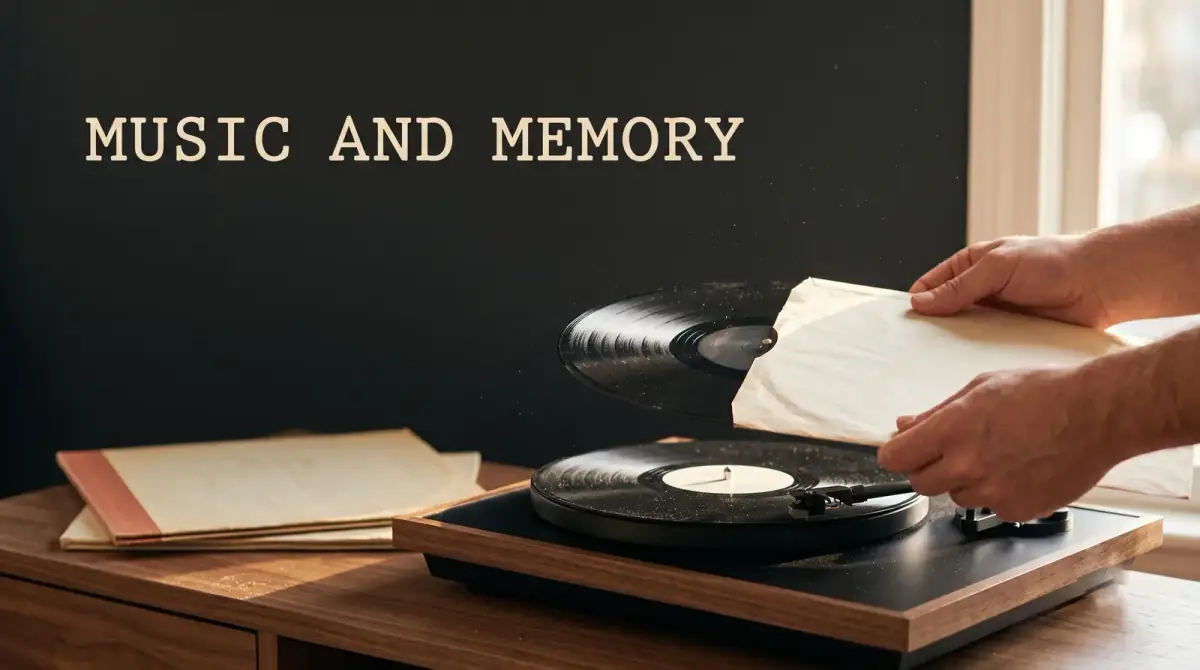
You are in a supermarket, mid-decision about pasta sauce, and four bars come through the ceiling speakers. Suddenly you are seventeen, in someone's back seat with the windows down, and you can almost smell the vinyl. The reason why music triggers memories this fast is that a song never gets filed away as sound alone. It gets filed with everything that was happening around it.
Your brain does not store a memory as one tidy object. It stores it as a scatter of details, sights, smells, feelings, muscle tension, that get bound together and then reactivated as a set. Music is unusually good at grabbing the whole set at once.
Which is why the supermarket ambush works when a photograph of the same summer often does nothing. The photo shows you the past. The song puts you back inside it.
Why music triggers memories better than a photograph
Memory runs on cues, and the richer the cue, the more of the original moment it drags back. A song is an absurdly rich one: tempo, key, a specific mix, a singer's rasp, plus whatever your nervous system was doing the first hundred times you heard it.
A photo is mostly one sense. Smell is famously powerful, but you cannot summon it on demand, and nobody has a playlist of smells. Music is the only strong cue you can carry around and press play on, and it unfolds over three minutes rather than arriving as a flash, so the details keep coming after the first bar.
Consider what a single song is quietly holding for you:
- Where you physically were, down to the light in the room and how the seat felt
- Who was there, and what you thought of them at the time rather than now
- What you were worried about that month, even if the worry was stupid
- The version of yourself you were performing back then, which is often the most uncomfortable part
Why do music memories feel so emotional?
Because most of them are autobiographical memories with the original emotion still bolted on. You are not retrieving a fact about your life. You are re-running a feeling, and the feeling gets there before the explanation does.
Music engages emotional and reward circuitry directly, which is why a chord change can raise the hair on your arms with no story attached at all. Layer a personal memory on top of that and you get an unusually loud signal.
This is the breakup track problem. For two years you skip it in three seconds flat, then one afternoon you let it play and it is merely a song again. Nothing about the recording changed.
The song keeps the feeling, not the facts
You may not remember what the argument was about, or which month it was, or what you said. The dread still arrives on cue at the second chorus. Emotional memory and factual memory are not the same system, and music talks mainly to the first one.
The reminiscence bump: why your teenage songs win forever
Ask almost anyone what the best era of music was and they will describe, with total confidence, whatever was playing when they were roughly fifteen to twenty-five. This tendency is commonly called the reminiscence bump: memories from adolescence and early adulthood are recalled more often and more vividly than memories from other stretches of life.
It is not that the music was objectively better. Sorry. Several things stack up:
- Everything is a first. First love, first job, first time out past midnight. Novel experiences get encoded more deeply than the four hundredth Tuesday of your thirties.
- You are building an identity, and music is the raw material. The bands you chose were an argument about who you were.
- You listened socially. Songs came attached to specific people, cars, bedrooms, and terrible parties, so they picked up cues by the dozen.
- The emotional volume was turned up. Everything mattered more, which meant everything got recorded louder.
Music you discover at forty rarely gets that treatment. It arrives into a life already furnished, so it has fewer places to attach.
Which is why a wedding first dance is such efficient engineering. One song, chosen deliberately, dropped into a night of high emotion, and it still works forty years later.
Why music can reach people whose other memories have faded
Carers and clinicians working with dementia commonly report the same striking thing: someone who cannot reliably name their own children will sing a whole verse from their youth, in time, with the right words. Face blank. Voice certain.
The likely reason is that music from early life is massively overlearned and held across many systems at once rather than in one fragile place. Melody, rhythm, emotion, and motor habit each carry part of the load, so damage in one area does not wipe the whole thing out.
There is a practical consequence here worth taking seriously. If you have older parents or grandparents, find out what they listened to at eighteen while they can still tell you. That playlist may end up being the last door left open.
Why do you remember lyrics you never tried to learn?
You cannot recall your own bank card PIN under pressure, but you have three verses of a song from 2004 that you actively disliked and only ever heard on the car radio during the school run. That is not a bug.
Melody and rhythm act as scaffolding. The tune tells you how many syllables come next, rhyme narrows the options, and repetition does the rest without your consent. Sung words are far easier to hold than spoken ones, which is why children learn the alphabet as a song and nobody has improved on it since.
Is this just nostalgia?
No, and the difference matters. Nostalgia is the warm ache you get afterwards. The trigger itself is a plain memory mechanism, and it is entirely neutral about what it hands you.
Plenty of song ambushes are not sweet at all. Embarrassment, grief, the hot feeling of a job you were bad at. The mechanism is indifferent; the mood is your business.
How to use music deliberately
For studying and focus
Lyrics compete with language, so instrumental music is the safer default for anything wordy. The better trick is to pair one album with one project and play nothing else while you work on it. You are building a retrieval cue on purpose, so do not waste it by putting that album on while cooking.
For mood
Do not lurch straight to relentlessly cheerful music when you feel low. It tends to bounce off. Start roughly where you actually are, give it two songs, then move the tempo up gradually: match, then move.
For reconnecting with someone
- Build a playlist from the years you overlapped with them, not the years you liked best
- For a parent or grandparent, aim at their teens and early twenties, which will not be your era at all
- Play it out loud in the room rather than through headphones, so it becomes a shared cue and not a private one
- Then say nothing. The stories arrive on their own if you leave the gap open
For the songs that hurt
You do not have to delete them. Play the difficult track on purpose, at a moment of your choosing, somewhere unrelated to the memory. Repetition in a new context slowly gives the song new company.
What your playlist is actually storing
Most people think of their music library as a record of taste. It is closer to a filing system for a life, indexed by feeling, built by accident and never labelled.
A song is not a recording of a moment. It is a key cut to fit one.
So the next time a track ambushes you between the pasta and the tinned tomatoes, do not rush past it. Something in you kept that room, that car, that person, filed under three minutes of sound, for years, without ever being asked to. Worth thirty seconds of standing still.


Comments
0 total