
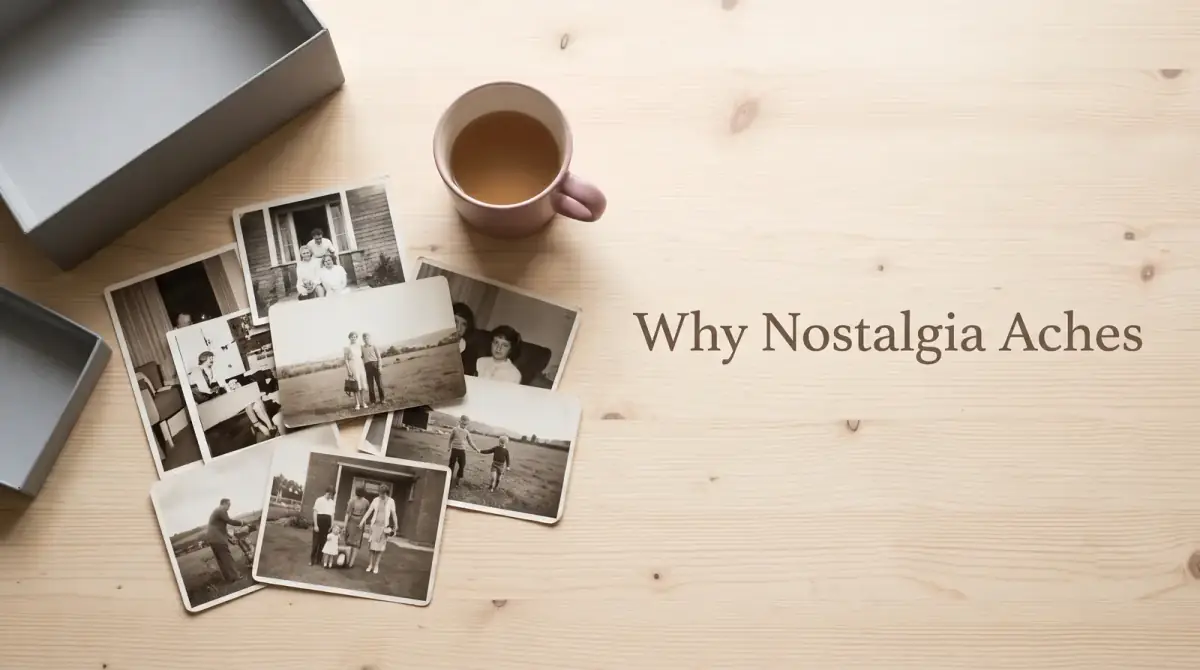
The short answer
Nostalgia was once treated as a disease. It turns out to be one of the more useful emotions you have, as long as you visit the past instead of moving in.
- You reach for it to avoid the present rather than steady yourself in it.
- Every memory ends with some version of the phrase "and now look at things".
- The past you miss is one you have quietly rewritten, edited down to the good bits.
- You come out flatter than you went in, rather than warmer.
There is a particular smell in old-fashioned sweet shops. Sugar, paper bags, something faintly dusty. If you grew up near one, it can take the wind out of you at forty in a shopping centre you did not want to be in. You are not thinking about being eight; for a second and a half you simply are, and that second and a half is why nostalgia feels good.
Then it passes and leaves you oddly tender. The warmth arrives with a small ache attached, which is why it never feels purely good. It is a pleasant emotion assembled out of a loss.
Nostalgia used to be treated as an illness
The word was coined by a physician describing soldiers far from home: a wasting homesickness serious enough to count as a medical condition. For centuries it kept that clinical reputation, drifting from a disease of the body to a symptom of a weak mind.
That framing has collapsed. Research points the other way. Nostalgia shows up across cultures and ages, and people prompted to dwell on a nostalgic memory tend to report feeling more connected, more optimistic, and more like their life has a point.
Nostalgia is not a malfunction. It is closer to a repair mechanism.
Why nostalgia feels good and hurts at the same time
The bittersweetness is not a flaw in the emotion. It is the entire design. Nostalgia only fires on things that were good enough to want back, and it only fires because you cannot have them back.
So the pleasure and the ache arrive from the same fact. The family kitchen you are picturing was warm and loud and smelled of something frying: that is the sweet half. It is also a kitchen that no longer exists, with people who have moved or changed or died. That is the bitter half.
Most emotions push you one way. Nostalgia holds you in two places at once, which is why it lingers and why people describe it as their favourite bad feeling.
What is nostalgia actually doing for you?
It keeps you the same person over time
You have almost nothing physically in common with yourself at nine. Memory is the thread. Nostalgia is how your brain keeps insisting that the kid with grazed knees and the adult answering a work email at 4pm are the same ongoing project. That continuity of identity is load-bearing.
It is almost always about people
Ask someone for a nostalgic memory and you will rarely get an object. You will get a person, or a crowd. A grandmother at a stove. A school corridor at home time. Nostalgia is a social emotion wearing a costume of places and things. Its real subject is belonging.
It puts meaning back into a flat week
When the present has thinned out into admin and commuting, nostalgia offers evidence that your life has had texture. The message is not that things were better. It is that things have mattered, which is a far more useful claim.
Why does nostalgia spike when you are lonely or in transition?
Notice when it turns up. Sunday evening. Your first month in a new city. Hour four of a boring task. It is not background noise. It arrives when something is missing.
Loneliness is the clearest trigger, and the pattern commonly described is a loop: feeling disconnected makes people more nostalgic, and nostalgia makes them feel more socially supported. You are using a memory of closeness as a stand-in for closeness now.
Boredom does the same job for meaning. Transitions do it for identity. A breakup, a redundancy, a child starting school, and suddenly the question of who you are wobbles. Nostalgia hands you back a stable draft.
Why the past looks better than it actually was
Because your memory is not a neutral archive. One well-established pattern is fading affective bias: the emotional sting of unpleasant memories tends to fade faster than the glow of pleasant ones. The bad material is still on file. It just stops hurting first.
Then add ordinary editing: you remember the summer, not the six weeks of drizzle around it. Add the reminiscence bump, the tendency to recall a disproportionate number of vivid memories from your teens and twenties, and you get a past weighted towards firsts, intensity and sunshine.
Which is why every generation thinks its era was the best
Everybody's adolescence happened to coincide with the best television, the best clothes, and the last time society made any sense. Statistically, this is improbable.
The honest version: you are not comparing eras. You are comparing a rose-tinted highlight reel of your own youth against an unedited live feed of the present, complete with your mortgage, your knees, and this morning's news. The present never gets the same edit.
Why smell and food are the strongest triggers
Smell has an unusually direct route into the brain regions handling emotion and memory, skipping much of the processing other senses go through. That is the standard explanation for why a lungful of a certain suncream, or wet playground tarmac, arrives fully formed before you can name it.
There is a second reason, and it might matter more. Nobody rehearses smells. You have retold your holiday story a hundred times and worn it smooth. You have not thought about your primary school cloakroom since you left, so it comes back unworn.
Food works the same way with added body: a specific biscuit, tea made too strong, a birthday cake with the wrong icing. Sound does its own version, which is why a Nokia ringtone in a quiet train carriage still turns heads of a certain age.
When nostalgia stops being useful
There is a real difference between visiting the past and moving into it.
Healthy nostalgia is a resource you bring back with you. You remember your grandfather's shed, you feel steadier for an hour, you text your brother about it. Stuck nostalgia is a comparison you lose every time. Some signs you have crossed over:
- You reach for it to avoid the present rather than steady yourself in it.
- Every memory ends with some version of the phrase "and now look at things".
- The past you miss is one you have quietly rewritten, edited down to the good bits.
- You come out flatter than you went in, rather than warmer.
The rule of thumb is simple. Does it send you towards people, or away from them?
How to use nostalgia on purpose
It responds remarkably well to being triggered deliberately.
- Build a trigger kit for bad weeks: photographs from one year, a film you loved at fifteen, a smell you can still buy.
- Do it socially. Reminiscing with a sibling or an old friend beats doing it alone: you get their footage as well as yours.
- Rewatch a childhood show as an adult, knowing every plot beat. Half of what you are watching is yourself watching it.
- Cook one dish from your family kitchen badly, from memory, and phone whoever taught it to you.
- Give the present a chance to become nostalgic later. Take the badly lit photo. Keep the ticket.
And when it arrives uninvited, in a supermarket aisle or at a funeral, resist the urge to cheer yourself up. Let it run for two minutes. It is doing something.
The past is a good place to visit
Nostalgia earns its keep when it reminds you what a good day looked like, then sends you off to build a rough version of one. It stops earning it the moment it becomes an argument that the good days are finished.
Nostalgia is not the past calling you back. It is the present telling you what it is short of.
So take the hint. If the memory is full of people, that is usually the instruction: ring one of them. The sweet shop is gone and the kitchen has different cupboards now, but the thing you actually miss was never the building.

Comments
0 total