

The short answer
Time management is not about cramming more into your day. See why it matters for students and professionals: less stress, sharper focus, and more genuinely free time.
- Good time management lowers stress by replacing vague worry with a clear plan.
- It protects your focus, so deep work stops getting eaten by small tasks.
- It buys back free time instead of filling every hour.
- For students, it turns panic-cramming into steady, calmer progress.
- The goal is a life that fits, not a schedule that is full.
Time management is important because it lowers your stress, protects your attention, and frees up time for the things you actually care about. That, in one line, is why time management is important, and it has little to do with cramming more tasks into a day. Done well, it helps you do less, but the right less, and feel calmer while you do it.
That is the case this article makes. Not be busier, but be freer. What follows are the real reasons it matters, in ways that go well beyond a tidy to-do list.
Key takeaways
- Good time management lowers stress by replacing vague worry with a clear plan.
- It protects your focus, so deep work stops getting eaten by small tasks.
- It buys back free time instead of filling every hour.
- For students, it turns panic-cramming into steady, calmer progress.
- The goal is a life that fits, not a schedule that is full.
It replaces stress with a plan
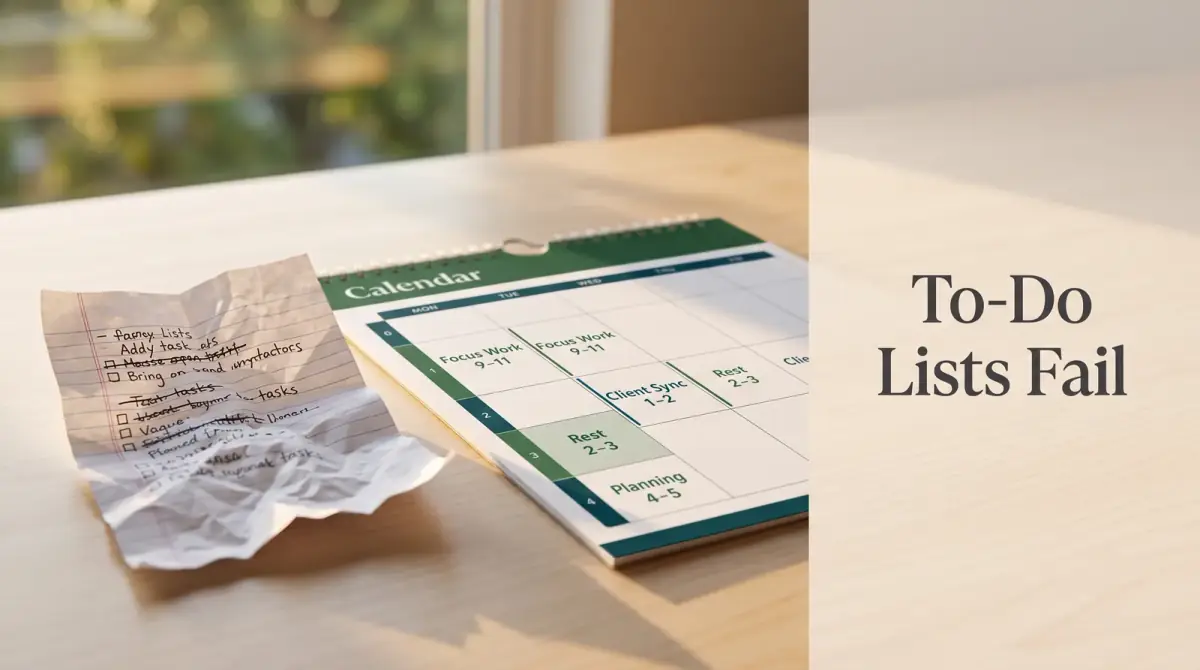
A lot of stress is not caused by having too much to do. It is caused by carrying it all in your head. When every task, deadline, and half-promise floats around loose in your mind, your brain treats them all as urgent at once.
Writing things down and giving them a time is what breaks that loop. The task is still there, but it now has a home. You are no longer trying to remember it and do it at the same moment, and that quiet relief is one of the clearest reasons time management matters.
You know the feeling of Sunday-night dread about the week ahead. A ten-minute plan often dissolves most of it, because vague worry becomes a short list of concrete steps.
It protects your focus
Attention is the real currency of good work, and it is easy to spend it badly. Without a plan, you drift toward whatever is loudest: the email, the notification, the small easy task. The important work keeps getting pushed to later.
Managing your time is really about managing your attention. When you decide in advance that the morning is for your hardest task, you give that task the sharpest part of your day. You stop letting other people's small requests set your priorities.
This is how time management is important in a way people underrate. It is not about the clock. It is about defending the hours when your mind works best.
It buys back free time
Here is the part that gets missed. The point of managing your time is not to fill every slot. It is to finish what matters and then stop, guilt-free.
When work is scattered and unplanned, it leaks into everything. You answer messages at dinner, think about the deadline during a movie, and never fully switch off. When work has a clear time and place, it can also have a clear end.
Good planning protects your evenings, your weekends, and your rest. That is not a bonus on top of productivity. For most people, it is the whole reason to bother.
Why time management is important for students
Students feel this sharply because the structure is loose. Nobody tells you when to study. Deadlines sit weeks away, then arrive all at once, and the gap in between is where good or bad habits form.
The reason why time management is important for students is that it turns a term from a series of panics into a steady rhythm. A little work spread across many days beats a giant push the night before, both for grades and for sleep.
It also protects the rest of student life. When study has a plan, you can enjoy the social side without a background hum of guilt, because you know the work is handled.
It improves your decisions and compounds over time
When you are rushed, you make worse choices. You grab the fast option, skip the review, send the sloppy version. Managing your time builds in a little slack, and slack is where good decisions live. You have room to check your work, to think twice, to notice a better approach. Results vary from person to person, but across a week the person with a plan usually makes calmer, clearer calls than the one always reacting.
That quality then stacks up. A single well-run day is nice, but the real value shows up over months, as small, consistent progress on something that matters adds up in a way that bursts of frantic effort never do.
Think of the essay written a few paragraphs at a time, the skill practiced for twenty minutes a day, the savings set aside each month. None of these feel dramatic on any given day. Over a year, they change things. Good time management is what makes that consistency possible, keeping the important-but-not-urgent work moving instead of forever losing to whatever is on fire today.
What good time management is not
It is worth clearing up a myth. Time management is not about scheduling every minute or turning yourself into a machine.
- It is not doing more things. It is doing the right things.
- It is not being busy. Busy and productive are not the same.
- It is not rigid. A good plan bends when life happens.
- It is not about guilt. A missed day is data, not a failure.
If your system leaves you more anxious, not less, it is too tight. Loosen it. The goal is a life that fits you, not a calendar you serve.
Where to start
You do not need an app or a whole new system to feel the benefit. Try one small thing this week.
- Each evening, write the two or three things that matter tomorrow.
- Give your hardest task the first, freshest block of your day.
- Protect one evening or afternoon as genuinely off.
Do that for two weeks and notice how you feel, not just what you finish. The stress you drop is often the clearest sign of why time management is important in the first place.


Comments
0 total