
The short answer
Wondering why to do lists don't work? See where the classic list breaks down, from missing priorities to no time estimates, and the simple tweaks that make it stick.
- A plain to-do list has no priorities, so everything feels equally urgent.
- Without time estimates, you plan far more than any day can hold.
- Lists never end, which breeds guilt and decision fatigue.
- The fix is to pick a few priorities, estimate time, and block them on a calendar.
- Some work belongs on a calendar or a project note, not a daily list at all.
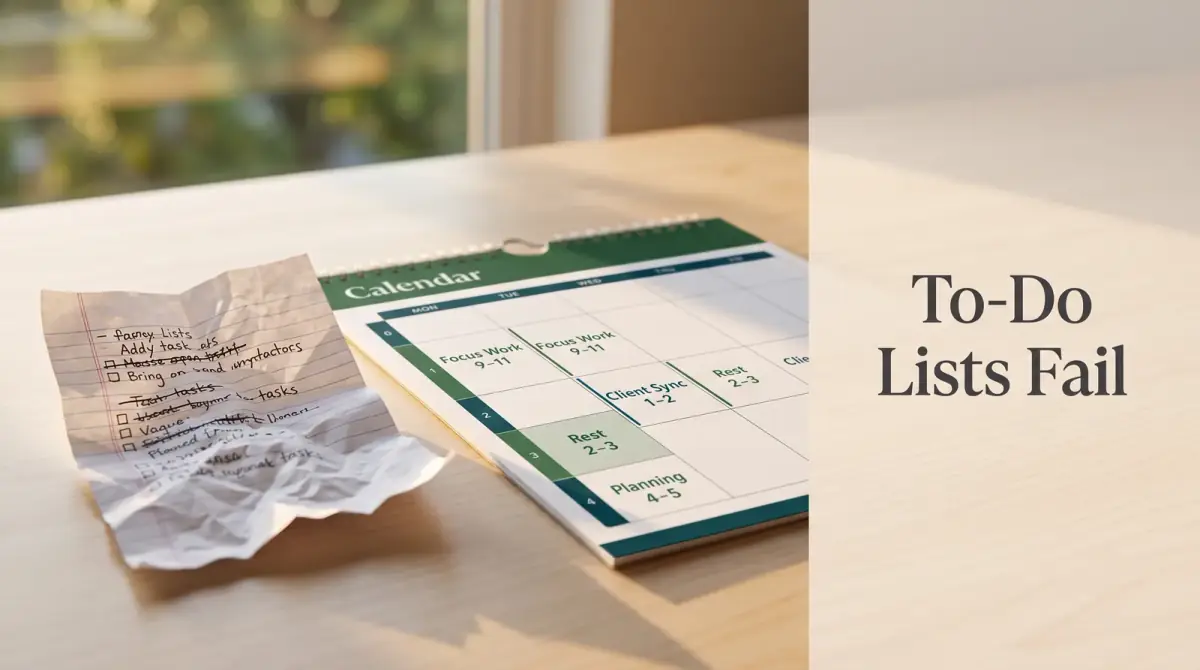
To-do lists often fail because they treat every task as equal, ignore how long each one takes, and never tell you what to do first. The list grows faster than you clear it, so it turns into a guilt pile instead of a plan. Understanding why to do lists don't work is the first step to building one that actually moves your day forward.
You are not lazy or disorganized. The tool itself has flaws. Below we break down where the classic list falls apart, then cover simple tweaks that make it stick.
Key takeaways
- A plain to-do list has no priorities, so everything feels equally urgent.
- Without time estimates, you plan far more than any day can hold.
- Lists never end, which breeds guilt and decision fatigue.
- The fix is to pick a few priorities, estimate time, and block them on a calendar.
- Some work belongs on a calendar or a project note, not a daily list at all.
Why to do lists don't work in the first place
The core problem is that a list is just a dump of tasks. It captures everything in one place, which feels good, but it does none of the thinking for you. It does not sort, schedule, or decide.
All of that still lands on you, usually at the worst moment, when you are tired and staring at twenty items. A capture tool and a real plan are two different things. Most people use their list as both, and that is exactly where it breaks.
Problem 1: Every task looks equal
On a plain list, "reply to one email" sits right next to "launch the new website." They look the same size. Your brain grabs the easy one for a quick win, while the task that actually matters slides to tomorrow, then the day after.
Without priorities, you stay busy but not effective. You clear small items and feel productive, yet the needle never moves on the work that counts. A good day should be measured by what mattered, not by how many boxes you ticked.
Problem 2: No sense of time
A list of ten items hides a trap. Some take two minutes. Some take three hours. Written down, they all look equally small, so you happily plan a day that would need twenty hours to finish.
When the clock runs out, the leftovers roll onto tomorrow's list, which was already full. The pile grows, and every unfinished item quietly chips away at your motivation. That slow buildup is a big part of why to do lists don't work for most people.
Problem 3: The list never ends
A to-do list has no bottom. Finish three things, and you add five more. It is designed to grow. That means you never reach done, and the feeling of always being behind becomes your normal state.
Over time, a bloated list stops feeling useful and starts feeling like a scolding. Many people cope by ignoring it, which defeats the whole point of writing things down.
What to do instead
You do not need to abandon lists. You need to give them the structure they are missing. Three small habits do most of the work.
Pick your top three
Each morning, choose the three tasks that would make the day a win. Not ten. Three. These are your priorities, and they get done before anything else. Everything else that day is a bonus, not a requirement.
Estimate how long each takes
Next to each task, jot a rough time: fifteen minutes, one hour, half a day. This single habit exposes fantasy days before they start. If your top three already need six hours, you know not to promise yourself much more.
Give tasks a home on your calendar
This is the big shift. A task with no time attached is really just a wish. Move your top items onto your calendar as real blocks, like "write report, 9:00 to 10:30." Now it is a commitment with a start time, not a floating hope. This method is often called time blocking, and it turns a list into a plan.
How to build a to do list that actually works
The trick is to split the list's two jobs. Keep one messy capture list where every idea and task lands, so nothing gets lost. That is your master what to do list, a safe dump for your brain that can be as long as it likes.
Then, each day, pull only a few items from that master list into today's plan. The master list can be endless. Today's plan cannot. That boundary is what keeps you sane and moving.
Keep a "done" list too
At the end of the day, write down what you actually finished. It sounds small, but seeing real progress counters the endless-list guilt. It also shows you how long tasks truly take, which sharpens your future estimates.
A simple daily routine you can copy
Here is a routine that ties it all together. It takes about five minutes.
- Brain-dump everything into one master list so it is out of your head.
- Circle the three tasks that matter most today.
- Add a rough time estimate to each one.
- Block those three on your calendar around your real commitments.
- Work the blocks, and treat any extra tasks as a bonus, not a debt.
- At night, note what you finished and carry over only what still matters.
That short setup replaces a vague, guilt-inducing list with a plan you can actually follow through the day.
When a list is the wrong tool
Sometimes the honest answer to why to do lists don't work is that the job was never a list job in the first place. A big goal like "get fit" or "launch a side business" is a project, not a task. It belongs in a project note, broken into small next steps, with only the very next step on today's list.
Recurring habits also belong on a calendar or a habit tracker, not a daily to-do. Writing "exercise" every single day just adds noise and makes the list feel heavier than it is.
Common mistakes that keep your list broken
Even with a good system, a few habits quietly drag people back to a list that does not work. Watch for these.
- Writing vague tasks. "Sort out finances" is a project, not an action. Rewrite it as a clear next step, like "list this month's subscriptions."
- Mixing urgent and someday items. When a wish for next year sits beside today's deadline, both lose meaning. Keep future ideas on a separate list.
- Never reviewing the list. A list you never revisit becomes a graveyard. Spend two minutes each week clearing dead items.
- Adding tasks you will not really do. If something has sat untouched for a month, either schedule it honestly or delete it.
Fixing these small habits protects the routine above. The goal is a short, honest plan you trust, not a long list you dread opening.
The bottom line
A plain to-do list fails because it captures tasks without helping you choose, schedule, or finish them. Add priorities, time estimates, and calendar blocks, and the same list quietly becomes a plan you trust.
Try it for one week. Keep your endless capture list, but each morning pick three, time them, and block them. You will likely put less on paper and get more done in real life. Results vary from person to person, so adjust the routine until it fits the way you naturally work.



Comments
0 total