
The short answer
Cups are not the same size in every country, and kg to lbs trips up almost everyone. Here are the conversions worth memorising, plus a free Android converter for the rest.
- A US customary cup is about 237 ml. US nutrition labelling rounds it to 240 ml.
- A metric cup, used in the UK, Australia and New Zealand, is 250 ml.
- The old imperial cup that turns up in vintage British cookbooks is about 284 ml.
Most unit mistakes trace back to a small handful of pairs: cups that are not the same size in every country, kilograms to pounds, and Celsius to Fahrenheit. Get those three straight and you have covered most of what goes wrong in a kitchen, a gym, or a hardware shop. For everything else, a converter sitting on your phone is quicker and safer than typing a fresh search every single time.
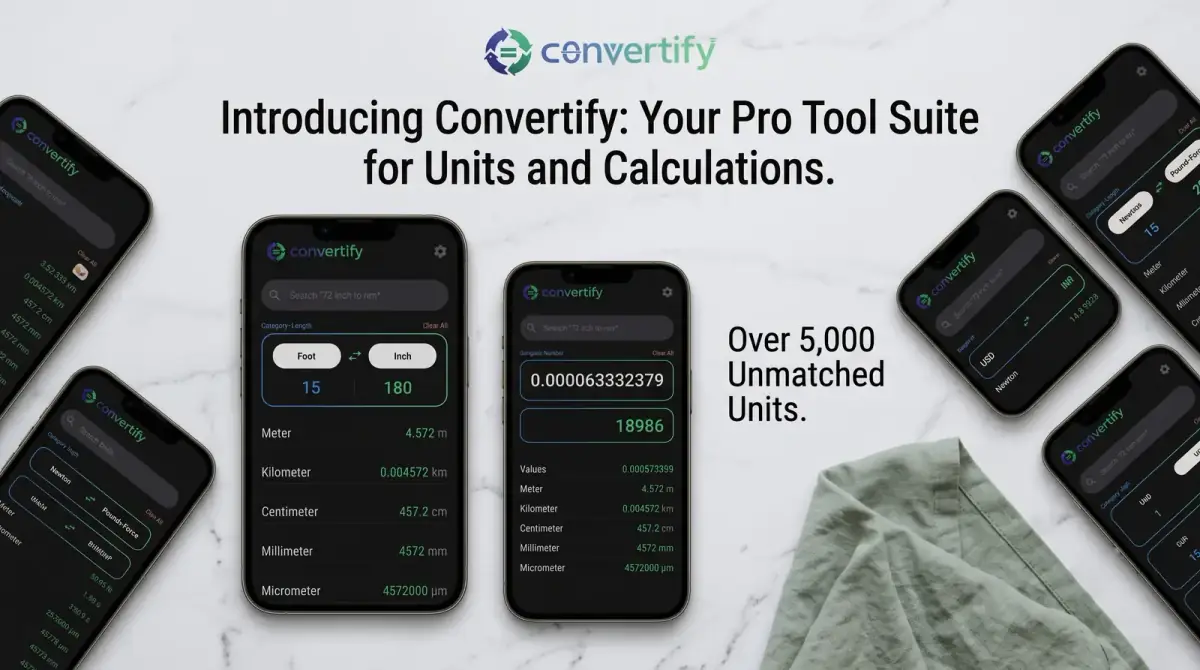
Before anything else, a disclosure: the app referenced throughout this article, convertify: Unit Converter Pro on Google Play, is one I built myself, so read the recommendation with that in mind. It is Android only, it is on Google Play, and it is free. The conversion facts below stand on their own whether you install anything or not.
The cup is not a universal measure
This is the single biggest source of ruined recipes. “One cup” means different volumes depending on who wrote the recipe:
- A US customary cup is about 237 ml. US nutrition labelling rounds it to 240 ml.
- A metric cup, used in the UK, Australia and New Zealand, is 250 ml.
- The old imperial cup that turns up in vintage British cookbooks is about 284 ml.
So a recipe calling for four cups of stock can mean roughly 950 ml or a full litre depending on where it came from. Soup survives that. Cake batter often does not.
Tablespoons have the same problem. A US or UK tablespoon is 15 ml, but an Australian tablespoon is 20 ml. Three teaspoons make a US tablespoon; four make an Australian one. Follow an Australian baking blog with American spoons and every raising agent measurement is quietly a quarter short.
Larger volumes diverge too. A US pint is 473 ml against 568 ml in the UK, and a US gallon is roughly 3.785 litres against 4.546. When someone quotes miles per gallon, the gallon matters as much as the miles.
Weight beats volume, and here are the numbers
If you can weigh an ingredient, weigh it. A cup of flour varies depending on whether you scooped it or spooned it in, because you are really measuring how tightly packed it is. Weight has no such ambiguity. The conversions worth knowing:
- 1 kilogram = 2.2046 pounds
- 1 pound = 453.59 grams
- 1 ounce = 28.35 grams
- 1 stone = 14 pounds, or about 6.35 kilograms
The mental shortcut for kilograms to pounds is genuinely good: double the figure, then add ten percent of that doubled figure. For 70 kg, double to 140, add 14, and you get 154. The exact answer is 154.3, so you are within half a pound.
This is the conversion people look up most, and it is the one where having a convert kg to lbs app on the home screen pays off immediately — because you rarely need it once. You need it for a whole shopping list, a whole recipe, or a whole training log.
Celsius and Fahrenheit, and the shortcut that mostly works
The exact formula is F = C × 9/5 + 32, and in reverse, C = (F − 32) × 5/9. Four anchor points are worth committing to memory:
- 0°C = 32°F, where water freezes
- 37°C = 98.6°F, normal body temperature
- 100°C = 212°F, where water boils at sea level
- −40°C = −40°F, the single point where the two scales agree
For weather, the rough trick is to double the Celsius figure and add 30. That gives 70 for 20°C when the true answer is 68, and lands exactly right at 10°C, which is 50°F. Close enough to decide on a jacket — nowhere near close enough for an oven. A recipe calling for 350°F wants about 177°C, and 180°C works out to 356°F. The doubling trick would have told you 390, and that is how biscuits burn.
Length: the two numbers that unlock the rest
1 inch = 2.54 centimetres, exactly. That is not a rounding, it is the definition, and everything else follows from it: a foot is 30.48 cm, a yard is 91.44 cm, and a mile is about 1.609 kilometres.
Height is where this gets fiddly, because it is a mixed-unit conversion. Someone who is 5 feet 9 inches is 69 inches, which is 175.26 cm. Two steps, with an easy place to slip — exactly the kind of job you want a metric to imperial converter app to absorb.
Why a wrong unit costs more than a wrong number
A number that is slightly off usually gets absorbed somewhere. A unit that is wrong multiplies everything by a fixed factor, and rides along undetected to the end.
The famous cases come from aviation and spaceflight. In 1983, an Air Canada Boeing 767 ran out of fuel in mid-flight after its fuel load was worked out in pounds when the aircraft ran on kilograms. In 1999, NASA lost the Mars Climate Orbiter because one team supplied thrust data in imperial units while the receiving software expected metric.
Nothing in your day is that dramatic, but the pattern repeats at small scale: timber cut too short, a parcel weight that pushes you into a higher postage band, curtains bought a third short. Conversions are cheap to do correctly and expensive to redo.
When a converter beats searching each time
Searching is fine for a one-off. It falls apart when you are converting in batches: standing over a mixing bowl with sticky hands, comparing product weights in a shop aisle, or working down a spec sheet. Every search is a page load, a cookie banner and a scroll.
A dedicated tool has structural advantages. It keeps your category selected between conversions, so you are not re-specifying “grams to ounces” on every line. It updates as you type rather than after a submit. And an app that works without a connection also works in a basement, on a plane and in the back corner of a supermarket, which is the real reason people go looking for an offline unit converter in the first place.
People also search for the best unit converter for Android as though there were one right answer. There is not. What actually decides it is whether the app opens fast, whether the categories you use are one tap away, and whether the keypad is usable one-handed. Those are things you judge in a minute of real use, not from a store listing.
Where convertify fits
convertify: Unit Converter Pro is a free unit converter app for Android that puts a converter and a calculator in the same place, across the everyday categories most people actually reach for. That pairing matters more than it sounds: recipes get halved, room dimensions get multiplied and parcel weights get added up, usually in the same breath as the conversion itself.
I have deliberately not published a feature checklist here, because I would rather you read the current Play Store listing than trust my summary of whatever build you would install today. The listing is the source of truth for the exact unit categories it covers, whether it doubles as a currency and unit calculator, and how it behaves without a connection. Take a look for yourself: convertify: Unit Converter Pro on Google Play.
Whatever you end up using, the advice does not change. Learn the handful of factors above. Weigh rather than scoop when you bake. Check which country a recipe came from before you trust its cups. And keep a cooking measurement converter within reach for the rest, because getting a unit wrong always costs more than the two seconds it takes to check.



Comments
0 total