
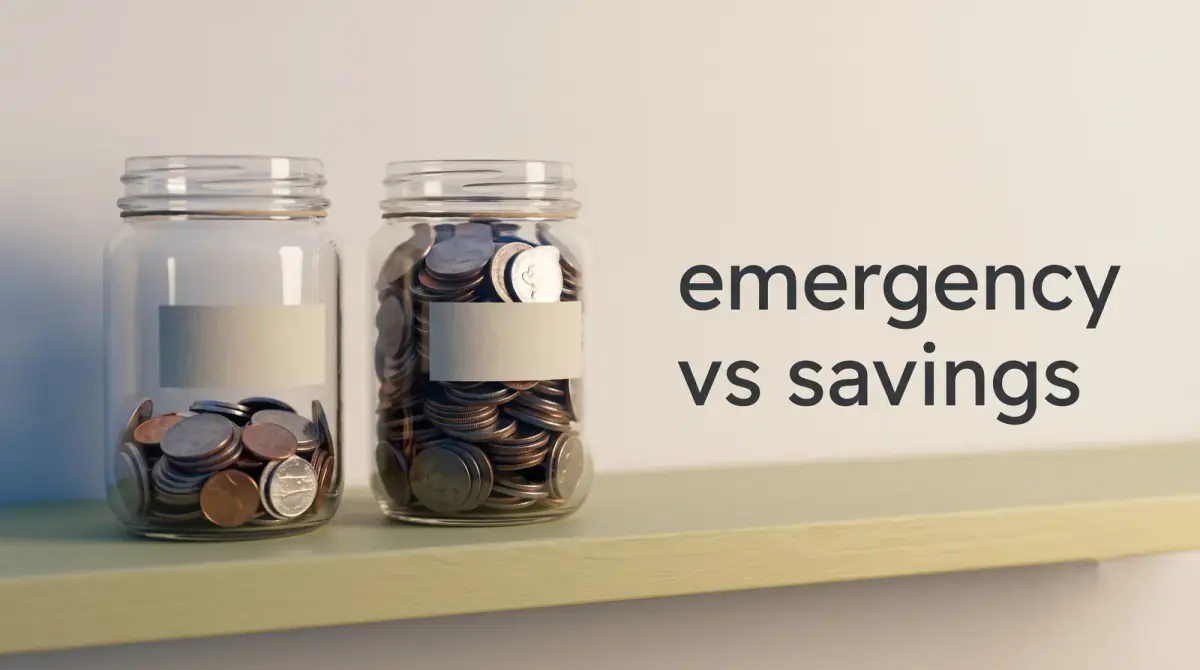
The short answer
An emergency fund and general savings sit in the same bank but do very different jobs. See how they differ, when to use each, and where to keep your money safe.
- An emergency fund covers surprise costs; savings is aimed at a planned goal.
- Mixing them makes it easy to spend money you meant to protect.
- Keep your emergency fund somewhere safe and easy to reach, not locked up.
- Use the emergency fund only for true, urgent, unexpected needs.
- You can build both at once, even with small amounts.
No, an emergency fund and general savings are not the same thing, even though both sit in a bank account. An emergency fund is money set aside only for real, unexpected costs. Savings is money you grow on purpose toward a goal you choose. So if you have ever wondered, is emergency fund and savings the same, the short answer is that they share a home but do very different jobs.
Keeping them separate is one of the simplest money habits you can build. Here is how the two differ, and why the line between them matters.
Key takeaways
- An emergency fund covers surprise costs; savings is aimed at a planned goal.
- Mixing them makes it easy to spend money you meant to protect.
- Keep your emergency fund somewhere safe and easy to reach, not locked up.
- Use the emergency fund only for true, urgent, unexpected needs.
- You can build both at once, even with small amounts.
Is emergency fund and savings the same thing?
They are not, and the difference is about purpose. Think of it as two buckets. One bucket is for 'just in case'. The other is for 'on purpose'.
Your emergency fund is the just-in-case bucket. It waits quietly until something goes wrong: a job loss, a medical bill, a broken car. General savings is the on-purpose bucket, filling up toward a holiday, a deposit, or a new laptop.
When people ask is emergency fund and savings the same, the confusion is fair. Both are money you are not spending today. But one protects you, and the other moves you forward.
A helpful way to picture it: your savings is money with a job title, while your emergency fund is money on standby. Savings has a plan and a date. The emergency fund has no plan at all, and that is exactly the point. It is there for the things you did not plan for.
Why an emergency fund is important
Life has a habit of sending bills at the worst moment. Without a cushion, a single surprise can push you toward credit cards or high-interest loans.
That is why an emergency fund is important. It stands between you and debt when something breaks. Instead of borrowing at a painful rate, you quietly pay from your own cushion and move on.
There is a calmer side too. Knowing you have a buffer lowers the background stress that money worries create. You tend to make steadier choices when you are not one flat tyre away from panic.
It also protects your longer-term savings. Without a buffer, the first surprise bill often gets paid by raiding money you set aside for a goal. Your holiday fund or house deposit takes the hit, and months of progress slip backward. A separate emergency fund keeps those goals intact.
When to use an emergency fund
Knowing when to use emergency fund money is what keeps it working. A simple test asks three questions. Is it unexpected? Is it necessary? Is it urgent?
If the answer to all three is yes, that is what the fund is for. If not, it probably belongs in your regular budget or your savings goal.
- Real emergency: an urgent car repair you need in order to get to work.
- Not an emergency: a sale on a gadget you have been wanting.
- Real emergency: a sudden medical cost or a gap after losing income.
- Not an emergency: a holiday you have known about for months.
The holiday is a savings goal. Plan for it. The blown transmission is what the fund is there to absorb.
How much to keep in each
A common guideline is to build an emergency fund worth a few months of essential expenses. Starting smaller is completely fine. Even one month of rent and food set aside changes how a bad week feels.
Your savings target is different, because it depends on the goal. A trip might need a set amount by a set date. A home deposit is a longer climb. Give each goal its own number and a rough deadline.
Results vary with income and life stage, so treat any figure as a starting point, not a rule you must hit.
One practical tip: aim for a small, reachable first milestone before worrying about the full target. Hitting an early goal builds momentum, and a partly filled fund still beats an empty one when trouble arrives.
Where to keep each one
This is where the two really split apart. Your emergency fund needs to be safe and quick to reach. You do not want it tied up when the boiler dies on a Sunday.
A separate, easy-access savings account usually fits well. It keeps the money out of your everyday spending but still lets you get it within a day or two.
People often ask about the best emergency fund investment, hoping to grow the money. Be careful here. The main job of this cash is safety, not returns. Anything that can drop in value, or lock your money away, works against the whole point of the fund. For an emergency fund, 'boring and reachable' beats 'clever and stuck'.
Longer-term savings can sit somewhere with a bit more growth, since you do not need it at a moment's notice. Just match the risk to the timeline.
How to build both at the same time
You do not have to finish one before starting the other. A simple split works for many people.
- Set a small starter emergency fund first, so you are not fully exposed.
- Then divide new savings between the fund and your chosen goal.
- Automate a transfer on payday so it happens without a decision.
Small and steady wins here. A modest amount each week quietly becomes a real cushion over a year.
If your income is irregular, base the split on a percentage rather than a fixed amount. That way a lean month still adds something, and a strong month gives your cushion a welcome boost.
Common mistakes to avoid
A few slip-ups blur the line between the two buckets and undo your progress.
- Keeping both in one account, so the emergency money gets spent by accident.
- Dipping into the fund for wants, then telling yourself it was a need.
- Chasing returns with money you might need next week.
- Waiting for a 'perfect' amount before you start at all.
If money feels tight or a decision carries real risk, it is worth speaking to a qualified financial professional about your own situation. This is general information, not personal advice.
Come back to the core idea whenever the buckets blur. An emergency fund protects you from surprises. Savings carries you toward plans. Both matter, they work best apart, and that difference is exactly why keeping them separate pays off.


Comments
0 total