
The short answer
Forget the vague three-to-six-months rule. Here is how to size an emergency fund for your actual life, and build it when money is tight.
- Rent or mortgage
- Utilities and essential bills
- Groceries, not restaurants
- Transport that gets you to work
- Insurance and any minimum debt payments
Your car makes a noise it has never made before. Not a rattle you can ignore with the radio turned up, but the kind of noise that means a mechanic is about to say a number out loud. That moment is when an emergency fund stops being a personal finance abstraction and becomes the difference between an irritating Tuesday and six months of paying off a credit card. Which raises the question almost nobody answers properly: how much should an emergency fund be for someone with your job, your bills and your life?
Almost everyone has heard the standard rule about saving three to six months of expenses. Almost nobody has heard the follow-up question, which is the one that actually matters: three to six months of whose expenses, for whose life? So let's answer the real question properly, because how much should an emergency fund be depends far more on your situation than on any rule of thumb.
So how much should an emergency fund be?
Here is the short version: your emergency fund should cover the gap between your money stopping and your money starting again. That is the whole idea. Everything else is detail.
If you lost your income tomorrow, how long would it realistically take to replace it? If you are a nurse in a city hiring constantly, that gap might be short. If you are a specialist in a small field where the right role opens up twice a year, that gap is long. Your fund should be sized to your gap, not to a number someone put in a listicle.
And if you are starting from zero, ignore the big number entirely for now. A first target of one month of bare-bones expenses will absorb the overwhelming majority of real-world emergencies without you ever touching a credit card. That single month is the highest-value savings you will ever do.
Start with your bare-bones number
Do not calculate your fund off your normal spending. Calculate it off your survival spending, which is a much smaller and much less intimidating figure. Add up only:
- Rent or mortgage
- Utilities and essential bills
- Groceries, not restaurants
- Transport that gets you to work
- Insurance and any minimum debt payments
- Childcare, medication, and anything else that genuinely cannot stop
Streaming, holidays, and the nice coffee do not belong in this number. In a genuine crisis those things pause, and pretending otherwise inflates your target so much that you give up before you start.
Why three to six months is a starting point, not an answer
The classic range exists because it is roughly right for a roughly average situation. The problem is that almost nobody is average. Two people with identical salaries can need wildly different cushions.
Things that push your number up
- Variable or commission-based income. Your fund is doing double duty: covering emergencies and smoothing out lean months.
- Being self-employed or on a short contract. No notice period, no severance, no cushion but your own.
- Being the only earner in a household, especially with dependants.
- A specialised job in a small market, where the search takes months rather than weeks.
- Owning your home. Nobody sends a landlord to fix your boiler.
- An older car, a chronic health condition, or ageing parents. These are not emergencies. They are near-certainties with unpredictable timing.
Things that let you hold less
- Two stable incomes in the same household, where one could carry the essentials alone
- In-demand skills and a job market that moves quickly
- Low fixed costs, which shrink both the monthly number and the number of months you need
- Genuine, reliable family support you would actually be willing to ask for
Be honest with that last one. Support you would be too proud to accept is not a safety net.
What kind of emergency are you actually funding?
Most people lump every unexpected cost into one pile, which is why the target feels so enormous. Split the job in two.
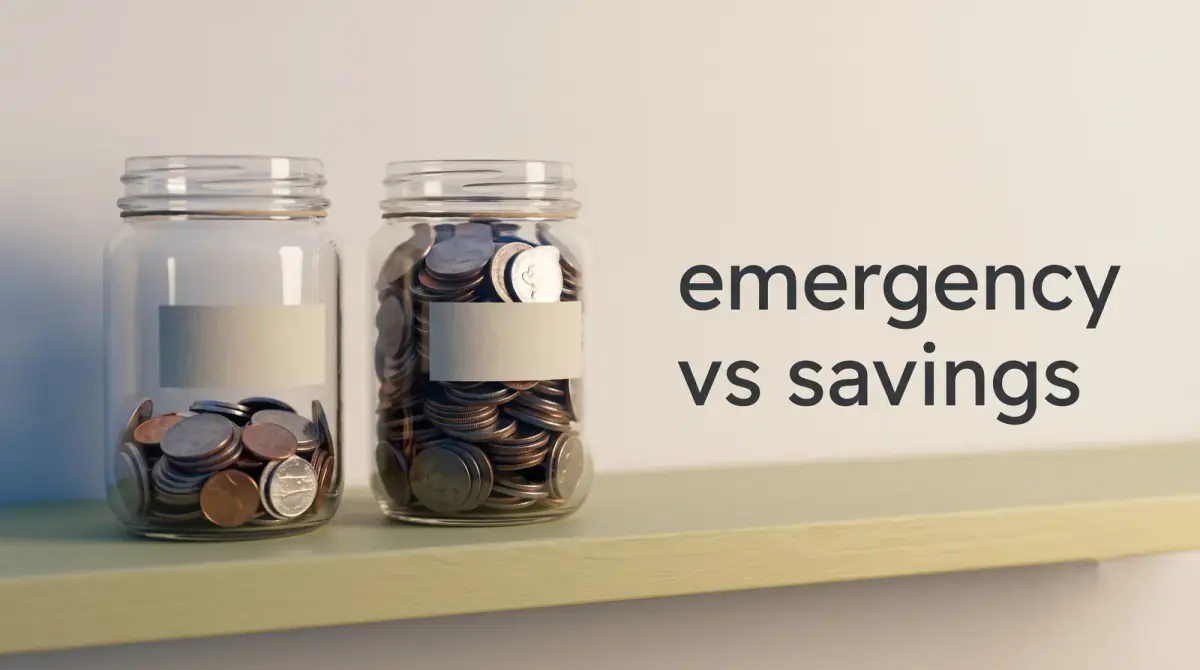
The small-shock cushion handles the boiler, the tyre, the emergency dental visit, the flight home when something goes wrong. These are frequent, survivable, and mostly in the hundreds. A modest amount sitting in cash handles nearly all of them.
The income-replacement fund is the big one. It exists for job loss, illness, or a business drying up. This is what the "months of expenses" conversation is really about, and it is the part you build slowly over years.
Build the first before you obsess over the second. A person with one month saved is in a dramatically better position than a person with nothing and a plan to eventually save six.
An emergency fund is not an investment. It is insurance you sell to yourself, and the payout is that a bad week never becomes a bad year.
Where should you keep it?
Your emergency fund has exactly two jobs: be there, and be reachable. Growth is not on the list. Judge any home for it against these:
- Separate from your everyday account. Money you can see while buying lunch is money you will spend.
- Accessible within a day or two. Fast enough for a real emergency, slow enough to break the impulse.
- No risk to the balance. Emergencies love arriving when markets are down. Investing this money defeats its purpose.
- Earning whatever interest you can get without giving up the first three points.
Account types, rates, and deposit protections vary a lot by country, so check what is available where you live. The principle holds everywhere: boring, separate, liquid.
How do you build it when money is tight?
If there were spare money lying around, you would have saved it already. So the answer is not "save more" but "make saving happen without a decision."
- Pick an embarrassingly small amount. Say twenty a week. The habit matters more than the sum right now.
- Automate it for payday, not the end of the month. Money left over at month-end is a myth.
- Give the account a name like "do not touch" or "the car fund." Sounds silly, works surprisingly well.
- Send windfalls straight in. Tax refunds, bonuses, gifts, the proceeds of selling things. This is where most of the early progress actually comes from.
- Raise the amount when your income rises. If you get a raise, move a slice of it before your spending finds it.
- Stop at your target, then send the money somewhere it can grow. An oversized cash pile is a slow leak.
One warning worth taking seriously: if you are carrying high-interest debt, do not try to build a full six-month fund first. Build the small cushion, then throw everything at the debt, then come back. Saving at low interest while paying much higher interest is a losing trade.
When should you actually spend it?
A fund you never use is not a success story. It is a fund that failed to do its job while you paid interest to a bank instead.
The test is simple. Is it unexpected, necessary, and urgent? A broken washing machine passes. A holiday you booked six months ago does not, because that was predictable and belongs in a separate savings pot.
If it passes the test, spend the money without guilt, then rebuild. Guilt about using an emergency fund correctly is the single most common way people end up in debt anyway.
The takeaway
Forget the generic rule and build your own number:
- Work out your bare-bones monthly costs, not your normal spending
- Estimate how long it would realistically take you to replace your income
- Multiply, then adjust up for instability and down for genuine backup
- Get one month saved first, and treat that as a serious win
- Keep it separate, safe, and reachable in a day or two
- Automate a small amount on payday and feed it every windfall
The goal was never to hit a number a stranger picked. It is to reach the point where a mechanic quoting you a bad figure is annoying rather than frightening. That shift happens far earlier than most people expect.

Comments
0 total