
The short answer
Most children who hate reading are not lazy. They find it hard, boring, or both. Here is how to work out which, and what actually changes a reluctant reader's mind.
- It is difficult. Decoding words takes so much effort that no attention is left for meaning. Watch for finger-tracking, losing the line, guessing from the first letter, sounding fluent but remembering nothing.
- It is boring. The words are fine, but nothing they have been given is remotely interesting to them.
- It has become loaded. Reading is tied up with school pressure, comparison to a sibling, or a nightly argument, so avoiding it protects their pride.
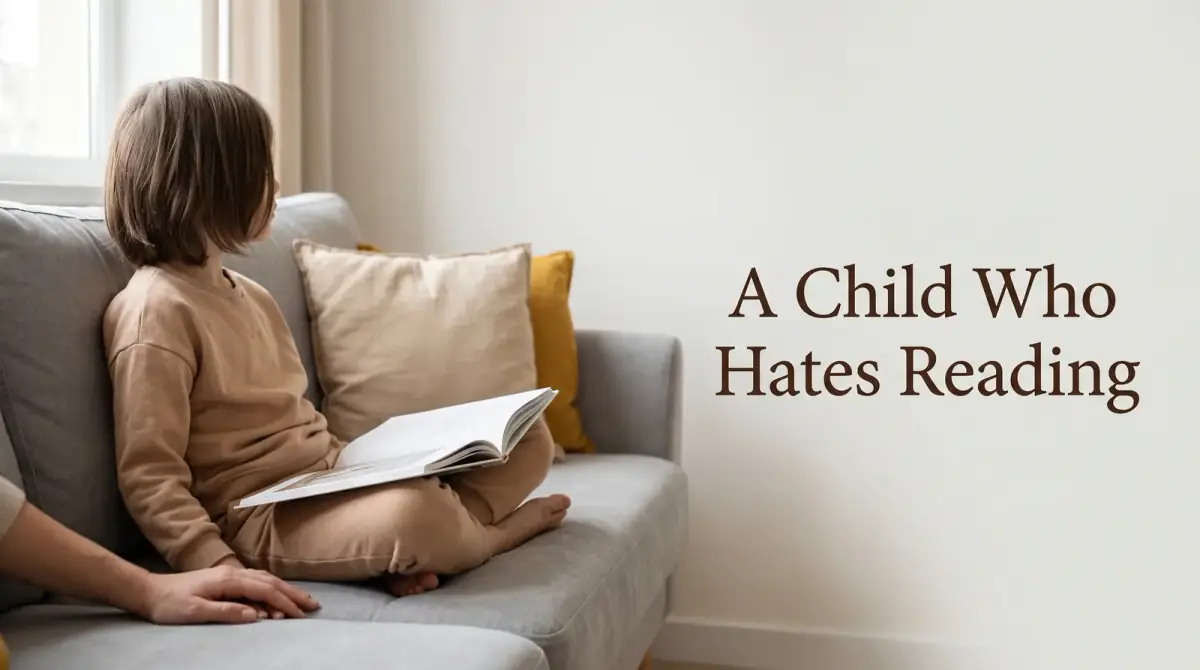
Most children who say they hate reading do not hate stories. They hate the experience of reading, usually because it is harder for them than it looks from the outside, or because every book they have been handed was chosen by an adult. Work out which of those you are dealing with, and the problem becomes much more solvable.
The instinct to push harder is understandable and usually backfires. Pressure turns a difficulty into a fight, and children who associate books with conflict read less, not more.
Start by working out which problem it is
Broadly there are three reasons a child avoids reading, and they need different responses.
- It is difficult. Decoding words takes so much effort that no attention is left for meaning. Watch for finger-tracking, losing the line, guessing from the first letter, sounding fluent but remembering nothing.
- It is boring. The words are fine, but nothing they have been given is remotely interesting to them.
- It has become loaded. Reading is tied up with school pressure, comparison to a sibling, or a nightly argument, so avoiding it protects their pride.
A quick check: ask them to read something aloud that is clearly easy for their age, then something at their expected level. If the easy text flows and the harder text stalls badly, difficulty is a big part of the picture.
If it is hard, take the pressure off the words
A child struggling to decode needs the load reduced before enthusiasm can come back. That means letting them read below their year group without comment. There is no prize for a hard book abandoned in chapter two.
Read to them, well past the age you think you should stop. Being read to builds vocabulary, comprehension, and the sense that stories are worth the effort, and it does all that without demanding the skill they find hard.
Try shared reading. You read a page, they read a page. Or you both read the same line aloud together, which lets them keep pace without stumbling in public.
Audiobooks are not cheating. A child who follows a complex story on audio is building the exact comprehension skills they will need when decoding catches up. Some children do well with the audiobook and the printed book together.
If it is boring, hand over the choice
Plenty of reluctant readers are simply being offered the wrong material. The fix is to stop curating and start following their interests, even if the result is not what you had in mind.
Comics and graphic novels count. Football annuals count. Joke books, game guides, magazines about horses, cookbooks, the fact-heavy books about sharks that have twelve words a page. All of it counts. The goal at this stage is volume and pleasure, not literary merit.
Take them to a library and let them leave with whatever they want, including things you consider too easy or too silly. A child who reads three books they chose is in a better position than a child who read none of the one you chose.
Series help enormously. Once a child likes one character, the second book requires no new decision and no new effort of imagination.
Change the conditions, not just the books
Small environmental changes often do more than persuasion.
- Have books in the room where they actually are, not only on a shelf upstairs.
- Make reading the last thing before lights out, with a slightly later bedtime as the trade. Most children will take that deal.
- Keep sessions short. Ten minutes that end while they are still interested beats thirty that end in tears.
- Let them be seen reading things you read too, including the sports pages or the back of a cereal box.
Your own reading matters more than any speech about the importance of books. Children copy what they see people do for pleasure.
Stop doing these things
Some common habits quietly make reluctance worse.
Do not correct every mistake. If the meaning survives, let it go. Constant correction turns a story into a test, and nobody relaxes into a test.
Do not quiz them at the end of every chapter. Comprehension questions have their place at school. At home they convert reading into homework.
Do not use reading as a punishment or a condition for screen time. It teaches exactly the association you are trying to break.
And avoid comparisons with siblings or classmates, even the encouraging kind. Children hear the ranking, not the encouragement.
Build a habit that survives busy weeks
Consistency beats intensity. A short daily read is more useful than an ambitious weekend session that happens twice a term.
Attach it to something that already happens: after teeth are brushed, in the car on the way to a club, at the table on Saturday morning. Habits stick to existing routines much better than to good intentions.
Track it lightly if your child likes that sort of thing. A simple chart of books finished works well for some children and feels like surveillance to others, so read the room.
When to look for a formal assessment
If a child is well behind their peers, if reading remains slow and effortful after a couple of years of instruction, if they mix up similar-looking words persistently, or if there is a family history of reading difficulty, it is worth raising with the school.
Ask to speak to the class teacher first, then the school's special educational needs coordinator. You are entitled to ask what support is in place and what they have observed. Early support makes a real difference, and waiting to see if it resolves on its own often costs years of confidence.
Also worth ruling out the simple things: eyesight and hearing. Both get missed surprisingly often, and both are quick to check.
Keep the long view
Children arrive at reading at very different points, and a child who resists at seven can become a heavy reader at twelve. It happens constantly, usually because something finally caught their interest.
Your realistic job is not to make them love books this month. It is to keep the door open. Keep reading to them, keep interesting things within reach, keep the atmosphere around books free of conflict, and give it time.




Comments
0 total