

The short answer
Reading the same line over and over? Learn how to focus better when reading dense text, with pacing, note tricks, and simple ways to cut the distractions that pull your eyes away.
- Passive reading invites your mind to wander, active reading does not.
- Notes and questions give your brain a task to stay on.
- Re-reading the same line usually means you drifted, not that it was too hard.
- Distractions pull your eyes away, so remove them first.
- Your body and setup affect focus more than you think.
To focus better when reading, slow down and read with a purpose, keep your mind active with notes and questions, and cut the distractions that keep pulling your eyes off the page. Learning how to focus better when reading is less about forcing concentration and more about giving your brain a job so it stops drifting.
Dense text is hard for everyone. When your eyes slide over the same paragraph three times, the problem is usually passive reading, not a broken attention span.
Here is the short version first:
- Passive reading invites your mind to wander, active reading does not.
- Notes and questions give your brain a task to stay on.
- Re-reading the same line usually means you drifted, not that it was too hard.
- Distractions pull your eyes away, so remove them first.
- Your body and setup affect focus more than you think.
Why your mind wanders when you read
Reading looks simple, but staying focused is real work. Your eyes can move across words while your mind quietly slips somewhere else. Minutes later you realize you have no idea what you just read.
This happens most with dense or dry material. When the text does not grab you, your brain looks for something more interesting, and off it goes. The fix is to give your mind a reason to stay on the page.
How to focus better when reading dense text
Dense text needs a different approach than a quick article. The biggest mistake is trying to read it fast and straight through. Slowing down on purpose is what makes it stick.
- Preview the section first by skimming headings and the first line of each part.
- Set a small goal, like understanding one idea before you move on.
- Read in smaller chunks and pause to make sure it landed.
- Say hard ideas back to yourself in plain words.
Previewing gives your brain a map, so new details have somewhere to attach. Reading without that map is like driving in a new city with no sense of direction.
Beat the re-read-the-same-paragraph problem
Everyone knows the feeling. You reach the bottom of a paragraph and realize none of it stuck. You go back, read it again, and it still slides right off.
This usually means your attention drifted mid-paragraph, not that the text was too hard. Instead of blindly re-reading, try these.
- Pause and ask what the last paragraph was actually about.
- If you cannot answer, read it once more slowly with that question in mind.
- Use a finger or a card under the line to keep your eyes anchored.
- If your mind is fried, take a short break rather than forcing it.
Anchoring your eyes and reading with a question turns a passive slog into an active search, which is far harder to drift away from.
Read actively with notes and questions
Active reading is the strongest fix for wandering focus. When your brain has a job beyond just seeing words, it has far less room to drift.
Turn each heading into a question before you read that part, then read to find the answer. Jot short notes in your own words as you go, not copied sentences. Summarizing forces you to actually process the idea instead of skimming past it.
If you own the book, underline sparingly and mark only what matters. Highlighting everything is just passive reading with a marker, and it does little for focus or memory.
Pace yourself and use breaks
Focus fades over long stretches, so pushing for hours usually backfires. Reading in shorter, focused blocks with real breaks tends to work better than one long marathon.
Try reading for a set stretch, then pausing to stand, stretch, or look at something far away. A short reset keeps your attention fresher for the next block. The exact timing does not matter, so test a couple of lengths and keep what fits you.
During breaks, avoid your phone if you can. Trading dense text for a fast feed does not rest your attention, it just scatters it in a new direction.
Cut the distractions that pull your eyes away
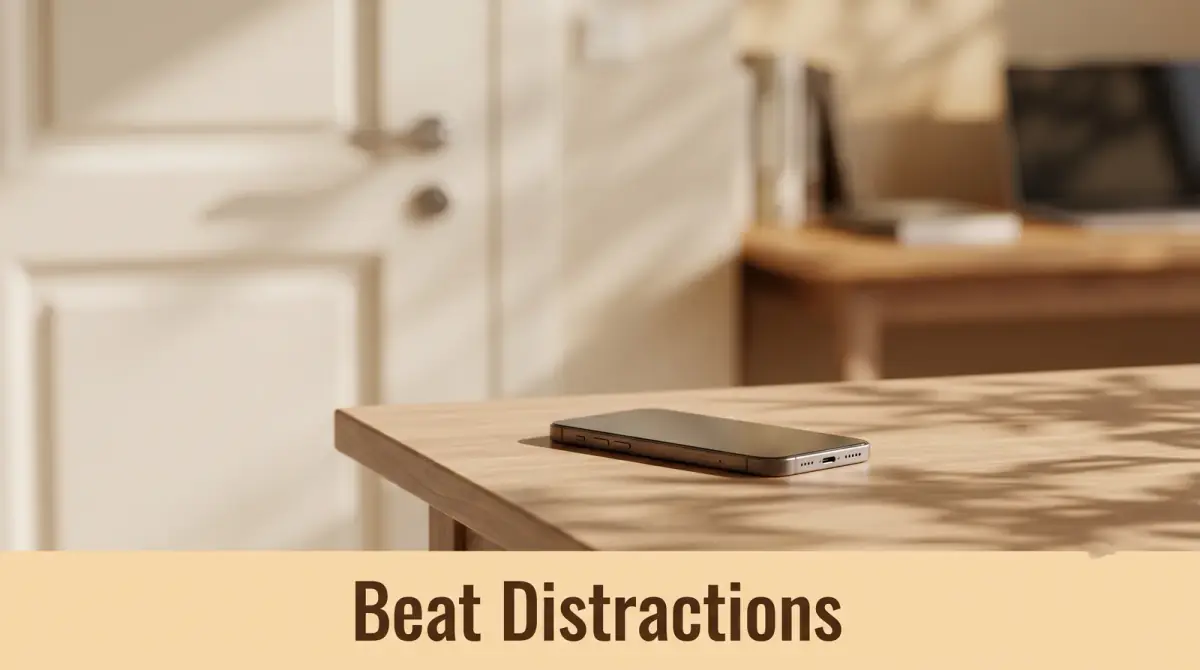
You cannot read deeply while your phone is buzzing beside you. Distractions are the main thing that drags your eyes off the page, so clear them before you start.
- Put your phone in another room or on silent, out of sight.
- Close extra tabs and apps if you are reading on a screen.
- Let people around you know you need a quiet stretch.
- Keep water nearby so you are not popping up every few minutes.
If you often ask what helps you focus better, the honest answer is usually this: not adding tricks, but removing the interruptions that break your attention in the first place.
Set up your body and space to read
Focus is physical as much as mental. It is hard to concentrate on dense text when you are slumped on a bed at midnight, half asleep.
Sit somewhere upright with good light, and hold or prop the text at a comfortable angle. Read at a time when you are reasonably alert rather than running on empty. Basic rest, water, and a little movement quietly support your ability to focus better at anything, reading included.
If you consistently cannot concentrate no matter what you try, and it is affecting your work or study, it may be worth talking with a doctor to rule out other causes.
The bottom line
Knowing how to focus better when reading comes down to reading actively, pacing yourself, and cutting the distractions that pull your eyes away. Give your brain a job with notes and questions, and dense text stops feeling like a fight. Results vary, so try a few of these and keep the ones that click. Pick one for your next reading session and start there.

Comments
0 total