

The short answer
Losing focus mid-session? Learn how to focus better when studying with simple attention habits, smart break timing, and setup tweaks that actually work for you.
- Distractions are the main enemy; remove them before you start.
- Short focused blocks beat long, foggy marathons.
- Active recall keeps your brain engaged and awake.
- A tidy, single-task setup protects your attention.
- Sleep, water, and movement quietly power your focus.
To focus better when studying, clear away the distractions that keep breaking your attention, work in shorter blocks with real breaks, and keep your brain active with recall instead of passive rereading. Learning how to focus better when studying is mostly about designing the session so your attention has fewer places to wander.
You do not need more hours. You need cleaner focus during the hours you already have. A short, sharp session where you are fully present beats a long one spent half-checking your phone.
The short version first, then the details:
- Distractions are the main enemy; remove them before you start.
- Short focused blocks beat long, foggy marathons.
- Active recall keeps your brain engaged and awake.
- A tidy, single-task setup protects your attention.
- Sleep, water, and movement quietly power your focus.
Clear the distractions first
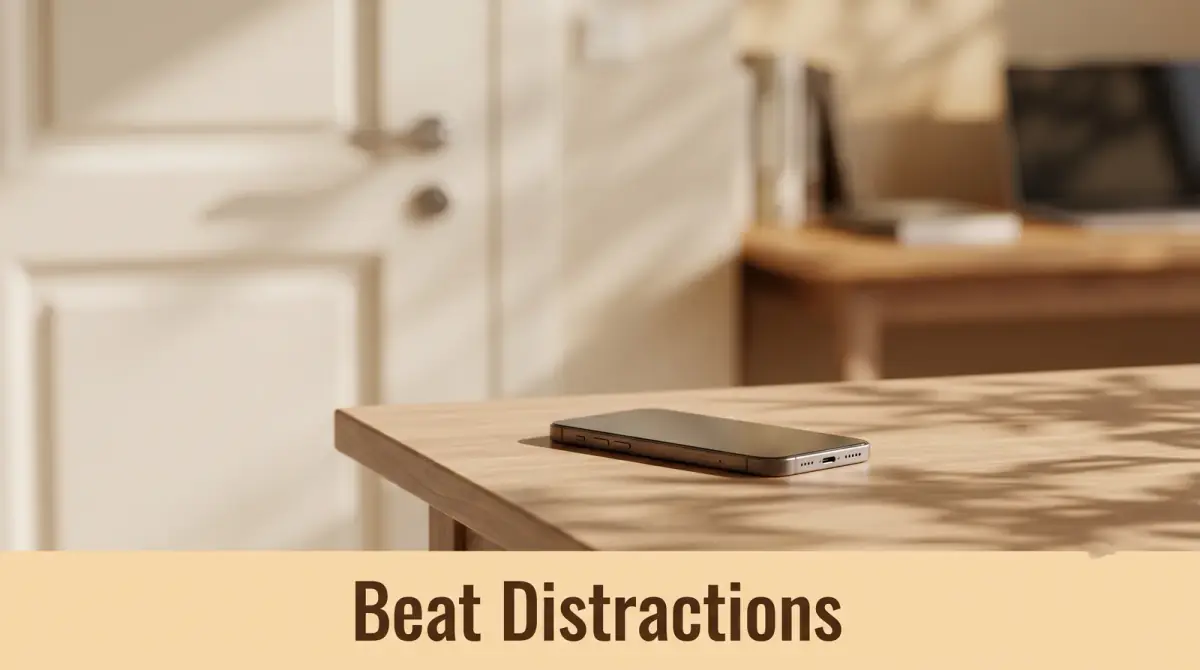
Your phone is the biggest focus thief for most students, so deal with it before anything else. Every buzz pulls your attention away, and it can take several minutes to fully get back on track after each one.
- Put your phone in another room or in a drawer, not face-down beside you.
- Close every browser tab that is not part of the task.
- Use a website blocker during study blocks if open tabs tempt you.
- Tell people around you that you are heads-down for the next stretch.
Out of sight really does help. When the distraction takes effort to reach, you reach for it far less often. The idea is to make focus the path of least resistance, so staying on task takes less effort than drifting off it.
How to focus better when studying with the right session length
Trying to focus for three hours straight is a recipe for a foggy brain. Attention fades over long stretches, so break your work into focused blocks with short breaks between them.
A popular approach is to study for around 25 minutes, then take a five-minute break, and take a longer break after a few rounds. The exact timing is not sacred. Some people focus better while studying in 45-minute blocks. Test a couple of lengths and keep what fits you.
The key is a real break. Stand up, stretch, look out a window, or grab water. Scrolling your phone is not a break for your attention; it just trades one screen for another. Looking at something far away for a moment also rests your eyes during long study days.
Study actively, not passively
Rereading your notes feels productive, but it is one of the weakest ways to learn, and it makes your mind wander fast. Active studying keeps you engaged because your brain has to do real work.
Active recall means closing the book and trying to pull the answer from memory. It is harder than rereading, and that difficulty is exactly why it works.
- Read a section, then cover it and write what you remember.
- Turn headings into questions and try to answer them.
- Use flashcards and quiz yourself instead of just reviewing.
- Explain the idea out loud as if teaching someone else.
When your brain is busy retrieving, it has no spare room to drift. Focus becomes a side effect of doing the work the active way. It feels harder than rereading because it is harder, and that effort is what moves the material into memory.
Set up a focus-friendly space
Your environment shapes your attention more than you might think. A cluttered, noisy space pulls your mind in ten directions, while a simple one lets it settle.
Clear your desk of anything unrelated to the task. Have your water, pens, and materials ready so you are not popping up every few minutes. If silence feels loud, try soft instrumental music or a steady background hum, but skip lyrics, which tend to compete for your attention.
Try to keep one space mainly for studying. Over time your brain links that spot with focus, and settling in gets easier. If a dedicated desk is not possible, even a consistent corner of a table can do the same job.
How to focus better in class and school
Focus is not only for solo study. To focus better in class, sit near the front where there is less to look at between you and the teacher, and fewer classmates to watch.
Take notes by hand when you can. Writing forces you to process and summarize, which keeps you present instead of zoning out. Jot down questions as they pop up so your mind stays curious and engaged.
If you want to focus better in school overall, protect your sleep. A tired brain cannot concentrate no matter how hard you push it, and no study trick fully makes up for lost rest.
Look after the basics
Focus is physical as much as mental. The strongest study habits fall apart on a body running on empty.
- Sleep is the big one; aim for a consistent, full night.
- Drink water, since even mild dehydration dulls attention.
- Eat something steady rather than studying on pure sugar.
- Move a little; a short walk can reset a scattered mind.
If you consistently cannot focus no matter what you try, and it is hurting your studies, it may be worth talking with a doctor or counselor to rule out other causes.
Avoid the burnout trap
More studying is not always better studying. Pushing for hours past the point of focus just teaches your brain that study time is misery, which makes it harder to start next time.
Set a realistic stopping point and honor it. A focused 90 minutes usually beats a distracted, resentful four hours. Protecting your energy today is what lets you show up again tomorrow.
The bottom line
Knowing how to focus better when studying comes down to a few habits: kill the distractions, work in short focused blocks, study actively with recall, and protect your sleep and energy. Results vary from person to person, so try a few of these and keep the ones that click. Pick one change for your next session and start there.


Comments
0 total