
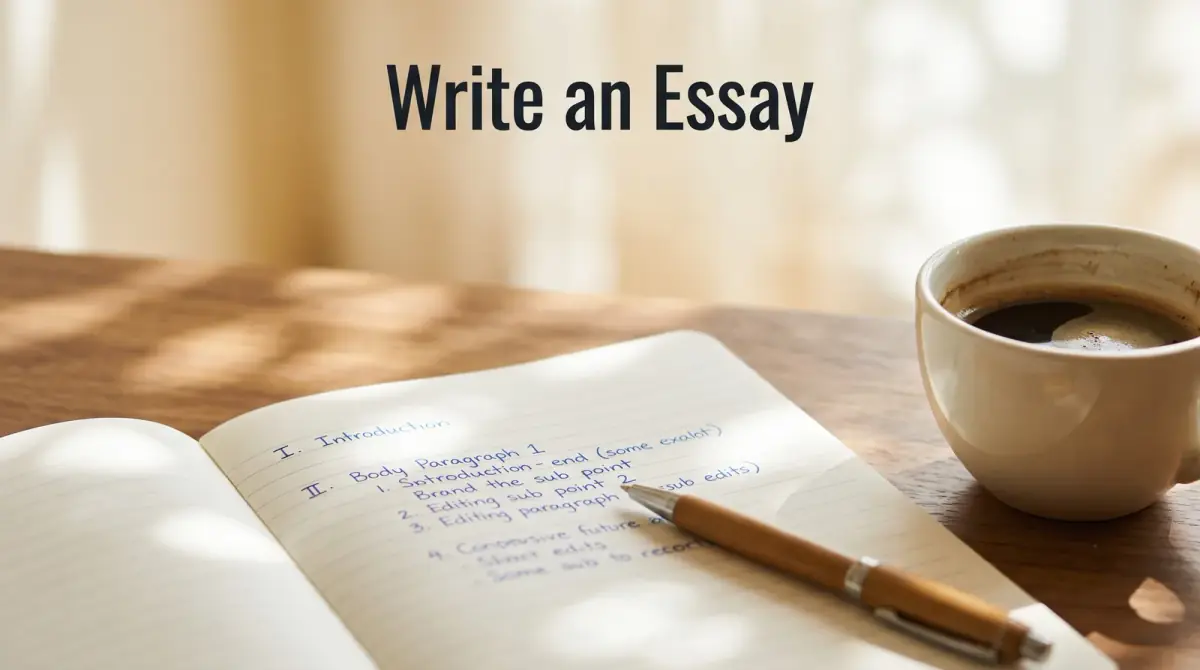
The short answer
New to essays? This clear essay writing format walks you through structure, from a strong thesis to a tidy conclusion, with a step-by-step guide anyone can follow.
- Every essay has three parts: introduction, body, and conclusion.
- Start with a clear thesis, the single point your essay argues.
- Give each body paragraph one idea that supports the thesis.
- Plan before you write to keep your argument on track.
- Edit in a separate pass, after the draft is done.
A good essay writing format follows the same simple shape every time: an introduction that states your point, body paragraphs that support it, and a conclusion that ties it together. Once you know this structure, a blank page stops being intimidating. You are just filling in a reliable framework, one part at a time.
Whether it is a school assignment or an exam answer, essays reward clear structure over clever words. This step-by-step guide gives you a format you can reuse for almost any topic.
Key takeaways
- Every essay has three parts: introduction, body, and conclusion.
- Start with a clear thesis, the single point your essay argues.
- Give each body paragraph one idea that supports the thesis.
- Plan before you write to keep your argument on track.
- Edit in a separate pass, after the draft is done.
Step 1: Understand the question
Before writing a word, be sure you know what is being asked. Read the prompt carefully and underline the key instruction words, such as describe, compare, or argue. Answering the wrong question is the most common way a well-written essay loses marks.
Step 2: Plan and build your thesis
Planning is where good essays are won. Jot down your main ideas, then decide on your thesis, the central claim your whole essay will support. A strong thesis is specific and arguable, not a vague statement of the topic.
Outline your points
List the two to four main points that back up your thesis. Each will become a body paragraph. A short outline keeps your essay writing format organized and stops you wandering off topic halfway through.
Step 3: Write the introduction
The introduction sets up your essay and tells the reader where you are going. A simple, effective introduction does three things.
- Open with a hook. A relevant fact or question draws the reader in.
- Give brief context. A sentence or two of background frames the topic.
- State your thesis. End the introduction with your central claim, clearly worded.
Step 4: Write the body paragraphs
The body is where you make your case. The key rule is one main idea per paragraph. A clear, repeatable paragraph structure keeps each one focused.
- Point. Open with the paragraph's main idea in a topic sentence.
- Evidence. Support it with an example, fact, or quotation.
- Explanation. Explain how the evidence supports your thesis.
- Link. Connect back to the argument or lead into the next paragraph.
Use linking words like however, therefore, and in addition to guide the reader smoothly from one point to the next.
Step 5: Write the conclusion
The conclusion brings your essay to a satisfying close. It should not introduce new information. Instead, restate your thesis in fresh words, briefly draw your main points together, and end with a final thought that leaves the reader with something to consider.
Tell them what you will argue, argue it, then remind them what you argued. That simple rhythm is the backbone of every clear essay.
Step 6: Edit and proofread
A first draft is never the finished essay. Editing is a separate job from writing, so do it afterward with fresh eyes. First, check the big picture: does your argument flow, and does every paragraph support the thesis? Then check the details, grammar, spelling, and punctuation. Reading your work aloud helps you catch clumsy sentences you would otherwise miss.
Common mistakes to avoid
Even with a solid format, a few habits regularly cost students marks. The most common is drifting off the question, answering what you wish had been asked instead of what actually was. Keep the prompt in front of you and check each paragraph against it.
Another frequent error is cramming several ideas into one paragraph, which muddies your argument. Stick to one main idea per paragraph. Watch too for missing evidence, claims stated without support convince no one, and for a conclusion that simply repeats the introduction word for word rather than drawing the argument together.
Writing essays under exam pressure
Timed essays call for a slightly different approach. You cannot draft slowly, so plan fast and commit. Spend the first few minutes jotting a quick outline, your thesis and the two or three points you will make, before you start writing. That small investment keeps you from rambling and running out of time mid-argument.
Watch the clock and give each section a rough time budget, leaving a couple of minutes at the end to check for obvious errors. A clear, well-structured exam essay with simple language almost always scores better than an ambitious one that never reaches its point.
A simple essay checklist
Before you consider an essay finished, run through a short checklist. Does the introduction state a clear thesis? Does every body paragraph make one point that supports it, backed by evidence? Do your ideas flow in a logical order with smooth links between them? Does the conclusion pull everything together without adding anything new?
Finally, have you checked spelling, grammar, and punctuation in a separate pass? Running through these questions each time builds good habits, and before long the whole essay writing format becomes second nature rather than something you have to think about.
Questions students ask about essay writing
How long should each part of an essay be?
A common guide is a short introduction and conclusion, with the bulk of your word count in the body. As a rough rule, the introduction and conclusion together take up around a quarter of the essay, and the body paragraphs fill the rest. Every body paragraph should carry roughly equal weight, since each is making one important point in support of your thesis.
How many paragraphs does an essay need?
There is no fixed number, because it depends on the length and the question. A short essay might have an introduction, two or three body paragraphs, and a conclusion. A longer one simply adds more body paragraphs. What matters is not the count but the rule behind it: one clear idea per paragraph, each one supporting your central argument.
Should I write the introduction first?
Not always. Many writers find it easier to draft the body first, once their argument is clear, and then write the introduction to fit. Some even write the introduction last. Do whatever helps you get words on the page, then revise the opening at the end so it accurately promises what the finished essay delivers.
A reusable structure to remember
Keep this skeleton in mind and you can write an essay on nearly any subject: introduction with a thesis, a few body paragraphs each making one supported point, and a conclusion that pulls it together. Master this essay writing format once, and every future essay becomes a matter of filling in the parts rather than starting from nothing.



Comments
0 total