

The short answer
Facts will not stick? Learn how to improve memory for exams with proven techniques like active recall, chunking, spaced practice, and smarter revision habits.
- Test yourself often, since retrieval builds memory better than rereading.
- Space your revision over days rather than cramming it all at once.
- Break big topics into smaller chunks your brain can hold.
- Use mnemonics and connections to make facts stickier.
- Protect your sleep, because memories consolidate while you rest.
The most reliable way to improve memory for exams is to practice pulling information out of your head, not just pushing it in by rereading. Memory strengthens when you retrieve it, so testing yourself is far more powerful than passively reviewing notes. If your facts never seem to stick, the problem is usually the method, not your brain.
Memory is not a fixed talent. It is a skill you can train with the right techniques. Here are the approaches that genuinely help, without any tricks or false promises.
Key takeaways
- Test yourself often, since retrieval builds memory better than rereading.
- Space your revision over days rather than cramming it all at once.
- Break big topics into smaller chunks your brain can hold.
- Use mnemonics and connections to make facts stickier.
- Protect your sleep, because memories consolidate while you rest.
Use active recall
Active recall means closing your notes and trying to remember the material from memory. Each time you retrieve a fact, you strengthen the path back to it, which is exactly what you need in an exam.
- Make questions, not summaries. Turn your notes into questions and answer them from memory.
- Use flashcards. Prompt on one side, answer on the other, and test both directions.
- Do brain dumps. Write everything you know about a topic on a blank page, then check for gaps.
It feels harder than rereading, and that difficulty is the point. The effort of remembering is what builds a durable memory for exams.
Space out your revision
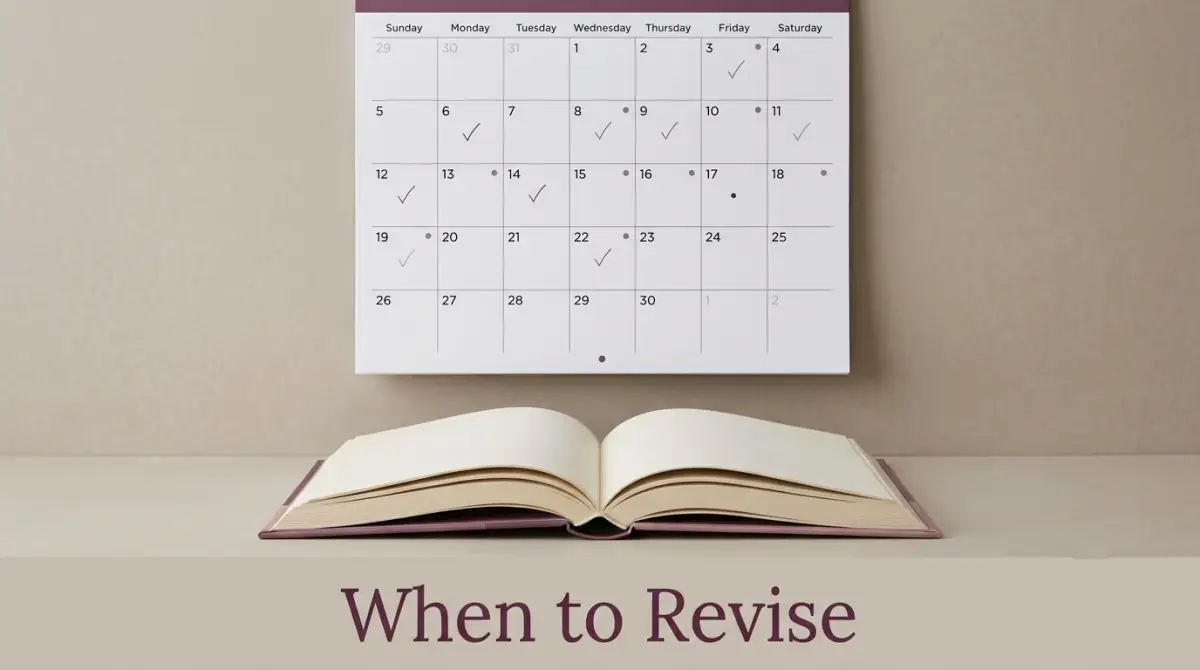
Cramming everything the night before crams it into short-term memory, where it fades fast. Spacing the same revision across several days lets each review reinforce the last, moving knowledge into long-term memory.
A simple spacing plan
Review a topic today, again in a couple of days, then again later in the week. Each revisit takes less time and locks the material in deeper. Starting early is what makes spacing possible, which is the real reason last-minute study underperforms.
Break material into chunks
Your working memory can only hold a few items at once, so a wall of facts overwhelms it. Chunking groups small pieces into larger, meaningful units that are easier to store and recall.
A long string of numbers is hard to hold, but split into small groups it becomes manageable. Do the same with study material by grouping related ideas under clear headings, so you remember a few organized clusters instead of dozens of loose facts.
Make facts meaningful and connected
We remember meaning far better than isolated information. When you link a new fact to something you already know, you give your brain a hook to hang it on.
- Use mnemonics. Acronyms, rhymes, and silly phrases turn dry lists into memorable cues.
- Tell a story. Linking facts into a narrative makes a sequence far easier to recall.
- Explain it simply. Teaching an idea in plain words, as if to a friend, cements your own understanding.
You do not remember what you read. You remember what you do something with. Effort during study is what creates memory.
Sleep is part of studying
Sleep is not time away from revision, it is part of it. While you sleep, your brain consolidates what you learned that day, moving it into more stable storage. A full night after studying does more for your memory than the extra hour you would gain by staying up.
Short naps can help too, and reviewing material shortly before sleep can improve how well it sticks. Pulling an all-nighter, by contrast, sabotages the very memory you are trying to build.
Mix up your topics
Studying one subject in a long, single block feels tidy, but mixing related topics in a session, an approach called interleaving, often builds stronger memory. When you switch between different types of problems or subjects, your brain has to work harder to recall the right method each time, and that extra effort strengthens learning.
This can feel messier and less comfortable than blocking one topic at a time, and it may even feel like you are making slower progress. But that mild struggle is doing exactly what you want. Come exam day, when questions appear in an unpredictable order, your brain will already be practiced at pulling the right knowledge from a mix.
Use visualization
The mind remembers images far more easily than plain words. Turning information into vivid mental pictures gives your memory something concrete to hold. To recall a process, imagine it playing out as a scene. To remember a list, picture each item in an exaggerated, memorable way.
An old and powerful version of this is the memory palace, where you imagine placing facts along a familiar route through your home. To recall them, you mentally walk the route and collect each item. It sounds strange, but linking facts to strong images and places is one of the oldest and most reliable memory tools we have.
Look after the basics
No memory technique can fully compensate for a neglected body. Your brain needs fuel, water, and movement to work at its best. Skipping meals, running on too little sleep, or sitting still for hours all quietly weaken your ability to remember.
Eat regular, balanced meals, drink enough water, and take short movement breaks between study blocks. Even a brief walk boosts blood flow to the brain and can leave you sharper for the next session. Treat these basics as part of your revision, not a distraction from it, and every technique you use will work better.
Questions students ask about memory
Why do I forget what I studied so quickly?
Forgetting soon after learning is completely normal, not a sign of a poor memory. Your brain naturally lets go of information it does not use, which is why a single read-through fades fast. The fix is to revisit the material through active recall at spaced intervals, so your brain treats it as important and keeps it. Repeated retrieval, not repeated reading, is what makes knowledge stay.
Does handwriting notes help me remember better?
For many people it does. Writing by hand is slower than typing, which forces you to summarize ideas in your own words rather than copy them word for word. That extra processing helps the material stick. The real benefit, though, comes from doing something active with your notes afterward, such as testing yourself on them, rather than just filing them away.
How far ahead should I start revising?
The earlier the better, because the most powerful memory techniques depend on spacing your reviews over time. Starting a few weeks before an exam lets you revisit each topic several times at widening intervals, which locks it into long-term memory. Leaving it to the last night forces cramming, which loads short-term memory that mostly empties within days.
Practice under exam conditions
Finally, rehearse the way you will perform. Answering past questions under timed, quiet conditions trains you to retrieve knowledge the way the exam will demand it. It also reduces anxiety, because the real test feels familiar. Practicing retrieval in exam-like settings is one of the most effective ways to improve memory for exams and walk in feeling prepared.


Comments
0 total