
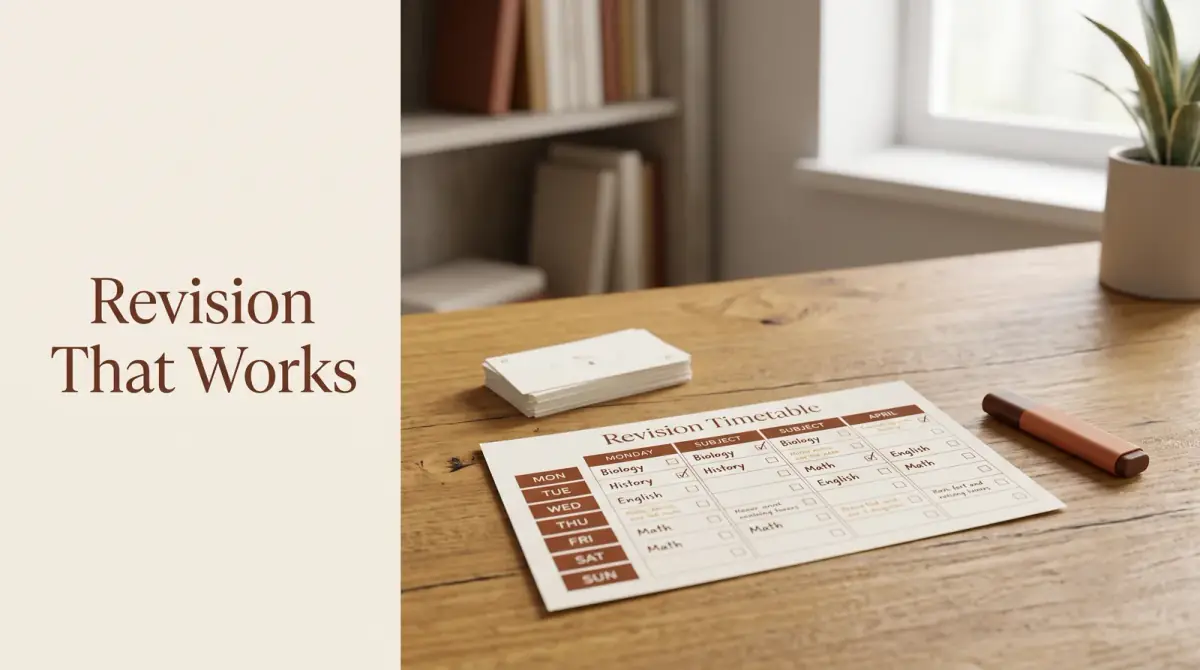
The short answer
Looking for the best revision technique? Compare methods that genuinely work, from active recall to past papers, and build a revision plan that actually sticks.
- Active recall beats rereading, because retrieval builds memory.
- Spacing revision over days locks knowledge in for the long term.
- Past papers train you to apply what you know under pressure.
- Teaching a topic reveals what you do and do not understand.
- Passive rereading and highlighting feel useful but do little.
The best revision technique is almost always active recall, testing yourself instead of rereading, combined with spacing your revision over time. Most students revise by highlighting and rereading, which feels productive but barely builds memory. The methods that actually work feel harder, and that difficulty is exactly why they succeed.
There is no single magic method, but some techniques are far more effective than others. Here is an honest comparison so you can build a revision plan around what genuinely works.
Key takeaways
- Active recall beats rereading, because retrieval builds memory.
- Spacing revision over days locks knowledge in for the long term.
- Past papers train you to apply what you know under pressure.
- Teaching a topic reveals what you do and do not understand.
- Passive rereading and highlighting feel useful but do little.
Active recall: the strongest method
Active recall means retrieving information from memory rather than looking at it. Every time you pull a fact out of your head, you strengthen your ability to find it again, which is precisely what an exam requires.
- Flashcards. Question on one side, answer on the other, tested both ways.
- Practice questions. Answer from memory, then check.
- Blank-page recall. Write everything you know about a topic, then fill the gaps.
If you adopt only one habit, make it this. Active recall is the closest thing to a best revision technique that research supports.
Spaced practice: revise over time
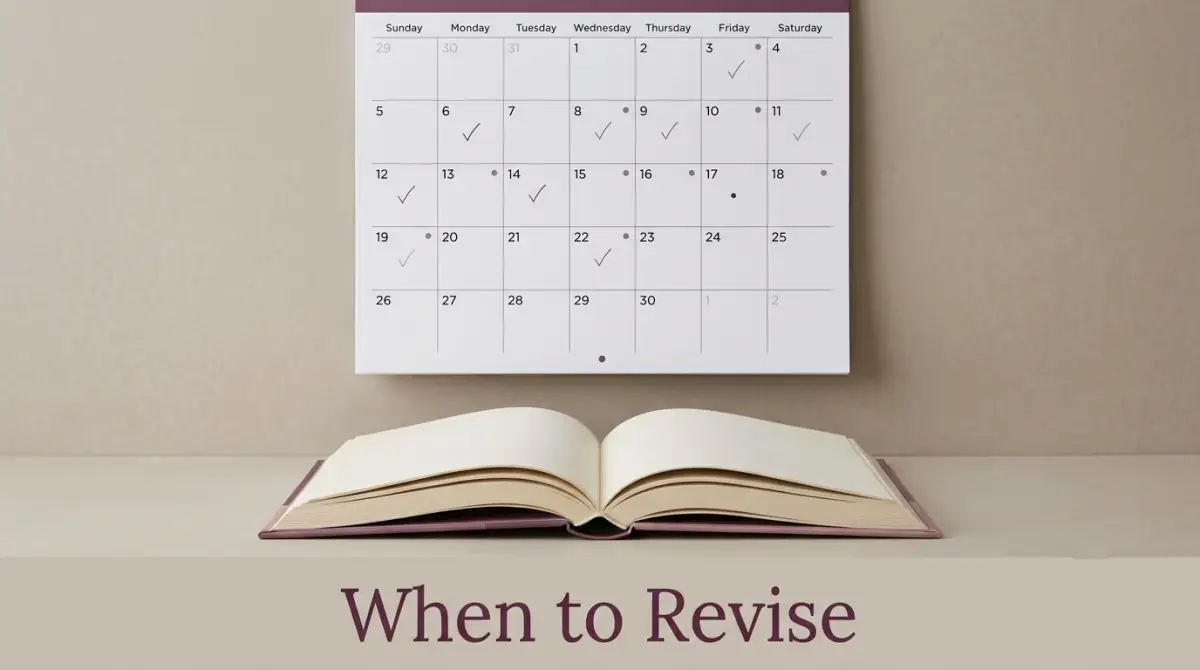
When you revise matters as much as how. Reviewing a topic once and moving on lets it fade. Revisiting it across spaced intervals, a few days apart, keeps refreshing the memory before it disappears.
How to space it
Study a topic, then revisit it a couple of days later, then again later in the week. Each review takes less time and drives the material deeper. This is why starting revision early beats cramming, spacing is only possible with time on your side.
Past papers: practice the real thing
Past exam papers are one of the most valuable revision tools available. They show you the style of questions, the language examiners use, and how marks are awarded.
Working through past papers under timed conditions trains you to apply knowledge, not just recognize it. It also highlights your weak spots, so your remaining revision targets exactly what needs work. Reviewing mark schemes afterward teaches you what a strong answer actually looks like.
Teach it to someone else
Explaining a topic out loud, as if teaching it, is a powerful test of understanding. If you can teach it clearly, you know it. If you stumble, you have found a gap to fix.
If you cannot explain it simply, you do not understand it well enough yet. Teaching turns fuzzy knowledge into clear knowledge.
You do not need a real audience. Explain it to an empty room, a patient friend, or even a pet. The act of putting ideas into your own words does the work.
Mind maps and organization
For visual thinkers, mind maps help by showing how ideas connect. Drawing a topic as a branching diagram organizes scattered facts into a structure you can picture in the exam. Used together with active recall, redrawing a mind map from memory, they become more than a pretty summary.
Combine methods for the best results
No single technique does everything, and the strongest revision comes from combining a few. Active recall builds memory, spacing makes it last, and past papers train you to apply it under pressure. Used together, they cover the full range of what an exam demands.
A simple combined routine might look like this: learn a topic, test yourself on it from memory a day later, revisit it a few days after that, and then work through past questions closer to the exam. Each method reinforces the others, so the whole is far more effective than any one technique on its own.
Match the technique to the subject
Different subjects reward slightly different approaches. Fact-heavy topics, with definitions, dates, or vocabulary, respond well to flashcards and active recall. Problem-based subjects like maths or physics need lots of practice questions, because you have to rehearse the method, not just remember facts.
Essay subjects benefit from planning practice, sketching quick outlines for likely questions, and from writing timed answers. There is no single best revision technique for every subject, so think about what each one actually asks of you and choose your methods to match.
Avoid common revision traps
A few habits reliably waste revision time. Spending hours making beautiful, colorful notes can feel productive while teaching you very little, because copying and decorating is passive. Revising only the topics you already enjoy or find easy is another trap, since it leaves your weak areas untouched.
Guard against these by testing yourself honestly to find your real gaps, then aiming your revision squarely at them. It is uncomfortable to work on what you are worst at, but that is precisely where your marks have the most room to grow.
Questions students ask about revision
How many hours a day should I revise?
Quality matters far more than raw hours. A few focused sessions of genuine active recall beat a whole day of passive rereading. Rather than chasing a number of hours, aim for a set of specific goals each day, such as testing yourself on two topics and completing a past-paper section. Frequent, focused, well-rested sessions outperform long, exhausting ones every time.
Are group study sessions effective?
They can be, if they stay focused. Explaining a topic to others is a powerful test of your own understanding, and classmates can fill gaps you did not know you had. The risk is that groups drift into chatting or one person doing all the work. Keep sessions short, set a clear agenda, and use them mainly for quizzing each other rather than silent reading.
What is the biggest revision mistake to avoid?
Relying on rereading and highlighting. Both feel productive and comfortable, which is exactly why they mislead so many students. Because your brain is barely working, very little sticks. Swap that time for active recall and past papers, which feel harder precisely because they are doing the real work of building memory.
What to do less of
Some popular habits give a false sense of progress. Rereading notes, highlighting large passages, and copying text out word for word all feel productive but build little lasting memory, because your brain is barely working. If a technique feels easy and comfortable, it is probably not doing much. Swap that time for active recall and past papers, and your revision will finally start to pay off.

Comments
0 total