
The short answer
What human behaviors are instinctual, and what do we simply learn? A clear, honest look at the reflexes, drives, and fears we seem born with, without overclaiming.
- True instincts are automatic, appear without teaching, and look roughly similar across cultures.
- Reflexes like blinking and flinching are the clearest examples we have.
- Some fears and social pulls have deep roots but still get shaped by experience.
- Most complex behavior is a mix of nature and nurture, not one or the other.
- Calling something an instinct does not make it fixed or excuse it.
What human behaviors are instinctual? Honestly, fewer than most people assume. The clearest cases are automatic reflexes and a small set of built-in drives and fears. Most of what we do each day is learned, shaped by culture, or a mix of both. So the true list of what human behaviors are instinctual is real, but smaller than the myths suggest.
That gap matters. When people ask this question, they often picture complex habits like jealousy or competitiveness. Those are far too layered to call pure instinct. So let us separate the hardwired from the learned, without overclaiming in either direction.
Key takeaways
- True instincts are automatic, appear without teaching, and look roughly similar across cultures.
- Reflexes like blinking and flinching are the clearest examples we have.
- Some fears and social pulls have deep roots but still get shaped by experience.
- Most complex behavior is a mix of nature and nurture, not one or the other.
- Calling something an instinct does not make it fixed or excuse it.
What actually counts as an instinct?
An instinct is a behavior you do not have to learn. It shows up on its own, tends to look the same across very different cultures, and often appears early in life.
Contrast that with a learned behavior, which you pick up through practice, imitation, or reward. Riding a bike can feel automatic later, but nobody is born knowing how. That gap is the line we are trying to draw.
The tricky part is that few human behaviors sit cleanly on one side. Even simple actions get filtered through what we have learned. So it helps to treat instinct as a spectrum rather than an on-off switch.
Reflexes: the clearest instincts we have
If you want a solid example of built-in behavior, start with reflexes. These are fast, automatic responses that skip conscious thought entirely.
- You blink when something moves toward your eye.
- You pull your hand back from a hot surface before the pain registers.
- You flinch at a sudden loud noise.
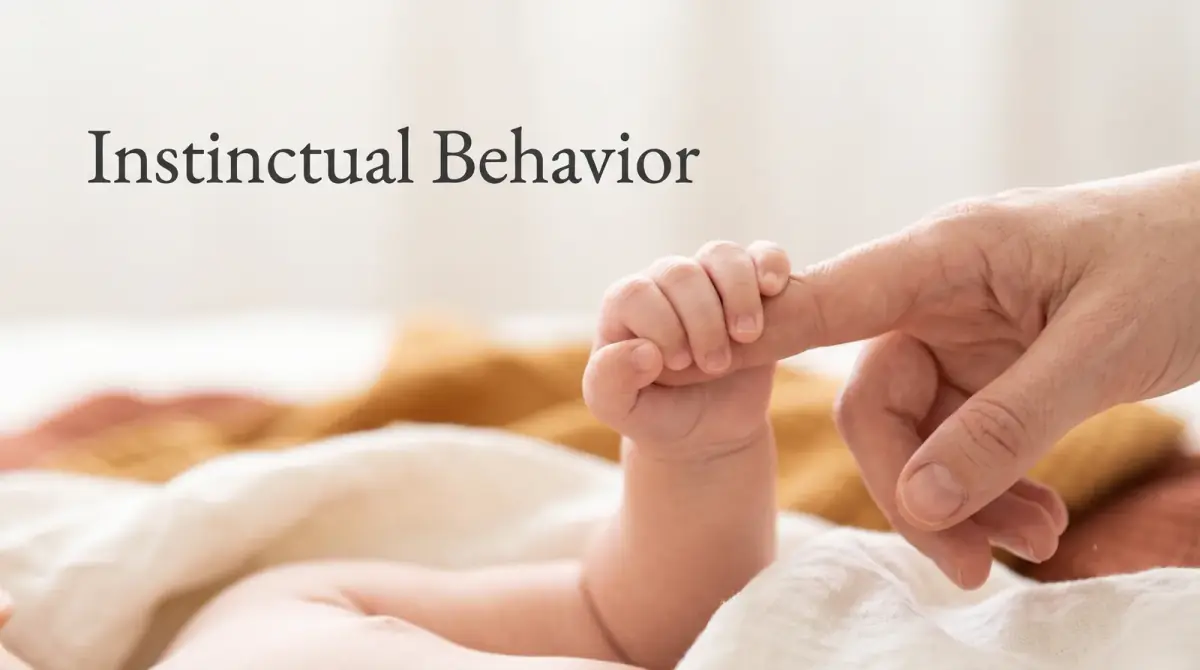
- A newborn grips a finger placed in its palm.
These are not decisions. Your nervous system handles them, often before your thinking brain catches up. That speed is the point, because reflexes evolved to protect the body quickly. You can even try to hold back a blink and find that the reflex mostly wins anyway.
Built-in drives and early fears
Beyond reflexes sit a few deeper drives. Hunger, thirst, and the pull toward sleep are not behaviors you were taught. Your body generates them to keep you alive, and they return whether you want them or not.
Some fears also seem to come partly prewired. Many people show an easy, early wariness of snakes, spiders, heights, and sudden drops. One common idea is that ancestors who reacted fast to such threats were more likely to survive and pass that readiness on.
Notice the careful wording. It is not that you are born terrified of snakes. It is that humans seem to learn these particular fears unusually fast, which hints at a built-in head start rather than a fixed program.
Newborn behavior offers other clues. Babies root and suck to feed, cry to signal a need, and grasp reflexively. Nobody teaches these, and they appear across every culture, which is exactly the pattern we expect from a real instinct.
Social instincts, or something close to them
Humans are deeply social, and some of that appears to run deep. Very young infants tend to prefer face-like patterns and human voices. The urge to bond with a caregiver looks less like a choice and more like a pull.
Some researchers argue we lean toward fairness, belonging, and reading other people's emotions. These tendencies may have roots in our long history as a group-living species, where cooperation had real survival value.
Still, be cautious here. How these leanings play out varies enormously by culture and upbringing. The raw pull may be shared, but the shape it takes is learned. This is where human behavior psychology gets genuinely hard, because the same drive can look completely different in two places. A shared need to belong, for example, can produce very different customs from one community to the next.
Where instinct ends and learning begins
Here is the honest picture: the list of pure instincts is short, and it gets murky fast.
Take a smile. A basic smile of joy appears even in infants, which suggests something built in. But when, how, and at whom you smile is heavily shaped by culture and context.
Language works the same way. Humans seem born ready to learn language, with brains primed for it. Yet which language you speak, and every word in it, is entirely learned.
So the useful frame is not nature versus nurture. It is nature and nurture, working together on nearly everything you do.
What this means for predicting people
People often ask a linked question: is human behavior predictable if so much of it is instinct? Partly. Reflexes are highly predictable, and broad drives like hunger follow clear patterns you can plan around.
But once learning, culture, and personal choice enter, prediction gets shaky. Two people in the same situation can act very differently, because their learned scripts differ. Results vary from person to person, and that variety is not a flaw in the science. It is the reality of being human.
So the safe rule is to expect the built-in pull and stay open to the exception. The instinct sets a tendency. It does not lock in the outcome, because a learned habit or a deliberate choice can override it in the moment.
So what human behaviors are instinctual?
In the strict sense, mostly reflexes, core survival drives, a few fast-learned fears, and some early social pulls. That is the reliable core, and it is worth respecting.
It is also tempting to explain away habits as instinct. People say it is just human nature to overeat, to compete, or to gossip. That kind of claim deserves a second look, because it can make a behavior sound fixed when it is not.
Most day-to-day behavior is flexible. You can learn, adapt, and override many pulls, even ones with deep roots. When you read a confident claim that some rich behavior is pure instinct, stay a little skeptical. The truth is usually more interesting, and far more shaped by learning, than a single tidy label suggests.


Comments
0 total