

The short answer
Why does overthinking happen, what does it look like, and is it a disease? A plain look at the mental loops behind rumination, minus the usual pop-psychology myths.
- Overthinking is often the brain trying to solve for safety and certainty.
- It loops when a problem has no clear answer or is out of your control.
- Common signs include replaying the past and rehearsing worst cases.
- Overthinking is not a formal diagnosis, but it can be part of other conditions.
- Small actions that interrupt the loop tend to help more than more thinking.
Why does overthinking happen? In short, your brain is trying to protect you. It treats unsolved problems as threats and keeps looping on them, hoping more thinking will finally make you feel safe. The trouble is that some worries cannot be solved by thought alone. That, in a sentence, is why overthinking happens, and it is not a sign that something is broken in you.
It is a normal process that has simply slipped into overdrive. Almost everyone does it, and the mechanics are the same whether the worry is a text you sent or a decision you are dreading. Let us unpack how it works and what it tends to look like.
Key takeaways
- Overthinking is often the brain trying to solve for safety and certainty.
- It loops when a problem has no clear answer or is out of your control.
- Common signs include replaying the past and rehearsing worst cases.
- Overthinking is not a formal diagnosis, but it can be part of other conditions.
- Small actions that interrupt the loop tend to help more than more thinking.
Why overthinking happens in the first place
Your mind is a problem-solving machine, and mostly that is a gift. It planned your day, dodged a pothole, and remembered a friend's birthday. Overthinking is that same machine pointed at a problem it cannot close.
When a worry has no clear solution, the brain does not give up easily. It flags the issue as unfinished business and keeps returning to it. Each loop feels like progress, but usually it just reheats the same thoughts you already had.
Uncertainty makes this much worse. The mind hates open questions, so it fills the gap with what-ifs. That is why waiting for news, a reply, or a test result can trigger the most spinning. There is nothing to act on, so the brain acts on the only thing available, which is more thought.
The loops behind rumination
Overthinking usually takes one of two shapes, and both are loops.
The first points backward. You replay a past event, a conversation, or a mistake, hunting for what you should have done. This is rumination, and it rarely changes the past it keeps revisiting.
The second points forward. You rehearse everything that could go wrong next, running worst cases on repeat. This is worry, and it tries to prepare for a future that has not happened and may never happen.
Both feel productive because thinking feels like doing. But there is a real difference between useful reflection, which reaches a decision and then stops, and a loop, which just keeps circling the same ground.
A simple test helps here. Ask whether your thinking is moving toward an answer or away from one. Reflection narrows things down and ends in a choice. A loop keeps widening, adding new worries faster than it settles the old ones.
What overthinking looks like day to day
People experience it differently, but here is what overthinking looks like for many:
- Replaying a small comment for hours, sure you said the wrong thing.
- Struggling to make simple choices for fear of the wrong one.
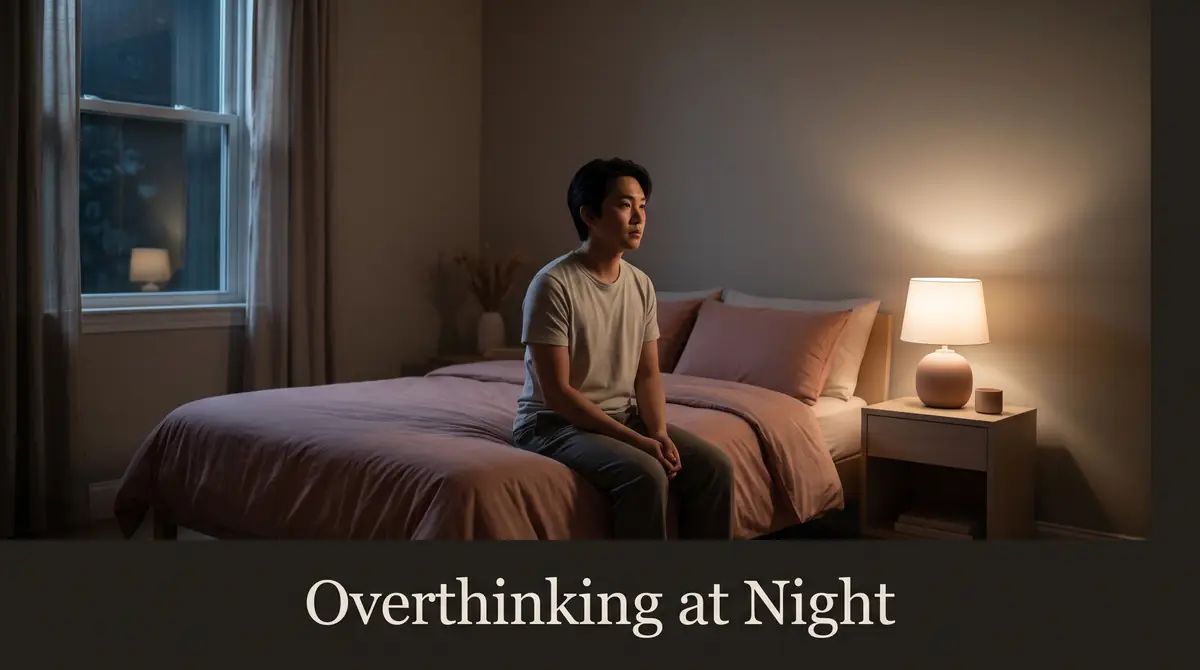
- Lying awake as your mind runs through tomorrow, or last week.
- Reading deep meaning into a short text or a passing facial expression.
- Feeling mentally worn out without having done much physically.
That last point is telling. Overthinking burns real energy. You can end a quiet day genuinely exhausted, simply from the noise running in your head. The body reacts too, so tense shoulders and a restless stomach often come along for the ride.
Is overthinking a disease?
This question comes up a lot, so let us be clear. Is overthinking a disease? No. Overthinking on its own is not a medical diagnosis or an illness.
It is better understood as a mental habit, or a pattern of thinking. Almost everyone does it sometimes, especially under stress or before a big change.
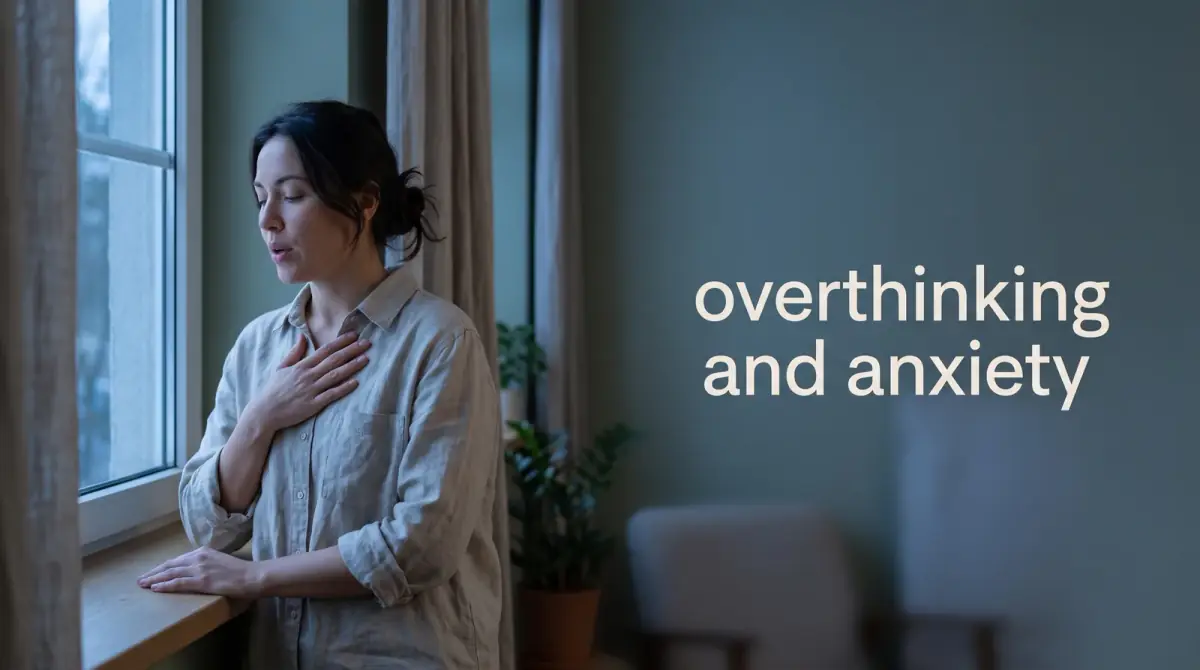
That said, heavy and constant overthinking can be a feature of conditions like anxiety or depression. So while overthinking itself is not a disease, it can be a symptom worth noticing. If it is frequent, distressing, and getting in the way of your sleep, work, or relationships, that is worth taking seriously. It is a good reason to talk with a doctor or a mental health professional. This article is general information, not a diagnosis of you.
Why some people loop more than others
Overthinking is not spread evenly. Several things can turn up the volume.
- Stress and lack of sleep leave the mind more reactive.
- A strong need for certainty makes open questions harder to tolerate.
- Perfectionism raises the stakes on ordinary choices.
- Big life transitions flood the mind with unknowns.
None of these mean you are broken. They simply describe conditions where the problem-solving machine is most likely to overheat. Notice which ones apply to you, since they often point straight at the trigger. Fix the trigger where you can, and the looping often eases on its own.
How to gently break the loop
You usually cannot think your way out of overthinking, because thinking is the loop. The way out tends to run through action and attention instead.
- Name it. Saying I am overthinking this creates a small gap between you and the thought.
- Set a limit. Give a worry ten minutes, then choose one next step, even a tiny one.
- Move your body or your focus. A short walk or a real task can break the circuit.
- Ask if it is solvable now. If yes, act. If no, that is your cue to let it rest.
Results vary from person to person, and none of this is a cure. But small interruptions, repeated often, tend to loosen the grip over time. The goal is not to silence your mind, which is impossible, but to stop feeding a loop that has stopped helping.
The takeaway on why overthinking happens
Overthinking is your protective, problem-solving brain working overtime on problems it cannot close by thinking alone. Knowing why overthinking happens takes some of the fear out of it. The mind is not betraying you. It is trying too hard to keep you safe.
Treat the loops as a signal, not a flaw. When the thinking stops helping, that is your moment to step out of your head and back into the world, even for a single minute.

Comments
0 total