
The short answer
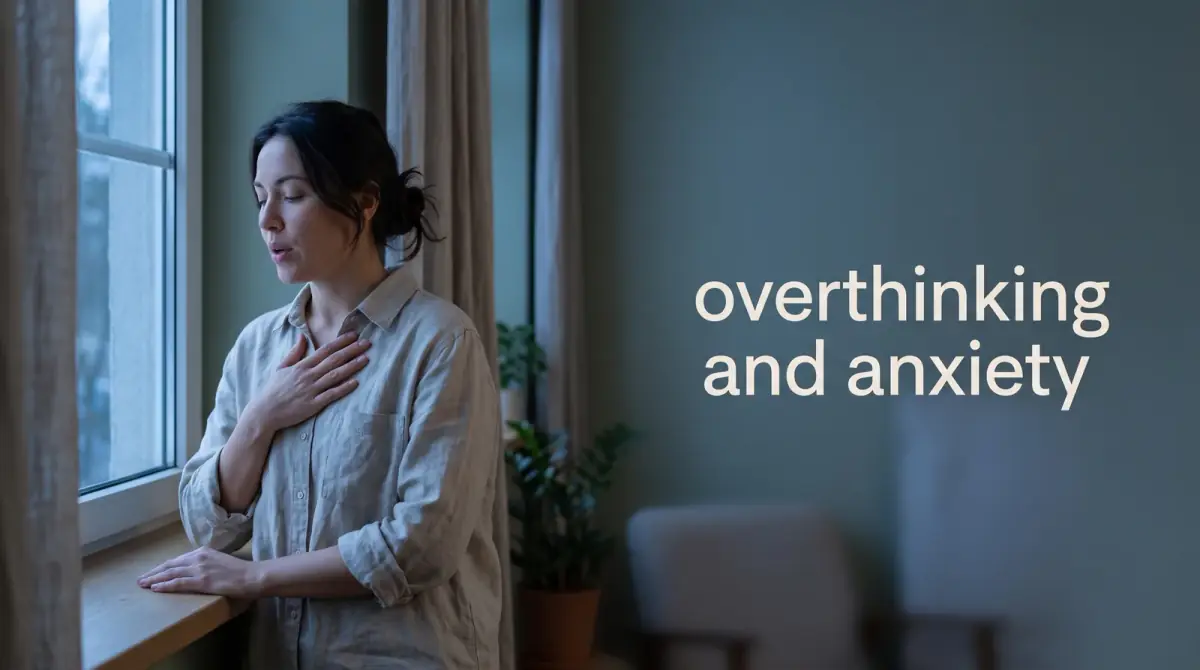
Overthinking and anxiety feed each other in an exhausting loop. Learn how to stop overthinking and anxiety with grounding, thought-reframing, and small daily habits.
- Overthinking, also called rumination, is a major fuel for anxiety.
- You interrupt the loop rather than trying to erase every thought.
- Grounding techniques pull you back to the present moment.
- Thoughts are not facts, and you can question them.
- Persistent anxiety deserves support from a professional.
To stop overthinking and ease anxiety, you interrupt the loop of repeated worried thinking, ground yourself in the present, and treat your worries as thoughts rather than facts. Learning how to stop overthinking and anxiety does not mean pushing feelings away or forcing your mind to go blank. It means changing your relationship with your thoughts so they lose some of their grip.
Overthinking and anxiety feed each other. The more you replay a worry, the more anxious you feel, and the more anxious you feel, the harder it is to stop. Breaking that link is the real goal.
Key takeaways:
- Overthinking, also called rumination, is a major fuel for anxiety.
- You interrupt the loop rather than trying to erase every thought.
- Grounding techniques pull you back to the present moment.
- Thoughts are not facts, and you can question them.
- Persistent anxiety deserves support from a professional.
How overthinking and anxiety feed each other
Overthinking is often called rumination, which means chewing on the same worry over and over without solving it. It feels productive, but it usually just deepens the worry.
Anxiety adds fuel. It makes your mind scan for threats and imagine worst cases, which gives overthinking even more to grab onto. Together they form a loop that can run for hours.
Naming this loop is the first step. Once you can spot "I'm ruminating," you can choose to step out instead of sinking deeper.
It helps to notice the difference between worrying and problem-solving. Problem-solving moves toward a decision and then stops. Rumination circles the same worry without ever landing anywhere, which is a signal to change what you are doing.
How to stop overthinking and anxiety by interrupting the loop
You cannot force a thought to vanish. Trying usually makes it louder. Instead, you gently interrupt the loop and redirect your attention.
A few ways to break the pattern:
- Stand up and change rooms, or step outside.
- Do something that needs light focus, like tidying or washing dishes.
- Say "stop" softly and name what you are doing right now.
- Set a timer for a short walk and let your body reset.
The point is not to win an argument with your thoughts. It is to give your mind a different task so the loop loses momentum.
Movement is especially useful because it is hard to spiral and use your body at the same time. Even a brisk walk around the block can shift your state enough to break the grip of a stubborn worry.
Grounding techniques that pull you back
Anxiety lives in the future, replaying what-ifs. Grounding brings you back to the present, where you are usually safe in this moment.
Try one of these when your mind races:
- Name five things you see, four you hear, three you can touch, two you smell, and one you can taste.
- Hold something cool or textured and focus on how it feels.
- Press your feet into the floor and notice the support under you.
- Take slow breaths with a longer exhale than inhale.
These tools do not solve your problems, and they are not meant to. They lower the alarm enough that you can think more clearly.
Pick one grounding tool and practice it when you are calm, not only in a crisis. A skill you have rehearsed is far easier to reach for when your mind is racing and you need it most.
Question your thoughts without fighting them
Overthinking treats every worried thought as the truth. A calmer approach is to treat thoughts as guesses you can examine.
When a worry shows up, ask yourself:
- Is this a fact, or a fear dressed up as a fact?
- What evidence supports it, and what argues against it?
- What would I tell a friend who had this thought?
- Will this matter as much in a week or a year?
The aim is not forced positivity. It is a fair, balanced look that loosens the thought's hold. Some worries point to a real problem, and for those you plan a next step instead of replaying the fear.
Let feelings pass instead of suppressing them
Pushing feelings down tends to backfire. The emotion often returns stronger, and the effort of hiding it is exhausting.
A gentler path is to let feelings come and go like weather. You notice the anxiety, name it, and allow it to be there without acting on every thought it brings. Uncomfortable feelings usually peak and then fade on their own.
This takes practice and patience. Over time, letting emotions move through you feels safer than bracing against them.
A simple line can help in the moment: "I am having the thought that something bad will happen." That small shift, from "something bad will happen" to "I am having a thought," reminds you that a thought is an event in your mind, not a forecast of the future.
Small daily habits that lower the baseline
Some habits reduce how often the loop starts in the first place. They will not erase anxiety, but they lower the background pressure.
- Move your body most days, even a short walk.
- Keep a fairly steady sleep schedule.
- Go easy on caffeine and alcohol, which can spike worry.
- Write down worries so they leave your head.
- Stay connected to people you trust.
Pick one habit to start. Stacking too many changes at once often leads to giving up on all of them.
Be realistic about caffeine in particular. It can leave your body feeling wired, and a wired body is quick to read that buzz as anxiety. If afternoons are your worst time, an earlier cutoff is worth a try.
What about the popular overthinking books?
Many readers look for a stop overthinking book to guide them, and the best stop overthinking books can offer helpful frameworks and exercises. A good one can put language to what you feel and give you a plan to practice.
Just keep your expectations fair. A book is a tool, not a cure, and results vary from reader to reader. If your anxiety is severe, pair any reading with support from a qualified professional.
When to seek professional help
This article shares general information, not medical advice. If overthinking and anxiety disrupt your sleep, work, or relationships, or if they last for weeks, reach out to a doctor or a licensed therapist.
Support is not a last resort. Talking therapies work well for many people, and a professional can tailor tools to your situation. If you ever feel unsafe or have thoughts of harming yourself, contact local emergency services or a crisis line right away.
The bottom line
Learning how to stop overthinking and anxiety is about changing how you handle your thoughts, not silencing them. Interrupt the loop, ground yourself, question your worries, and let feelings pass. Add a few steady habits, be patient, and get professional support when the worry runs deep.


Comments
0 total