
The short answer
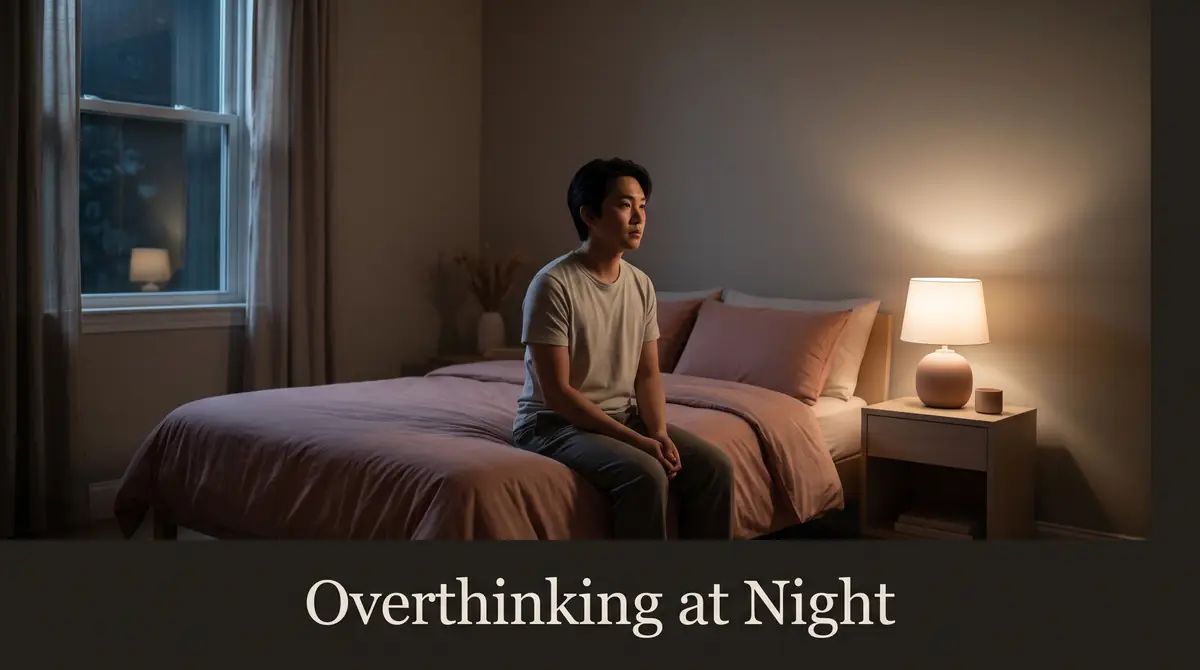
Can't switch your brain off at bedtime? Learn how to stop overthinking at night with a simple brain-dump, a worry window, and calming body tricks that protect your sleep.
- Overthinking at night thrives on silence and stillness, so give your mind a gentle focus.
- A brain-dump on paper clears mental clutter before bed.
- A daytime "worry window" keeps worries from piling up at night.
- Slow breathing and other body cues tell your brain it is safe to rest.
- If sleep will not come, get up briefly instead of lying there stewing.
To stop overthinking at night, you give your busy mind a job before bed, move worries out of your head and onto paper, and use simple body-based tricks to shift out of high alert. Learning how to stop overthinking at night is less about forcing your thoughts to go quiet and more about lowering the pressure so sleep can arrive on its own. The goal is not a perfectly blank mind. It is a calmer one.
Nighttime is prime time for spirals because the day's noise fades and there is nothing left to distract you. The good news is that a few small habits can break the loop.
Key takeaways:
- Overthinking at night thrives on silence and stillness, so give your mind a gentle focus.
- A brain-dump on paper clears mental clutter before bed.
- A daytime "worry window" keeps worries from piling up at night.
- Slow breathing and other body cues tell your brain it is safe to rest.
- If sleep will not come, get up briefly instead of lying there stewing.
Why your mind races at night
During the day, tasks and people keep your attention busy. At night, that busyness stops, and unfinished worries rush in to fill the gap. Your brain treats the quiet as a chance to sort through everything at once.
Tiredness makes it worse. A worn-out mind struggles to judge how serious a problem really is, so small concerns can feel huge at midnight. The same thought often looks manageable by morning.
Understanding this helps you take the 2 a.m. version of a problem less seriously. Your judgment is simply running on a low battery.
How to stop overthinking at night with a brain-dump
One of the most effective moves is a brain-dump. About an hour before bed, write down everything on your mind. Worries, to-dos, and random reminders all go on the page.
This works because your brain keeps looping on tasks it is afraid to forget. Once a worry is written down, your mind can loosen its grip, because the paper is now holding it for you.
Keep a notebook by your bed too. If a thought pops up after lights-out, jot it down in one line and let it go until morning.
You can add a second column for anything you can act on. Next to each worry, write the smallest next step, even if it is just "look into this tomorrow." Turning a vague fear into a tiny task often drains a lot of its late-night weight.
Set a worry window earlier in the day
A worry window is a short, set time to think about your problems on purpose. Pick 10 to 15 minutes in the early evening, well before bed. During that time, let yourself review concerns and jot down any next steps.
When a worry shows up later at night, you can tell yourself it already has a scheduled slot. That small promise makes it easier to set the thought aside.
This trick does not ignore your worries. It simply moves them to a time when you can actually do something about them.
Body-based tricks to calm a racing mind
Overthinking keeps your body in a state of alert. You can work backward by calming the body first, which then signals the mind to follow.
- Slow your breathing, making the exhale longer than the inhale.
- Relax your muscles from your feet up to your face, one group at a time.
- Warm up with a shower before bed, then let your body cool in a cool room.
- Name five things you can see or hear to pull focus out of your head.
These are not magic switches, and they work best with practice. Over a few weeks, your body learns to link them with winding down.
One reason the long exhale helps is that slow breathing gently nudges your body out of "alert" mode and toward "rest" mode. You do not need to breathe perfectly. Just make each out-breath a little longer than the in-breath, and let your shoulders drop as you go.
Build a wind-down routine your brain trusts
Your brain loves patterns. A steady pre-sleep routine becomes a signal that the day is closing and rest is coming.
Keep it simple and repeatable:
- Dim the lights an hour before bed.
- Put screens away, since bright light and endless feeds fuel overthinking.
- Do the same quiet activities each night, like reading or light stretching.
- Go to bed and wake up at similar times, even on weekends.
Consistency is what makes a routine work. The exact steps matter less than doing them in roughly the same order each night.
What to do when you cannot sleep
Sometimes the loop wins anyway, and you find yourself wide awake and frustrated. Lying there and trying harder usually backfires, because bed starts to feel like a place of stress.
If you are still awake after about 20 minutes, get up. Go to another room, keep the lights low, and do something dull and calming until you feel sleepy. Then head back to bed.
This teaches your brain that bed is for sleep, not for wrestling with thoughts. It can feel odd at first, but it protects the link between your bed and rest.
Try to avoid checking the clock while you are up. Watching the minutes tick by usually adds pressure, and pressure is the enemy of sleep. Keep the activity boring on purpose, and skip bright screens so your brain does not wake up further.
Why stopping the nightly spiral matters
It is worth knowing why stopping this habit helps beyond just one night. Steady sleep supports your mood, focus, and patience the next day. When you sleep better, small problems feel smaller, which means less to overthink.
Poor sleep does the opposite. It leaves you more anxious and more likely to spiral again, creating a loop that feeds itself.
Breaking the cycle even a little can start to tip things back in your favor.
When to seek extra support
Occasional overthinking at night is normal. But if racing thoughts wreck your sleep most nights, or come with strong anxiety or low mood, it is wise to talk to a doctor or a licensed therapist.
This is general information, not medical advice. A professional can rule out other causes and offer tools suited to you, and asking for help is a sign of strength.
The bottom line
Knowing how to stop overthinking at night comes down to lowering the pressure rather than forcing silence. Try a brain-dump, set a worry window, and lean on calming body cues and a steady routine. Results vary, so give the habits a few weeks, be patient with yourself, and reach out for support if the spirals stick around.



Comments
0 total