
The short answer
Burnout rarely arrives suddenly. It sends signals for months. Here are the early signs of burnout, why high performers miss them, and what helps.
- Exhaustion. Depleted, emotionally flat, running on fumes. The part everyone knows.
- Cynicism and detachment. Growing distance from the work and the people in it. Clients become tickets. Colleagues become obstacles. You catch yourself being sarcastic about things you used to care about.
- Reduced sense of effectiveness. The creeping conviction that you're bad at your job, that nothing you do matters, that your output is worthless no matter what anyone says.
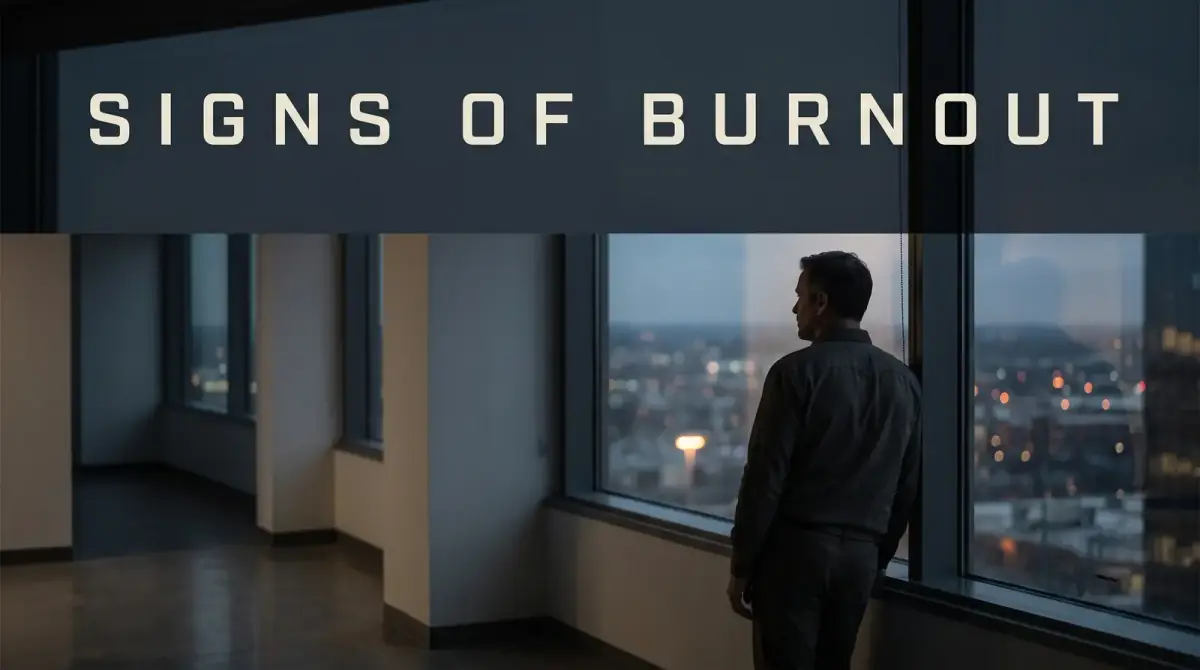
On a Saturday morning in March, a project manager named Marcus noticed he was already dreading Monday. Not Sunday night. Saturday, before ten. He put it down to a busy quarter and made coffee. That flicker of dread was one of the earliest signs of burnout, and it showed up roughly five months before he had to take leave.
Here is the direct answer: burnout is not simply being tired, and it rarely arrives suddenly. It builds as a three-part pattern, and the earliest reliable signals are behavioural, not dramatic. Weekends stop restoring you, small things start irritating you, and you work longer hours while finishing less. Catching it at that stage is the difference between an adjustment and a collapse.
Burnout has a shape, and tiredness isn't it
Tiredness responds to sleep. Burnout doesn't. You can take a full week off, sleep nine hours a night, come back on Monday, and feel the exhaustion settle back over you before lunch. That test alone separates the two.
Occupational burnout is generally described as having three components, and it's worth knowing all three because most people only recognise the first.
- Exhaustion. Depleted, emotionally flat, running on fumes. The part everyone knows.
- Cynicism and detachment. Growing distance from the work and the people in it. Clients become tickets. Colleagues become obstacles. You catch yourself being sarcastic about things you used to care about.
- Reduced sense of effectiveness. The creeping conviction that you're bad at your job, that nothing you do matters, that your output is worthless no matter what anyone says.
The second and third are the ones that sneak past. Exhaustion feels like a health issue. Cynicism just feels like realism, and feeling ineffective just feels like the truth.
What are the early signs of burnout people dismiss?
Early burnout doesn't announce itself. It disguises itself as personality, as a rough patch, as being busy. Watch for these.
Sunday dread creeping backwards
A bit of Sunday-evening reluctance is normal. What isn't normal is the dread migrating. When it reaches Sunday lunch, then Saturday night, then colours the whole weekend, your nervous system is telling you something your calendar isn't.
Losing interest in things that have nothing to do with work
Marcus stopped playing five-a-side. Not because of work commitments, but because the effort of getting there felt enormous. When the hobbies go, when you cancel plans you'd normally look forward to, that's not laziness. It's your reserves being spent before you get home.
Irritability at things that don't deserve it
Snapping at a slow loading screen. Genuine anger at a poorly worded email. Emotional regulation is expensive, and when you're depleted you can't afford it. The people at home usually notice this one before you do.
Working longer and finishing less
Perhaps the most reliable early indicator. Your hours creep up while your output drifts down, so you compensate with more hours, which deepens the depletion. Rereading the same paragraph four times. Taking a whole morning over a task that used to take forty minutes.
Weekends that no longer restore
Two days off used to reset you. Now Monday feels the same as Friday did. When recovery time stops producing recovery, the deficit is bigger than the time available to repay it.
The physical stuff
Sleep is usually first: trouble falling asleep despite exhaustion, or waking at 4am with your jaw clenched and work already running. Then tension headaches, a tight neck and shoulders, stomach trouble, catching every cold going round. Your body tends to file the complaint before your mind admits there's a problem.
Why high performers miss it for so long
There's a bitter irony in burnout: it tends to find the people who care most. If you were indifferent to your work you'd have stopped overextending long ago.
High performers have a specific blind spot. They've spent years proving that pushing through works, because for them it usually has. Every previous crunch ended fine, so the evidence says keep going, and the discomfort gets reframed as commitment.
There's also the comparison trap. "Other people have it worse" is true and completely irrelevant. Someone else's harder job does not make your depletion imaginary.
Burnout is not the price of caring about your work. It's the bill for caring without recovery.
Burnout, stress, or depression?
These overlap, and telling them apart matters because they need different responses.
Stress is characterised by too much: too much pressure, too much urgency, over-engagement. It's unpleasant but activated. Remove the stressor and it generally lifts.
Burnout is characterised by not enough: not enough energy, not enough feeling, disengagement. It's tied to a context, usually work or caregiving, and often lifts noticeably when you're genuinely away from that context.
Depression is broader. It doesn't respect context. It follows you into your weekends, your relationships, and the things you love, and it can bring hopelessness, worthlessness, or thoughts of self-harm.
Be clear with yourself about this line. If low mood, exhaustion, or loss of interest persist for more than a couple of weeks, follow you outside of work, or come with any thoughts of harming yourself, speak to a doctor or a mental health professional. That is not an overreaction. Burnout and depression can also occur together, and an outside perspective is far better at telling them apart than you are from the inside.
What actually helps early
Most burnout advice is self-care theatre. A meditation app doesn't fix a workload bigger than the hours available, and bubble baths don't restore autonomy. These things are pleasant, but treating them as the intervention just adds another obligation to someone with no capacity.
Research and practitioners tend to point to burnout being driven more by the conditions of work than by an individual's resilience. So the useful moves target conditions.
Reduce actual load
Not "work smarter." Fewer things. Pick one commitment this month and end it, hand it over, or let it be done badly. If nothing can be removed, the problem is structural and no amount of personal optimisation will touch it.
Restore some control
Feeling powerless is fuel for burnout. Find the areas where you do have discretion, however small, and use them deliberately. Choosing when you do deep work, or how you approach a task, matters more than the size of the choice suggests.
Defend recovery time like it's a meeting
Recovery only works if it's genuinely off. Half-watching TV while checking Slack is not rest, it's low-quality work. A protected two hours with no devices does more than an unprotected weekend.
Reconnect to why any of it matters
Cynicism grows in the gap between what you do and why you started. Spend a little time on the part of the job that once felt meaningful, even if it's not the most efficient use of an hour. This is often what makes the difference between recovering and drifting further.
What if you can't just quit?
Most people can't. That's the honest reality, and "leave your job" is useless advice to someone with a mortgage. Here's what to do inside the constraint.
- Write down where the hours actually go for one week. Not from memory. You'll find at least one large thing you didn't know about.
- Identify the single biggest drain, then request one specific change: a deadline moved, a meeting series ended, a responsibility reassigned. Concrete asks succeed far more often than "I'm overwhelmed."
- Set one hard boundary you can actually hold. No email after 8pm is better than an ambitious rule you'll break by Wednesday.
- Book real time off and take it properly. Not a long weekend spent anxiously monitoring your inbox.
- Talk to one person outside the situation. A friend, a mentor, a therapist. Burnout distorts your judgement in both directions.
- If nothing shifts in three months, start looking. A job that cannot be adjusted is information about that job.
The takeaway
Burnout rarely knocks you flat out of nowhere. It sends messages for months: the dread arriving earlier each week, the hobbies quietly dropped, the longer hours producing less, the weekend that no longer works.
You don't need a crisis to justify a change. Noticing early is not weakness, it's the cheapest possible intervention. And if the signs have been there a while and won't lift, talking to a professional is the sensible move, not the dramatic one.
Pay attention to Saturday morning. It knows before you do.



Comments
0 total