
The short answer
One is about where your energy goes. The other is about fear of being judged. Telling them apart changes what you should actually do about it.
- The core question. Introversion asks how much of this I have in me. Social anxiety asks how badly this is going.
- Beforehand. Introverts feel mild reluctance, mostly logistical: it is far, it is late, I was enjoying my evening. Anxiety is dread that starts hours or days early, sometimes with a stomach that arrives before you do.
- During. An introvert is often quiet because they have nothing they particularly want to say yet. An anxious person is quiet because saying something means being evaluated for it.
- Who you are with. Introverts get drained by their two closest friends too, just more slowly. Social anxiety eases a lot with safe people and spikes around strangers, authority figures, or anyone whose opinion feels like it counts.
- Afterwards. Introversion wants recovery. Social anxiety wants reassurance, and then quietly doubts the reassurance it gets.
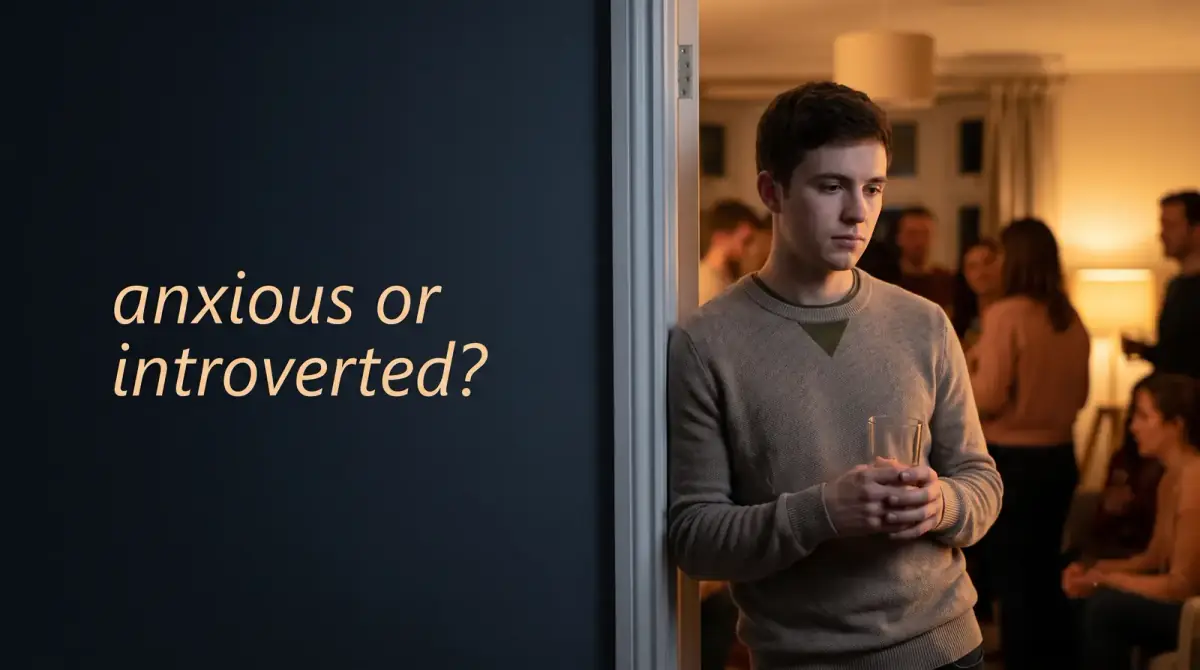
You leave the party at ten. Coat on, thanks said, door closed behind you. In the car, one of two things happens, and which one it is tells you more about social anxiety vs introversion than any quiz will.
Either you feel a pleasant, heavy quiet, like taking off shoes that fit fine but were still shoes. Or the replay starts: the thing you said about someone's dog, the half-second pause before anyone laughed, whether you were standing too close the whole time.
One is a preference about energy. The other is a fear of being judged. They get treated as the same thing constantly, and the mix-up costs people more than it sounds like it should.
Social anxiety vs introversion: the difference in one line
Introversion is about where your energy comes from and goes. Social anxiety is about what you think other people are deciding about you.
An introvert can enjoy an evening completely and still need the next one alone. Nothing went wrong. The battery ran down, the way it does after a long drive.
Social anxiety is not a battery problem. It is a threat problem. The room contains judges, the judging is ongoing, and you are the only one who never got a copy of the scoring rubric.
The drive-home test
Tiredness is a bad signal, because both groups get tired at parties. The useful signal is the ninety minutes afterwards.
Introverted tired is flat and slow and quiet. It wants a shower, a book, a kitchen with nobody in it. It fades with rest, and crucially, it does not come with commentary.
Anxious relief feels different. There is a real spike of thank-god-that-is-over, and then the evening starts up again inside your head. Sometimes at two in the morning, sometimes three days later.
If your social hangover comes with a script, it is probably not just introversion.
A side-by-side comparison, honestly
- The core question. Introversion asks how much of this I have in me. Social anxiety asks how badly this is going.
- Beforehand. Introverts feel mild reluctance, mostly logistical: it is far, it is late, I was enjoying my evening. Anxiety is dread that starts hours or days early, sometimes with a stomach that arrives before you do.
- During. An introvert is often quiet because they have nothing they particularly want to say yet. An anxious person is quiet because saying something means being evaluated for it.
- Who you are with. Introverts get drained by their two closest friends too, just more slowly. Social anxiety eases a lot with safe people and spikes around strangers, authority figures, or anyone whose opinion feels like it counts.
- Afterwards. Introversion wants recovery. Social anxiety wants reassurance, and then quietly doubts the reassurance it gets.
- The cost. Introversion shapes your calendar. Social anxiety shapes your life: the job not applied for, the question not asked, the friendship that stayed at acquaintance because you never suggested coffee.
Can you be both?
Yes, and plenty of people are. Introversion is a trait, roughly stable and mostly neutral. Social anxiety is a distress that can sit on top of any temperament at all.
Being both is confusing, because the two produce identical behaviour from opposite motives. You skip the leaving drinks. Was that preference or escape? The behaviour will not tell you.
The anxious extrovert
This is the combination nobody warns you about. You want the connection. You are genuinely energised by people, you like a crowded kitchen, you are the one who suggests the group holiday. And you dread the evaluation the entire time.
Anxious extroverts are often first to arrive and last to stop replaying it. Because they are visibly sociable, nobody believes them, sometimes including themselves.
Why "I'm just introverted" can quietly keep you stuck
Introversion has become a good identity. Well liked, well memed, reasonably respected, which is progress. It also makes an excellent hiding place.
If you file every avoided thing under temperament, you never have to look at it. The label does not just describe the pattern, it closes the case on it. And a closed case never gets reopened.
Here is the tell I would trust. Ask whether declining felt like choosing or like escaping. Choosing feels mildly pleasant and then boring. Escaping comes with a flood of relief far too big for a cancelled coffee.
The avoidance loop, and why it makes the fear stronger
That flood of relief is the whole problem. It feels like recovery. It functions like training.
Every time you avoid the thing and feel instantly better, your brain files a tidy little lesson: the danger was real, and dodging it worked. The fear never gets a chance to be wrong. So it grows, and the range of situations it covers grows with it, which is why social anxiety tends to shrink a life gradually rather than all at once.
Safety behaviours do the same job in disguise. Rehearsing your sentences, gripping a glass, volunteering to take the photos, doing all the asking so nobody asks you anything. They get you through. But afterwards you credit the crutch instead of yourself, so the belief underneath survives untouched.
What each one actually needs
Introversion needs design, not repair
Stop trying to fix it. Build around it. Put recovery time in the calendar before the event rather than treating it as something you earn afterwards, and protect it like a meeting.
Trade breadth for depth: one long conversation in the corner beats forty minutes of circulating. Arrive early, when the room is small and conversations are still forming. Leave when you are done, without the apology tour.
Social anxiety needs graded exposure and self-compassion
The way out of the loop is back through it, in doses small enough to survive and repeated often enough to count. Build a ladder: ask a shopkeeper a question, speak once in a meeting in the first ten minutes, send the message you have been drafting since Tuesday.
Do the rungs on purpose, more than once, and drop one safety behaviour each time. Aim your attention outward at the actual person in front of you rather than inward at your own performance. It feels wrong. It works better.
Self-compassion is not decoration here. Harsh self-talk is the fuel the loop runs on, and people who can be ordinary-kind to themselves after an awkward moment tend to recover faster and go back sooner.
One honest note: if this is persistently limiting your work, your relationships, or where you are willing to go, social anxiety is one of the more treatable things in mental health. Talking to a doctor or a therapist is a sensible next step, not a dramatic one.
What to try this week
- Run the drive-home test once. After your next social thing, notice whether you feel drained or interrogated. The first ten minutes tell you most of it.
- Pick one rung, not the ladder. Something you could do twice this week without needing a pep talk. Small and repeated beats big and once.
- Drop a single safety behaviour. Do not rehearse the opening line. Put the glass down. Let a silence sit two seconds longer than is comfortable.
- Change what counts as success. Score yourself on whether you did the thing, never on how smoothly it went. Smoothness was never under your control.
- Write the replay down once, then stop. Getting it onto paper tends to defuse it. The tenth mental rerun is not analysis, it is anxiety wearing a lab coat.
Why telling them apart is worth the trouble
Because the two need opposite things. Introversion needs accommodating, and pushing against it just leaves you tired and faintly resentful. Social anxiety needs contradicting, gently and repeatedly, and accommodating it makes it bigger.
Get that backwards and you can spend years applying the wrong medicine with total sincerity.
Introversion is a shape you can build a good life around. Social anxiety is a fence, and fences can be moved.
So next time you are in the car at ten past ten, notice which one you are feeling. Quiet is fine. Quiet is allowed. It is the replay that deserves your attention, and the replay is the part that can change.

Comments
0 total