
The short answer
You think everyone noticed the stain, the stumble, the late entrance. They did not. Here is why your brain insists otherwise, and how to turn it down.
- You do not go to the gym, because you picture a room of people evaluating your form, rather than a room of people counting their own reps and checking their own phones.
- You do not ask the question in the meeting, the one at least four other people also had, because asking would confirm publicly that you did not already know.
- You do not dance, at a wedding, at 11pm, surrounded by people who will not remember a single thing about how anyone moved.
- You do not wear the thing. The jacket stays on the hanger. The bright colour stays in the shop.
- You do not go alone. No solo coffee, no solo cinema, no solo table at the good restaurant, because eating alone feels like a statement to a jury that does not exist.
You spill coffee on your shirt at 9:40 in the morning. Nothing dramatic, just a brown comma sitting right over your ribs. For the rest of the day you angle your torso away from people in the hallway, hold a notebook against your chest, and decide not to stand up during the team meeting. That night someone asks how work was and you say, "fine, apart from the shirt situation." They say: what shirt situation? Congratulations, you have just spent nine hours inside the spotlight effect.
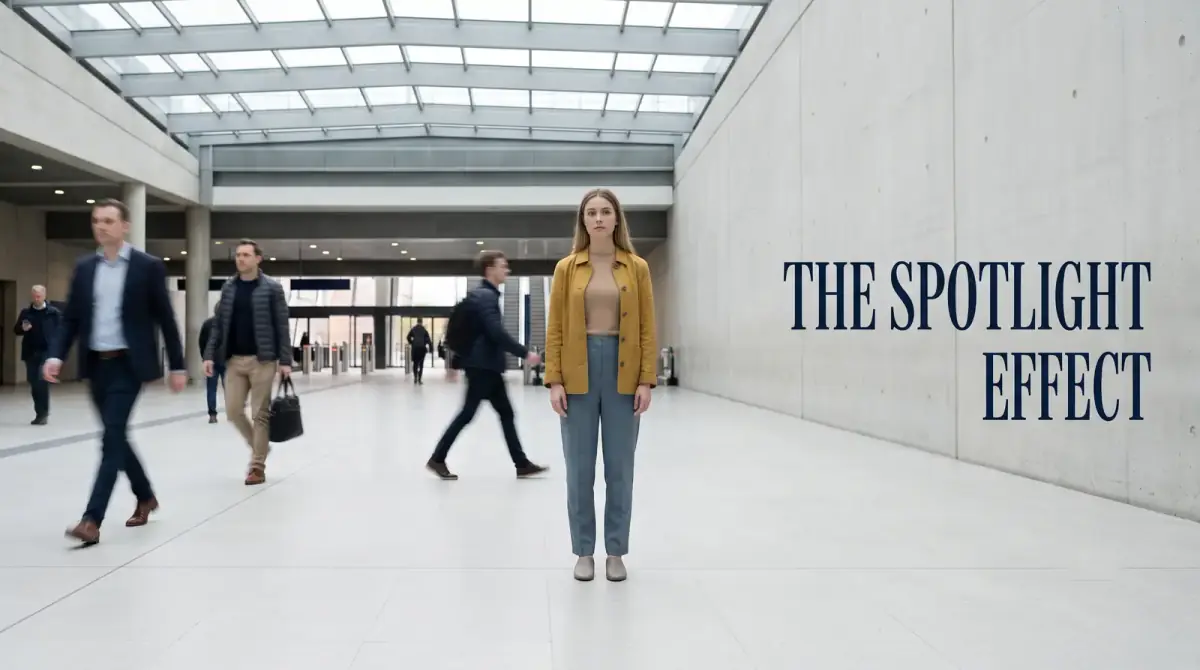
That gap, between the audience you imagine and the audience you actually have, has a name and a long history in social psychology. The spotlight effect is our tendency to wildly overestimate how much other people notice, evaluate, and remember about us. The short answer, before any explanation: people are registering a fraction of what you think they are registering, and holding on to a smaller fraction of that.
This is not a pep talk. It is closer to an accounting correction.
What the spotlight effect actually is
The spotlight effect is a well-documented bias in social psychology, and the name is doing the work for you. You feel lit. You feel like the room has a soft circle of light following you around, and every stumble happens inside that circle where everyone can see it.
In reality, everyone else has their own light, pointed at themselves. The stain you tracked all day was, at most, a half-second flicker in someone else's peripheral vision, filed under nothing and never retrieved again.
It shows up in small, embarrassing specifics: the word you stumbled over in your presentation, the fact that you walked into the party twenty minutes late, the haircut you think looks insane, the joke that landed at 70 percent. Each one feels broadcast. Each one is basically a private event with witnesses who were not paying attention.
Why does your brain do this?
Because you cannot subtract yourself from the scene. You are the main character of your own experience, permanently, with no option to log out. Everything that happens to you arrives with full sound, full internal commentary, and a memory attached.
So when you try to guess what other people saw, you start from your own vivid version and then adjust downward. And research on this kind of estimating suggests we do not adjust nearly enough. We start too high and stop early.
There is a second reason, less flattering and more useful to know. Social attention is not evenly distributed, and on some level we would like it to be. The spotlight effect quietly assumes we are important enough to be watched closely. It is anxiety, but it borrows the architecture of vanity.
The illusion of transparency: do people see your nerves?
There is a close cousin of this bias worth naming separately: the illusion of transparency, the belief that your inner state is visible on the outside.
You are five minutes from speaking and your heart is doing something violent. Your hands feel unsteady. Your mouth is dry in a way that feels audible. You are certain the front row can see all of it. They cannot. A racing heart is a private event. Slightly shaky hands read as almost nothing from three metres away.
This one is worth internalising because it is self-feeding. You think your nerves are showing, so you get more nervous about the nerves showing, so there is more to hide. Knowing that the transmission is far weaker than it feels actually cuts the loop. The panic stays inside your body, where it started.
Why one awkward moment plays on loop for three days
You sent a text at 1am. It was one sentence too long, or one degree too warm, or it had a full stop where a full stop felt cold. You have now read it back eleven times, and each time it means something slightly different.
This is the spotlight effect turning into rumination. Because you believe the moment was highly visible, it feels like an unresolved public problem, and your brain keeps it in the open-tabs pile. Psychologists often call this post-event processing, and it has a nasty property: the replaying itself makes the memory feel more significant. You mistake how often you have thought about it for how much it mattered.
Meanwhile the recipient read it once, in bed, and typed "haha ok" without a single thought about the punctuation.
The decisions the spotlight effect quietly makes for you
The embarrassment is annoying. The real cost is the choices you never noticed yourself making.
- You do not go to the gym, because you picture a room of people evaluating your form, rather than a room of people counting their own reps and checking their own phones.
- You do not ask the question in the meeting, the one at least four other people also had, because asking would confirm publicly that you did not already know.
- You do not dance, at a wedding, at 11pm, surrounded by people who will not remember a single thing about how anyone moved.
- You do not wear the thing. The jacket stays on the hanger. The bright colour stays in the shop.
- You do not go alone. No solo coffee, no solo cinema, no solo table at the good restaurant, because eating alone feels like a statement to a jury that does not exist.
Look at that list honestly and it is not a list of embarrassing moments avoided. It is a list of experiences declined, on behalf of an audience that never showed up.
How do you shrink the spotlight?
You cannot delete this bias. You are stuck inside your own head for the duration. But you can shrink the circle, and the methods are unglamorous and effective.
- Run the reversal. Think of a stranger you saw yesterday. What were they wearing? Did they stumble over anything? You have no idea. That is the exact quality of attention you are receiving.
- Give it the two-week test. Ask whether anyone in the room will recall this on a random Tuesday two weeks from now. Almost nothing passes. Act accordingly.
- Name the number. When you are convinced everyone noticed, guess how many people actually did, out loud. The honest answer is usually one, or zero, and saying it deflates the whole thing.
- Do the small, exposing thing on purpose. Ask the obvious question. Wear the colour. Arrive late and walk in normally instead of sliding along the wall. Each time nothing happens, your model of the world updates a little.
- Cap the replay. When a moment starts looping, give it a hard limit. Two minutes of thinking, then it goes in the drawer. Rumination is a habit before it is an insight.
One reframe that does most of the work
Assume everyone in the room is running the same software you are. They are also scanning for their own stain, their own stumble, their own text at 1am. The room is not an audience. It is a group of people each convinced they are being watched by the others.
The freedom hiding inside the bad news
There is something faintly humbling about learning that nobody was really looking. We would all like to be more memorable than we are. But the trade is a good one, because the same fact that deflates your ego releases your life.
If nobody is keeping score, you can walk into the party late. You can be bad at the sport, sing at the wrong pitch, ask the beginner question at the age of forty. The spotlight was never a spotlight. It was a mirror the whole time, and you can put it down whenever you want.



Comments
0 total