

The short answer
Intuition is not magic. It is compressed experience firing faster than your explanations, and knowing when it has earned your trust changes everything.
- The environment has to be regular enough to have patterns. Illness has patterns. Chess has patterns. Next quarter's stock market largely does not, which is why no amount of staring at charts builds a reliable feel for it.
- You need thousands of repetitions, not a handful of memorable ones. Ten dramatic experiences build a story. A thousand ordinary ones build a model.
- You need feedback that arrives fast enough to correct you. The nurse finds out within a day whether she was right. A recruiter who rejects a candidate never learns what that person would have become, so the hunch never gets graded, and an ungraded hunch never improves.
A nurse walks past a room she has already passed forty times that shift. The patient is chatting. His vitals are unremarkable. She says to a colleague, "I don't like how he looks," and cannot tell anyone why. Six hours later he is in intensive care, and everyone calls it a sixth sense. The science of gut feelings says otherwise.
It says the whole thing is far less mystical than that, and far more useful. Intuition is not a signal from the universe. It is memory doing arithmetic so fast you never see the working.
Which means the real question is never "should I trust my gut?" The question is whether your gut has ever had the chance to learn anything about this particular situation.
What a gut feeling actually is
Your brain is a prediction machine that resents spending energy on problems it has already solved. Every situation you live through gets filed away along with how it turned out. Repeat that a few thousand times and the pattern gets compressed into something that no longer requires conscious unpacking.
So when a new scene matches an old one, the match fires before the explanation does. You get the verdict without the evidence. That gap, conclusion arriving ahead of reasoning, is the entire sensation people call intuition.
The nurse has watched hundreds of patients decline. Somewhere in there her brain built a composite of what the hours before a crash look like: a particular greyness, a certain flatness in the way someone answers a question. She never wrote that list down. She doesn't need to. Her nervous system runs the comparison and hands her a feeling instead of a paragraph.
Why does intuition feel physical?
Because your body gets the memo first. The systems that handle threat, arousal and preparation do not wait for your deliberate mind to finish its analysis. Heart rate shifts, breathing changes, the stomach tightens.
Your brain then reads those bodily signals as information, a process psychologists usually describe as interoception. The feeling is not a metaphor. There genuinely is something happening in your gut, your chest, the back of your neck, and you are perceiving it.
This is also why intuition is so persuasive. An argument can be countered. A cold, dropping sensation in your stomach feels like fact, because it is arriving as sensation rather than as opinion.
When has your gut actually earned its authority?
Here is the part most inspirational advice skips. Intuition is a skill, and skills need training conditions. Research on expert judgement generally points to three requirements before a hunch deserves any weight:
- The environment has to be regular enough to have patterns. Illness has patterns. Chess has patterns. Next quarter's stock market largely does not, which is why no amount of staring at charts builds a reliable feel for it.
- You need thousands of repetitions, not a handful of memorable ones. Ten dramatic experiences build a story. A thousand ordinary ones build a model.
- You need feedback that arrives fast enough to correct you. The nurse finds out within a day whether she was right. A recruiter who rejects a candidate never learns what that person would have become, so the hunch never gets graded, and an ungraded hunch never improves.
Apply those three filters and something uncomfortable becomes clear. You probably have genuine expert intuition in two or three narrow areas of your life, and essentially none in the rest.
When it is just bias wearing a costume
The trouble is that a hunch about something you have no track record in feels exactly the same from the inside as a hunch about your own craft. Same certainty. Same physical hit. Different origin entirely.
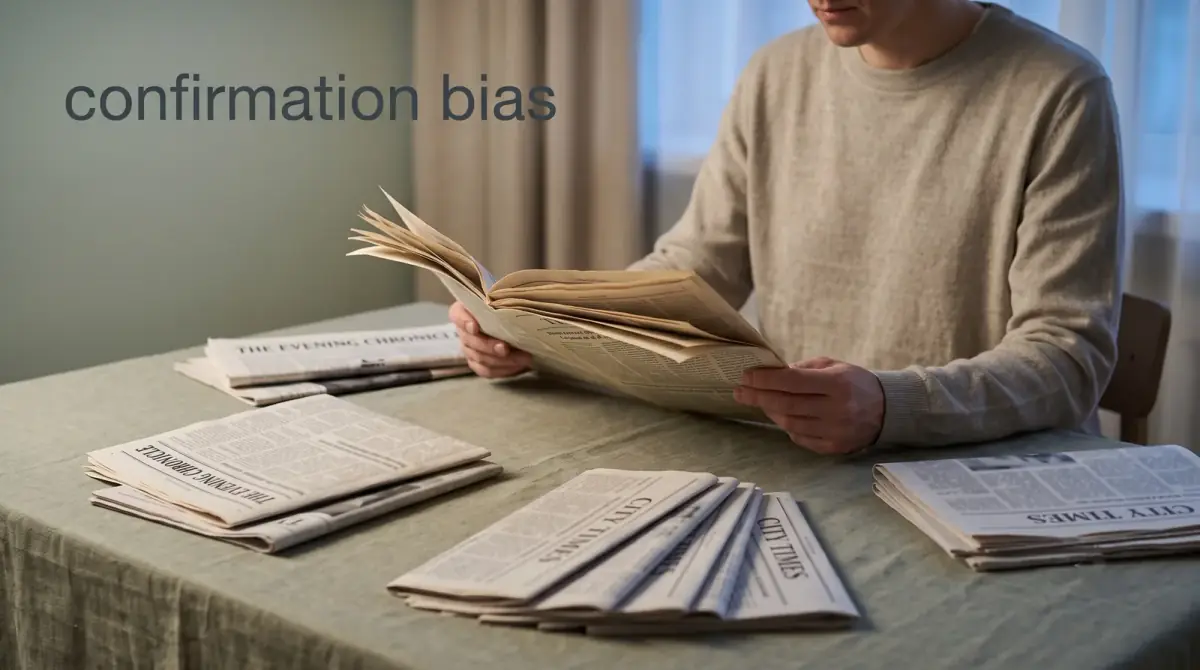
Think of the hiring manager who reads a strong resume, meets the person, and reports that "something's off." Sometimes that is twenty years of reading people. Often it is that the candidate reminded him of a colleague he disliked in 2011, or spoke with an accent his brain filed as unfamiliar, or simply did not match the mental template of what a person in that role looks like.
Familiarity is the loudest of these impostors. Your brain rewards recognition with a small hit of ease and comfort, and you experience that ease as rightness rather than as mere familiarity. This is how a business decision that pattern-matches to one past failure can poison an entire category of good opportunities for a decade.
How fear impersonates intuition
The other great counterfeit is anxiety, which is skilled at putting on intuition's clothes and speaking in its voice. There are reliable tells if you know where to look.
Intuition is quiet and specific
Real intuition tends to be a single clean observation about the present moment. This person. This room. Right now. It says its piece once and does not need to keep arguing with you.
Fear is loud and narrates the future
Anxiety comes with a script. It escalates, generates scenarios, and repeats itself at two in the morning. It is rarely about what is in front of you and almost always about what might happen in eight months.
A rough rule: if the feeling grows louder the more you sit with it, that is fear. If it stays steady and simply refuses to disappear, pay attention.
The dark street and the house you love
Two situations, two very different levels of trust.
Walking home at night, some part of you clocks the footsteps that adjusted their pace when you adjusted yours. Cross the road. You do not owe that feeling a cost-benefit analysis, because the downside of being wrong is a mildly awkward detour and the downside of overriding it is not.
Now the house you "just love." You have bought perhaps one home in your life. Zero repetitions, zero feedback, enormous stakes, and a feeling manufactured by morning light on a kitchen counter and a seller who baked something. Strong feeling, untrained gut. That is exactly when you slow down and check the survey.
Putting the science of gut feelings to work
You do not have to choose between blind instinct and endless spreadsheets. Run your hunch through a short interrogation instead.
- Ask what the feeling is made of. Try to name one concrete thing you noticed. If something surfaces, that is compressed observation. If nothing does after real effort, treat it as a mood.
- Count your reps. Have you faced this class of situation hundreds of times with honest feedback, or is this a first?
- Check the direction. Does the gut feeling conveniently recommend avoiding discomfort? Fear almost always votes for the exit.
- Ask who it reminds you of. If you can identify the ghost the person or deal resembles, you have found a bias, not a signal.
- Weigh the cost of being wrong. Cheap to obey and expensive to ignore, follow it. Expensive either way, use the hunch as a prompt to investigate, never as the verdict.
That last one carries most of the weight. Intuition is superb at telling you where to look and unreliable at telling you what you will find.
Your gut is a colleague, not an oracle
Treat it that way and it becomes genuinely valuable: a fast, experienced, occasionally paranoid colleague who is excellent in their own department and overconfident everywhere else. You listen. You ask what they saw. Then you decide.
The people who get burned are the ones at either extreme, the ones who obey every flutter and the ones who have trained themselves to feel nothing at all. The skill is not trusting your gut. The skill is knowing which of your guts has done the reading.


Comments
0 total