
The short answer
How cognitive biases affect decision making touches your money, health, and relationships. Here are the mental shortcuts behind smart people's predictable mistakes.
- Biases are mental shortcuts. Your brain trades accuracy for speed, which usually helps but sometimes hurts.
- They are predictable. The same biases trip up almost everyone in similar situations.
- They touch everything. Money, health, and relationships are all shaped by hidden shortcuts.
- Awareness helps. Naming a bias is the first step to reducing its pull.
Here is the heart of how cognitive biases affect decision making: your brain relies on mental shortcuts to save time and energy, and those shortcuts sometimes steer you wrong in predictable ways. That is why intelligent, careful people still make choices that look irrational in hindsight. The bias is not a sign of a weak mind. It is a feature of every human mind.
The good news is that once you can name these patterns, you can catch them more often and make cleaner decisions about money, health, and the people around you.
Quick answer: the key takeaways
- Biases are mental shortcuts. Your brain trades accuracy for speed, which usually helps but sometimes hurts.
- They are predictable. The same biases trip up almost everyone in similar situations.
- They touch everything. Money, health, and relationships are all shaped by hidden shortcuts.
- Awareness helps. Naming a bias is the first step to reducing its pull.
What is a cognitive bias?
A cognitive bias is a consistent error in how we think, judge, or remember. Your brain faces far more information than it can fully process, so it takes shortcuts, sometimes called mental rules of thumb.
Most of the time these shortcuts serve you well. They let you decide quickly without weighing every detail. The problem is that the same shortcuts misfire in certain situations, nudging you toward a choice that feels right but is not.
Why your brain takes shortcuts
Understanding how cognitive bias affects decisions starts with why the shortcuts exist. Careful, step-by-step thinking is slow and tiring. Fast, automatic thinking is efficient and usually good enough.
So your mind leans on the fast system by default and only switches to slow, effortful thinking when it has to. Biases tend to sneak in during that fast mode, especially when you are rushed, tired, stressed, or overloaded with information.
How confirmation bias affects decision making
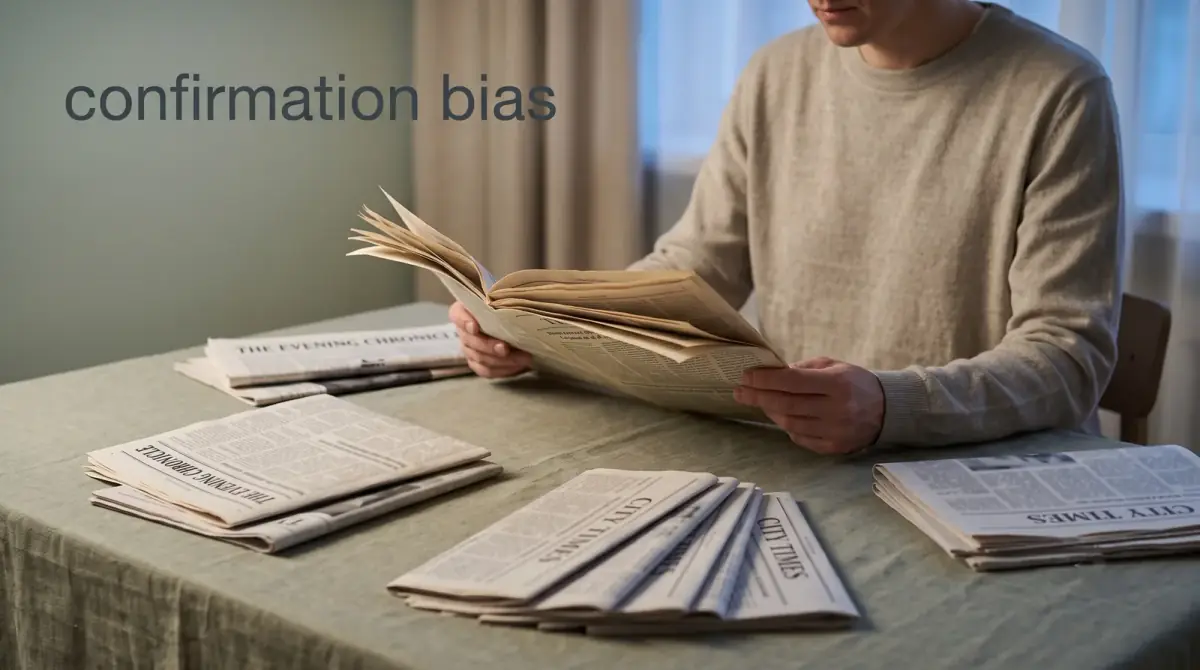
One of the most powerful examples is confirmation bias, so it is worth seeing exactly how confirmation bias affects decision making. Confirmation bias is your tendency to notice, favor, and remember information that fits what you already believe, while brushing off what does not.
It quietly warps decisions in everyday ways:
- Research that only confirms. You search for reviews that praise the choice you already lean toward.
- Selective memory. You recall the times your hunch was right and forget the times it was wrong.
- Echo chambers. You follow voices that agree with you and tune out the rest.
The result is false confidence. You feel well informed, but you have mostly gathered evidence for a conclusion you already reached. The fix is uncomfortable but simple: deliberately look for the strongest case against what you believe.
Other biases that steer your choices
Confirmation bias has plenty of company. A handful of others show up constantly.
Anchoring
The first number you see sets a mental anchor. A slashed price looks like a deal partly because the original price anchored your sense of value, whether or not it was ever fair.
Availability
You judge how likely something is by how easily examples come to mind. A dramatic story in the news can make a rare event feel far more common than it is.
Loss aversion
Losses tend to hurt more than equal gains feel good. This can make you cling to something failing, simply because letting go feels like a loss.
Present bias
Rewards you can have now feel much larger than rewards later. This is why saving, exercising, and other long-game choices are so hard to stick with.
Overconfidence
Most of us rate our own judgment as better than average, which cannot be true for everyone. Overconfidence makes you underestimate risks and skip the extra check that would have caught a mistake.
How cognitive biases affect decision making in real life
These patterns are not just lab curiosities. To see how cognitive biases affect decision making day to day, look at three areas where they shape choices that really matter.
Money
Anchoring makes you overpay when a high starting price frames the discount. Loss aversion makes you hold a losing investment too long. Present bias makes you spend today instead of saving for later.
Health
Availability can make a scary but rare risk feel urgent while a common, boring risk goes ignored. Confirmation bias can lead you to trust only the sources that echo what you already hoped was true about a habit or remedy.
Relationships
Confirmation bias makes you collect evidence that supports a first impression, good or bad. The sunk cost trap, a cousin of loss aversion, can keep you invested in a relationship long past the point it works, because leaving feels like wasting the time already spent.
How to reduce the pull of bias
You cannot delete biases, but you can blunt them. A few habits genuinely help:
- Slow down on big decisions. Biases thrive on speed, so give important choices real time.
- Argue the other side. Force yourself to build the strongest case against your first instinct.
- Seek outside views. Ask people who disagree with you, not just those who nod along.
- Use simple rules. Checklists and preset limits reduce in-the-moment temptation.
- Sleep on it. Distance often reveals a bias you could not see in the moment.
You cannot outsmart your biases by being smarter. You beat them with better habits and a little humility.
The bigger picture
Cognitive biases are part of being human, not a personal flaw. They helped our ancestors decide fast in a risky world, and they still help you move through a busy day without overthinking everything.
The goal is not to eliminate them, which is impossible, but to notice when the stakes are high enough to slow down and check your thinking. That awareness is where better decisions begin.
So, how cognitive biases affect decision making comes down to speed versus accuracy. Your brain chooses fast, and fast is usually fine, until it quietly steers you wrong. Learn the common patterns, watch for them when it matters, and build a few simple habits to counter them. You will still be human, but you will make sharper choices with your eyes open.
Comments
0 total