

The short answer
From anchoring to hindsight, cognitive bias examples shape your choices every day. See the most common thinking traps in plain English and how to spot them.
- Biases are systematic shortcuts, so they show up in patterns you can learn.
- Anchoring, availability, and confirmation bias affect us almost daily.
- These traps feel like plain common sense from the inside.
- Spotting a bias by name is the first step to slowing it down.
- Everyone falls for these, no matter how smart they are.
Cognitive bias examples are everywhere in daily life, from the way a first price shapes what you will pay to the way a scary headline feels more likely than it really is. These are not signs of weak thinking. They are the predictable shortcuts every human brain makes. Below are some of the most common ones, in plain language, with everyday cognitive bias examples you will probably recognize.
You will not 'cure' these by reading about them. But naming them makes them far easier to spot in the moment.
Key takeaways
- Biases are systematic shortcuts, so they show up in patterns you can learn.
- Anchoring, availability, and confirmation bias affect us almost daily.
- These traps feel like plain common sense from the inside.
- Spotting a bias by name is the first step to slowing it down.
- Everyone falls for these, no matter how smart they are.
What these examples have in common
The basic cognitive bias meaning is a consistent lean in how you think, a shortcut your brain takes to save time. Each example below is one of those shortcuts, tuned for speed but wrong in the wrong setting.
Keep that in mind as you read. None of these require a decision to switch on. They happen quietly, on their own.
Because they are patterns, you can study them like anything else. Once a bias has a name and a familiar example, your mind starts flagging it far more readily in real life.
Everyday cognitive bias examples
Here are several well-documented biases you likely met this week without noticing.
Anchoring bias
The first number you see becomes a mental 'anchor' that drags your judgment toward it. A jacket marked down from a high original price feels like a bargain, even if the sale price on its own is nothing special.
You see it in salary talks, restaurant menus, and any 'was X, now Y' tag. The opening figure shapes everything that follows.
Availability bias
You judge how likely something is by how easily an example comes to mind. After seeing news about a rare disaster, it suddenly feels common, because a vivid case is fresh and easy to recall.
Dramatic, recent, or emotional events loom large. Quiet, everyday risks fade, even when they matter more.
Confirmation bias
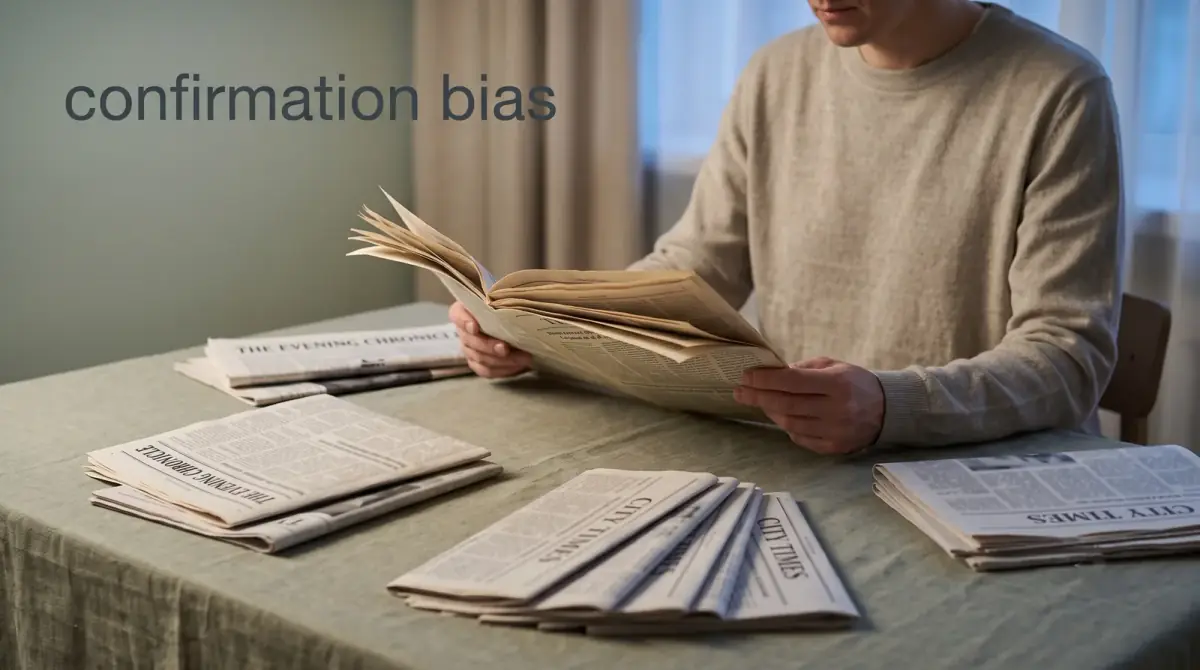
You notice and trust information that fits what you already believe, and quietly skip what does not. Once you decide a new phone is great, you focus on the glowing reviews and wave away the critical ones.
This one is powerful because it feels like being right. You are simply 'seeing the evidence', while filtering it without realizing.
Hindsight bias
After something happens, you feel you 'knew it all along', even if you had no idea beforehand. Once a game ends, the result seems obvious, and yesterday's genuine uncertainty vanishes from memory.
It quietly rewrites the past as more predictable than it was, which can make you overconfident about the future.
Sunk cost fallacy
You keep going with something because of what you have already spent, not because it is still worth it. You sit through a dull film to the end 'because you paid for the ticket', even though leaving would cost you nothing more.
The money or time is already gone. But it tugs at future choices anyway.
Bandwagon effect
You lean toward a belief or a purchase partly because many others already have. A packed restaurant feels safer to choose, and a popular opinion feels more correct, simply because it is popular.
Negativity bias
Bad news tends to stick harder than good news. One sharp criticism can outweigh ten compliments in your memory, and a single bad experience can colour how you feel about a whole place or person.
Your brain treats threats as more urgent than rewards, which once helped keep people safe. Today it can leave you dwelling on the one thing that went wrong.
Optimism bias
You tend to assume bad outcomes are more likely to land on other people than on you. Many of us quietly underestimate the odds of an accident, an illness, or a project running late, simply because it is our own plan.
A little optimism keeps you moving. Too much can leave you underprepared for perfectly ordinary setbacks.
What is the most common cognitive bias?
People often ask which is the single most common cognitive bias, hoping for one clear winner. There is no official ranking, so any list of the top cognitive biases is a rough guide rather than a scoreboard.
That said, confirmation bias is one many experts point to as especially widespread, because it touches almost everything you read, watch, and discuss. It quietly shapes what you accept as true all day long.
The honest answer is that these biases overlap and feed each other, so ranking them precisely is less useful than learning to notice them.
Whichever bias you catch yourself falling for most, the fix is similar. Notice it, name it, and give yourself a beat before you act on the feeling.
Why these thinking traps matter
On their own, any single slip is minor. Stacked up over months, they steer real decisions.
- Anchoring can nudge how much you pay for big purchases.
- Availability can make you fear the wrong things.
- Confirmation can trap you in an echo of your own views.
- Sunk cost can keep you stuck in a job, project, or plan long past its use.
The point is not to feel bad. It is to see that 'just trusting your gut' is not neutral. Your gut runs on these shortcuts.
They also compound. One bias often sets up the next, as when availability makes a risk feel huge and confirmation then gathers every story that agrees. Untangling them starts with seeing each one on its own.
How to catch yourself
You cannot delete these patterns, but you can build small habits that slow them down.
- When a deal feels amazing, ask what number anchored you.
- When a fear feels huge, ask if it is just easy to picture.
- Before deciding, go looking for the case against your view.
- When quitting feels hard, ask what you would choose starting fresh today.
Do not aim to catch every bias, every time. That is impossible and exhausting. Pick the decisions that really matter, and give those your slower, more careful attention.
Work through enough real cognitive bias examples like these and something shifts. You start to feel the tug of a shortcut as it happens, which is the moment you get a little more room to choose.
Comments
0 total