
The short answer
Confirmation bias happens because your brain loves comfort over accuracy. Here is the mechanism behind it, why it is so costly, and how it differs from bias in general.
- Confirmation bias is your brain favoring evidence that fits your current beliefs.
- It happens to save effort and to shield you from the sting of being wrong.
- It is one type of cognitive bias, not the whole category.
- It can quietly steer decisions about money, health, and relationships.
- Simple habits can weaken it, even if they cannot erase it.
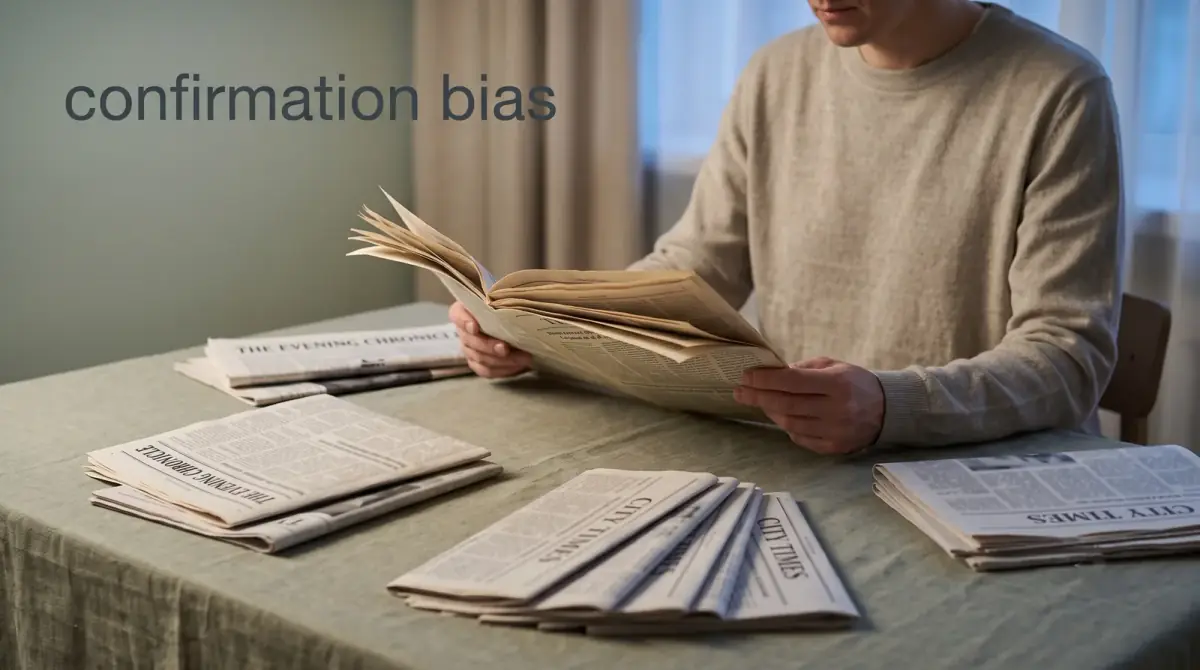
Confirmation bias happens because your brain prefers ideas that are easy and comfortable over ideas that are simply accurate. The honest answer to why confirmation bias happens is that comfort usually beats accuracy. When new information matches what you already believe, you accept it quickly. When it clashes, you question it, argue with it, or forget it. That quiet double standard is why confirmation bias fools almost everyone, no matter how smart they are.
Understanding why confirmation bias happens is the first step to catching it in the act. Once you see the mechanism, it is hard to unsee.
Key takeaways:
- Confirmation bias is your brain favoring evidence that fits your current beliefs.
- It happens to save effort and to shield you from the sting of being wrong.
- It is one type of cognitive bias, not the whole category.
- It can quietly steer decisions about money, health, and relationships.
- Simple habits can weaken it, even if they cannot erase it.
Why confirmation bias happens in the first place
Your brain is a prediction machine that hates wasting energy. Rethinking a settled belief costs effort, so your mind takes the cheaper route and looks for reasons you were right.
There is an emotional side too. Being wrong can feel like a small threat to your identity, especially on topics you care about. Accepting evidence that fits protects both your energy and your ego at the same time.
So confirmation bias is not a sign of low intelligence. In fact, sharper thinkers can be better at inventing clever reasons to keep believing what they already believed. The skill that helps you win an argument can also help you fool yourself.
Is cognitive bias the same as confirmation bias?
Not quite, and this is a common mix-up worth clearing up. A cognitive bias is any mental shortcut that can distort your thinking. Confirmation bias is one specific example within that larger family.
Think of it like fruit and apples. All apples are fruit, but not all fruit is apples. Confirmation bias is one well-known example among many biases your brain can fall into.
It gets extra attention because it is so widespread and because it feeds so many other errors. When you already want to believe something, the rest of your thinking tends to fall in line behind that wish.
How your brain seeks confirming evidence
Confirmation bias works in three quiet steps, and you rarely notice any of them.
First, you search selectively. You type questions into a search bar that already hint at the answer you want. You ask the friends who tend to agree with you.
Second, you interpret selectively. The same fuzzy fact looks like strong proof when it supports you and a weak fluke when it does not.
Third, you remember selectively. The hits stick in your memory while the misses slip away, so looking back only strengthens your original view.
Put the three together and you have a loop that feeds itself. Each pass leaves you a little more certain, even when no real new evidence has arrived.
The result is a belief that feels battle-tested, when in truth it was never really challenged. You did not lie to yourself. You just never gave the other side a fair hearing.
A quick example of confirmation bias in action
Picture two friends who read the same news story about a new diet. One already believes the diet works. The other is sure it is just a fad.
They read identical words, yet each walks away more certain of what they thought before. The believer highlights the success stories. The skeptic zeroes in on the fine print and the missing proof.
Neither one is lying, and neither feels biased. Each simply gave more weight to the parts that fit their view. That is confirmation bias in a nutshell: the same facts, filtered two different ways, hardening two opposite opinions.
Why confirmation bias is bad for your decisions
Left unchecked, this bias can be costly. Understanding why confirmation bias is bad helps you take it seriously instead of shrugging it off.
- It can keep you in a losing plan because you only track the good signs.
- It can harden a first impression of a person into a permanent verdict.
- It can make you overconfident, since your evidence always seems to agree.
- It can deepen conflict, because both sides feel the facts are clearly on their side.
The danger grows with the stakes. On big choices about health, money, or work, a one-sided view can lead you somewhere you would not have gone with the full picture in front of you.
Over months and years, these small slants can quietly steer a whole life, from the career you chase to the people you choose to trust.
Where confirmation bias shows up most
Some settings make the bias stronger. Emotional topics are the biggest trigger, because you have more to defend.
Social media pours fuel on it. Feeds learn what you click and serve up more of the same, so it can start to feel like the whole world agrees with you. That comfortable echo is easy to mistake for truth.
Groups amplify it as well. When a team already leans one way, doubts feel awkward to raise, and agreeable voices grow louder than careful ones. Over time the group can drift far from reality without noticing.
How to think around confirmation bias
You cannot switch the bias off, but you can build habits that keep it honest.
- Deliberately seek the best case against your view, not a cartoon version of it.
- Before deciding, ask "what evidence would prove me wrong here?"
- Give ideas you dislike the same patient attention you give ideas you like.
- Talk with people who think differently, and listen to understand, not to win.
- Sleep on important calls so the first comfortable answer is not the last word.
None of this is about doubting everything. It is about staying open long enough to see the parts your brain wanted to skip.
Start small. Pick one belief you hold strongly and spend ten honest minutes reading the other side. The goal is not to flip your view, but to see it more clearly.
The bottom line
Confirmation bias happens because your brain trades a little accuracy for a lot of comfort. It is one type of cognitive bias, not the whole story, and it fools nearly everyone at some point. You will not outgrow it, but you can outsmart it in small, steady ways. Ask what would change your mind, and you take away much of its power.


Comments
0 total