
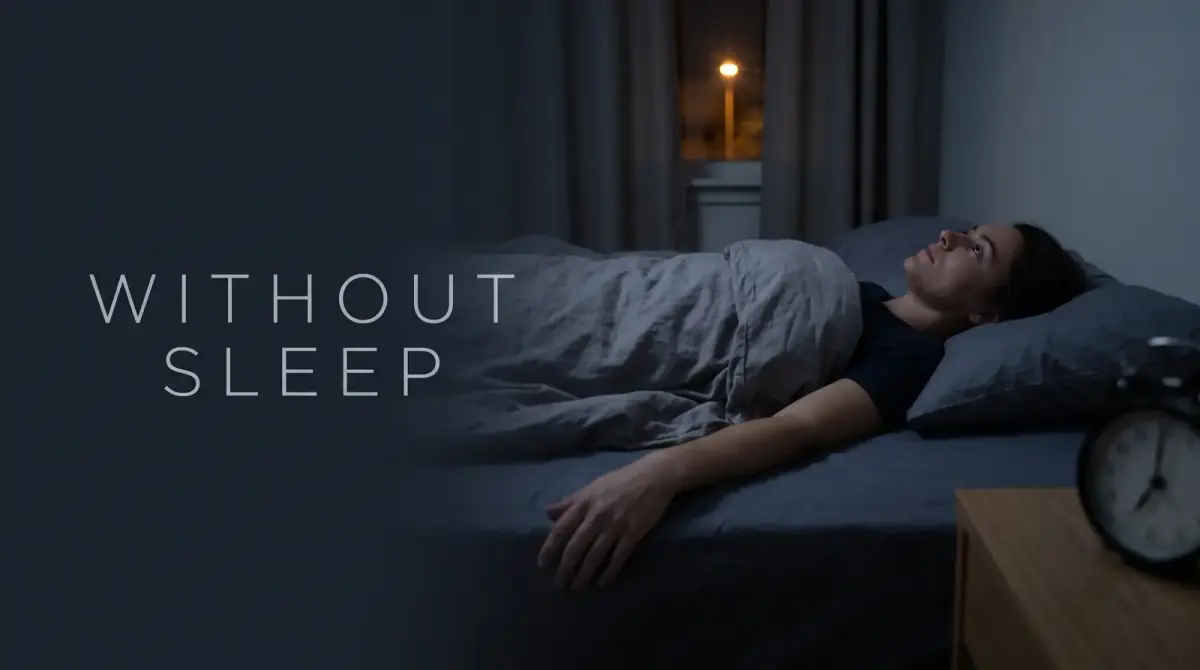
The short answer
Sleep loss arrives in stages, and every one of them comes with a broken gauge. What really happens at 24, 48 and 72 hours awake - and how to recover.
- You cannot remember the last few miles or junctions
- You drift toward the lane markings and correct with a jolt
- Your blinks feel long and heavy
- You keep opening the window and turning up the music
- You have started talking to yourself to stay engaged
Somewhere tonight, a careful, law-abiding driver is going to shut their eyes for three or four seconds without ever deciding to. They will not feel it happen. The car will cover the length of a football pitch with nobody meaningfully in charge of it, and then they will blink back into the world convinced they were awake the whole time. That is what happens to your body without sleep once the brain stops asking permission and simply takes what it is owed.
Sleep loss is not one experience. It arrives in stages, and most of us are fluent in the first stage and almost completely ignorant of the rest.
What happens to your body without sleep for 24 hours?
The first thing to go is not your energy. It is your reaction time. Somewhere between sixteen and twenty-four hours awake, the gap between seeing something and responding to it stretches out, and the stretch is invisible from the inside. You still feel like you. You are simply arriving at every moment slightly late.
Researchers often compare a day without sleep to mild intoxication - not because the mechanisms match, but because the profile does: slower responses, worse judgement of your own impairment, and a stubborn confidence that you are fine. That last part is the dangerous one.
Mood goes next, and it goes sideways rather than down. One leading idea is that the brain's emotional alarm systems become less restrained by the slower regions that normally talk them down. A delayed train becomes a personal insult. A mild joke lands as an attack. Volatility is the word - not sadness, volatility.
Then come the microsleeps, which almost nobody plans for.
Microsleeps: the seconds you will never remember
A microsleep is a brief intrusion of sleep into wakefulness. Your eyes may stay open, your hands may stay on the wheel, but for a second or several the brain has gone offline and stopped processing what is coming in. The cruel part: you get no memory of the gap, so you cannot report it. You experience a continuity that did not exist.
This is why drowsy driving is worse than tired people believe. A drunk driver at least brakes late. A microsleeping driver does not brake at all, because there is nobody home to see the brake lights ahead. Sleep-related crashes tend to happen at speed, on straight roads, with no skid marks.
If you are driving and notice any of these, the situation is further along than it feels:
- You cannot remember the last few miles or junctions
- You drift toward the lane markings and correct with a jolt
- Your blinks feel long and heavy
- You keep opening the window and turning up the music
- You have started talking to yourself to stay engaged
Those last two are not solutions. They are symptoms. The only reliable fix is stopping.
36 to 48 hours: the body starts renegotiating
Past a day and a half, this stops being a brain story and becomes a whole-body story. Studies suggest short-term sleep restriction can nudge markers of inflammation upward and change how the immune system responds - part of why a run of terrible nights so often ends with you catching whatever was going around the office.
Hormones drift too. There is reasonable evidence that even a few bad nights can worsen how the body handles glucose, temporarily pushing healthy people toward less efficient blood sugar control. Stress hormone rhythms flatten and shift. None of this is permanent after one rough stretch, but it makes a point: sleep is not downtime, it is maintenance, and skipping maintenance has mechanical consequences.
Perception frays here as well. Not hallucinations yet - more that the edges of things become untrustworthy. Halos around lights. Peripheral movement that is not there. Words swimming slightly on a screen. The brain starts making small errors assembling reality, and it does not flag them for you.
72 hours and beyond: when the brain fills in the gaps
Here things get genuinely strange, and the honest answer is that the science is thinner than you would hope - keeping people awake this long is not something researchers can do casually.
What is consistently described is a slide into hallucination and disordered thinking. Figures at the edge of vision. Objects mistaken for animals or people. Hearing your name called. Some people develop fixed, paranoid ideas that they defend with complete sincerity, and the ability to hold a plan in mind or follow a conversation collapses.
Crucially, by this point you can no longer assess your own state. The instrument you would use to notice impairment is itself impaired. Extreme sleep deprivation is not a test of willpower; it is closer to a controlled demolition.
Most people never go near this territory. The version that actually damages lives is far quieter.
What months and years of short sleep quietly cost you
Chronic short sleep - six hours a night, five on bad weeks, for years - never feels like an emergency. That is its trick. You adapt, recalibrate your sense of "normal tired", and stop noticing the deficit.
Appetite gets rewritten
Research suggests curtailed sleep shifts the hormones signalling hunger and fullness in the direction of eating more and feeling satisfied less. Add a tired brain's weaker impulse control and more waking hours in which food exists, and weight gain during sleepless periods stops being mysterious.
The heart and metabolism take strain
Blood pressure normally dips at night, and persistently short sleep interferes with that recovery window. Long-running population studies have repeatedly linked habitual short sleep with higher rates of cardiovascular and metabolic problems. Causation is hard to prove cleanly here, and researchers still argue over how much is sleep itself versus everything that travels with a sleepless life - but the association is stubborn across very different populations.
Memory never gets filed
One of the better-supported ideas in sleep science is that sleep is when the day's experiences are consolidated - replayed, sorted, moved into more durable storage. Cut the night short and you are not merely tired tomorrow; part of the filing never happened. Over years, that is a lot of learning experienced but never kept.
Why caffeine masks the debt but never pays it
Caffeine is a brilliant liar. It works largely by blocking the receptors that register a sleep-promoting chemical which builds up across your waking hours. The chemical keeps accumulating. You just stop getting the memo.
So the debt stays intact - everything above is still happening underneath the borrowed alertness - and when the caffeine clears, the whole accumulated signal lands at once. That is the four o'clock wall, and the second coffee that fixes it is borrowing from the same account at a worse rate.
Can you catch up on sleep at the weekend?
Partly. Imperfectly. Not the way you want to hear.
Extra weekend sleep does seem to help with the crude stuff - alertness, mood, reaction time. But other consequences, including certain metabolic effects and the memory consolidation that simply did not happen on the nights it was meant to, do not appear to be fully reversed by a long Sunday lie-in. You cannot retroactively file Tuesday.
The strategy also carries its own cost. Sleeping until midday shifts your body clock later, and by Sunday night you are effectively jet-lagged going into Monday.
How to actually recover from a bad stretch
The instinct is to sleep fourteen hours and declare the matter closed. A better approach:
- Take the first night early, not long. Going to bed earlier protects your body clock; an enormous lie-in wrecks it.
- Get bright light in the morning. Daylight soon after waking is one of the strongest anchors for a drifting schedule.
- Allow several nights, not one. Real recovery takes a few consecutive decent nights, and deep sleep usually rebounds first.
- Cut caffeine early in the day. It lingers far longer than most people assume and will sabotage the nights you are relying on.
- Do not drive until you have had one proper night. Non-negotiable.
- Keep your wake-up time steady. A consistent morning beats almost any bedtime ritual.
If the sleeplessness is not circumstantial - eight hours in bed and still wrecked, or heavy snoring and waking unrefreshed - that is a conversation with a doctor rather than another strategy. This is general information, not medical advice, and persistent sleep problems have causes no amount of sleep hygiene will fix.
The takeaway
The unsettling thing about sleep deprivation is not the hallucinations at seventy-two hours. It is that every stage before that arrives with a broken gauge. You lose reaction time and do not feel slower. You lose emotional control and feel justified. You lose seconds of consciousness and remember them as continuous.
So stop treating your own sense of "I'm fine" as evidence. It is the first thing sleep loss takes and the last thing you would think to check. Sleep is not the reward for finishing the day's work - it is the equipment you use to do it.



Comments
0 total