
The short answer
You are not multitasking, you are switching, and every switch has a cost. Here is what task switching does to your work and how to stop paying for it.
- One automatic task plus one demanding one. Walking while thinking, folding laundry while listening to something. The automatic task requires no attention, so nothing competes.
- Waiting time. Reading while a file uploads or a kettle boils is not multitasking, it is using a gap.
- Genuinely trivial work. If neither task requires accuracy or thought, the switching cost is small and probably not worth managing.
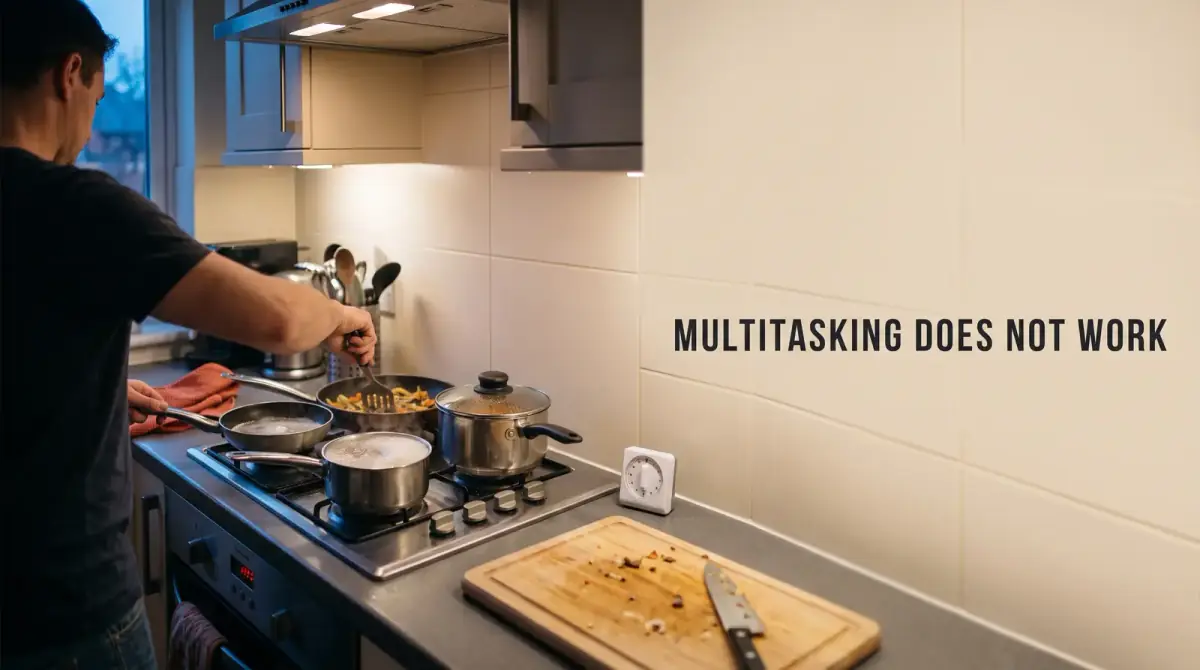
You cannot multitask, and neither can anyone else. What you are doing is switching between tasks quickly, and each switch costs you time and accuracy that you do not notice paying. That is the entire reason multitasking does not work.
The brain does run genuinely automatic things in parallel. You can walk and hold a conversation. What it cannot do is apply deliberate attention to two demanding things at once, and everything that counts as real work sits in the second category.
Switching, not sharing
Picture writing an email while a colleague explains a problem to you. It does not feel like two streams running side by side. It feels like flicking between them, catching the last few words, losing your sentence, going back.
That is precisely what is happening. Attention moves, it does not divide. And every move has three separate costs: the time to disengage, the time to load the new context, and the errors introduced while you were only half present.
The third one is the expensive one, because you rarely see it. A dropped detail in an email or a misread number in a spreadsheet does not announce itself. It shows up later as a correction, a confused reply, or a meeting that should not have been needed.
Why it feels productive anyway
Here is the uncomfortable part. Multitasking feels good, and the feeling is not a coincidence.
Switching provides novelty, and novelty feels like momentum. When you jump between four tasks in twenty minutes you experience four fresh starts, which registers as energy. Sitting with one difficult task for those same twenty minutes feels slow and slightly unpleasant, because difficulty always does.
So the version of work that feels most productive is often the least productive, and your own sense of efficiency is not a reliable instrument. This is why people defend their multitasking sincerely. They are reporting an experience accurately, just not an outcome.
Busy is not the same as effective
A day of constant switching produces a lot of activity and a strange emptiness at the end of it. You were occupied for nine hours and you cannot name one thing that moved meaningfully forward.
That gap between effort spent and progress made is the clearest signal that switching, rather than workload, is the problem.
Attention residue
When you leave a task before finishing it, part of your attention stays behind. You open the next thing but a piece of your mind is still holding the unfinished one, and you work at reduced capacity without realising it.
This is why a five-minute interruption does not cost five minutes. It costs the interruption plus the ramp back up plus the quality lost while you were still partly elsewhere.
It also explains why fragmented days feel so tiring. You are not doing more work. You are repeatedly paying a start-up cost, and start-up costs are where a lot of the day quietly goes.
Where multitasking is genuinely fine
Blanket rules are wrong here, and it is worth being precise about the exceptions.
- One automatic task plus one demanding one. Walking while thinking, folding laundry while listening to something. The automatic task requires no attention, so nothing competes.
- Waiting time. Reading while a file uploads or a kettle boils is not multitasking, it is using a gap.
- Genuinely trivial work. If neither task requires accuracy or thought, the switching cost is small and probably not worth managing.
The rule that actually holds: two tasks can share your time only if at most one of them needs your judgement. Two demanding tasks will always take longer together than they would in sequence.
What to do instead
Single-tasking is easy to describe and hard to do, because the pull toward switching is constant and mostly self-generated. These are the mechanics that make it survivable.
- One thing visible at a time. Close the other tabs and windows. Not minimised, closed. Visible things are invitations, and you will accept most of them.
- Keep a capture pad. A notebook or blank file beside you. When an unrelated thought arrives, write one line and go back. This is the highest-value habit here, because most switching is triggered by your own memory rather than by other people.
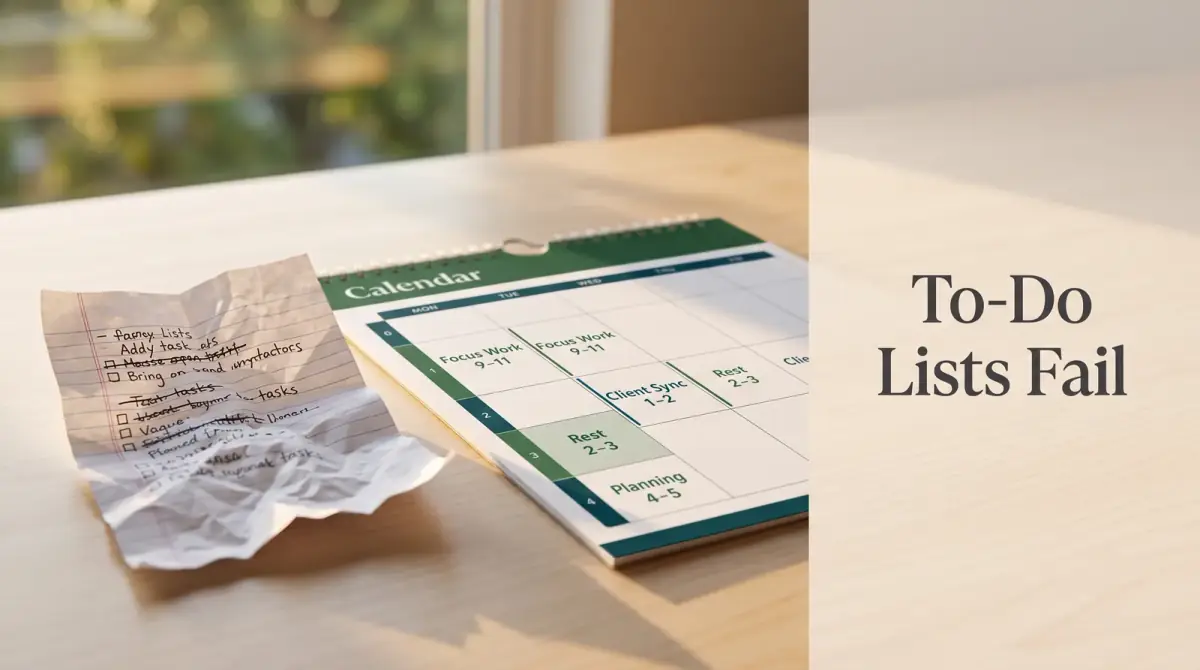
- Work in defined stretches. Twenty-five minutes, ninety minutes, whatever suits the task. A defined end makes it easier to resist a mid-task jump because the switch has a scheduled time coming.
- Batch the small things. Messages, approvals, quick replies. Collect them and run them together rather than letting each one puncture a different hour.
- Silence the sources. Notifications are switching triggers with a delivery service. Turning them off is not optional if focus matters to you.
- Finish, or stop cleanly. If you must leave a task, spend thirty seconds writing down where you were and what comes next. That note removes most of the reload cost later.
What if your job requires interruption?
Plenty of jobs do. Support, healthcare, teaching, management, anything where people need you unpredictably. Telling someone in that position to work in uninterrupted ninety-minute blocks is useless advice.
The realistic adaptation is to protect a smaller amount of time rather than all of it. One defended hour a day, agreed with the people around you, is worth more than a general intention to focus more.
The rest of the day can stay reactive. That is not a compromise, it is the job. What matters is that the work requiring real thought has somewhere to live that is not the gaps between interruptions.
Most people do not need more hours. They need a few hours that are not being cut into pieces.
The trade-offs of single-tasking
Working on one thing at a time has real costs and it is dishonest to pretend otherwise.
You will be slower to respond. Some people will notice, and a few will mind. If your workplace treats fast replies as evidence of commitment, focused work carries a social price you should decide consciously whether to pay.
You will also feel less busy, which is more unsettling than it sounds. A calm day can trigger genuine anxiety in someone used to constant switching, and that discomfort is the most common reason people give up in the first fortnight.
And sometimes switching is correct. A genuinely urgent problem should interrupt you. The aim is not rigidity, it is making interruption a decision rather than a reflex.
A two-week test
- Pick one task tomorrow and do it with everything else closed. Note how long it takes.
- Put a capture pad beside you and write down every urge to switch instead of acting on it.
- Count the notes at the end. Most people are surprised by the number, and by how few needed attention at all.
- Batch your messages into two or three windows rather than checking continuously.
- Repeat for ten working days before judging it.
The measure of success is not whether the day felt efficient. It is whether, at six o'clock, you can name something that genuinely moved. That question is harder to fool than the feeling of being busy, which is exactly why it is the one worth asking.


Comments
0 total