
The short answer
Why smells trigger memories harder than photos: the brain shortcut behind the Proust effect, and how to use scent anchoring for study and sleep.
- Temporary loss commonly follows colds, sinus problems, allergies and viral infections, and often recovers gradually.
- Persistent or unexplained loss is worth a medical opinion. Changes in smell can accompany a range of conditions, including some neurological ones.
- Distorted smell - familiar things smelling wrong, chemical or rotten - is worth reporting rather than waiting out.
- Safety matters too: without smell you lose an early warning for gas, smoke and spoiled food.
Sunscreen. Chlorine. A particular brand of soap in a stranger's bathroom. One breath and you are eleven years old again, standing somewhere you have not thought about in twenty years, feeling something you cannot quite name. If you have ever wondered why smells trigger memories so violently when a photograph of the same moment barely moves you, the answer is buried in some genuinely odd brain wiring.
Smell is the strange one. Every other sense politely queues up for processing. Smell does not queue. It takes a shortcut - and that shortcut appears to explain almost everything peculiar about scent-triggered memory.
Why smells trigger memories more directly than anything else
When you see something, the signal goes first to the thalamus - the brain's switchboard, sorting and forwarding sensory information onward for interpretation. Sight, sound and touch all pass through it.
Smell largely does not. Odour molecules reach receptors high in your nose, and the signal goes to the olfactory bulb, which sits remarkably close to - and connects directly with - the amygdala and the hippocampus. The amygdala handles emotional significance. The hippocampus is central to forming and retrieving memories.
So a smell reaches the emotion centre and the memory centre almost immediately, before much conscious interpretation happens. The feeling hits first; the memory assembles a beat later. You are moved before you know why.
Worth saying plainly: the anatomy is well supported, but "shortcut" simplifies a genuinely complicated system, and researchers are still working out how much of the Proust effect it truly accounts for.
Why the emotion arrives before the memory
Notice the order next time. The lurch comes first - a wash of warmth, or unease, or something like homesickness. Only afterwards does your mind produce the scene: the kitchen, the car, the school corridor.
Why scent memories feel older than any other kind
Ask someone what a smell reminds them of and you will very often get an answer from childhood. Rarely last Tuesday. Almost never last year.
Part of this is the reminiscence bump - the tendency for autobiographical memories to cluster around adolescence and early adulthood, the years packed with firsts. But scent memories skew earlier still, and one explanation is simply that childhood is when you smelled most things for the first time.
Marcel Proust built a famous passage of literature on exactly this: a madeleine dipped in tea unlocking a vanished childhood. The observation was a novelist's, though, not a laboratory finding, and the two are worth keeping separate.
Why you can recognise a smell instantly but never name it
Hand someone a jar of cinnamon with their eyes closed. They will know it immediately - and then flounder. "It is... warm? Christmas? The bakery one?" Recognition is instant. The word is nowhere.
The leading explanation follows the same anatomy. Smell has a fast, privileged route to emotion and memory and a comparatively poor connection to language. Our odour vocabulary is borrowed - we describe smells by source (lemony, smoky, floral) or by taste words (sweet, sharp) because there is barely any native smell vocabulary to reach for.
That has a consequence people rarely notice. Because smells resist language, they resist the tidying-up language does to memories. A story told fifty times gets smoothed a little each retelling. A smell you have not met in decades has been sitting untouched.
Why the same smell means opposite things to different people
Nothing about a smell is inherently comforting or repulsive. Almost all of it is learned.
Hospital disinfectant is neutral to a nurse and stomach-turning to someone who sat beside a bed during the worst month of their life. Petrol delights some people and nauseates others. Whatever your grandmother's perfume was, it means nothing to a stranger and everything to you.
Scent meaning is association, not chemistry. The molecule is identical for everyone; the emotional tag was written by your own history. A few responses may have an innate basis - recoiling from rot has obvious survival logic - but the emotional landscape of everyday smells is built almost entirely from experience.
Which explains something that otherwise makes no sense: two people can smell the same thing in the same room, react in completely incompatible ways, and both be right.
When the shortcut works against you
The same wiring that hands you a warm childhood kitchen can hand you something much harder. Smell triggers can be unusually difficult in trauma and grief, precisely because the route is so fast and so hard to intercept. A visual reminder gives you a fraction of a second to brace. A smell is already in the emotional system before you have consciously identified it - which is why people describe scent triggers as arriving with no warning at all.
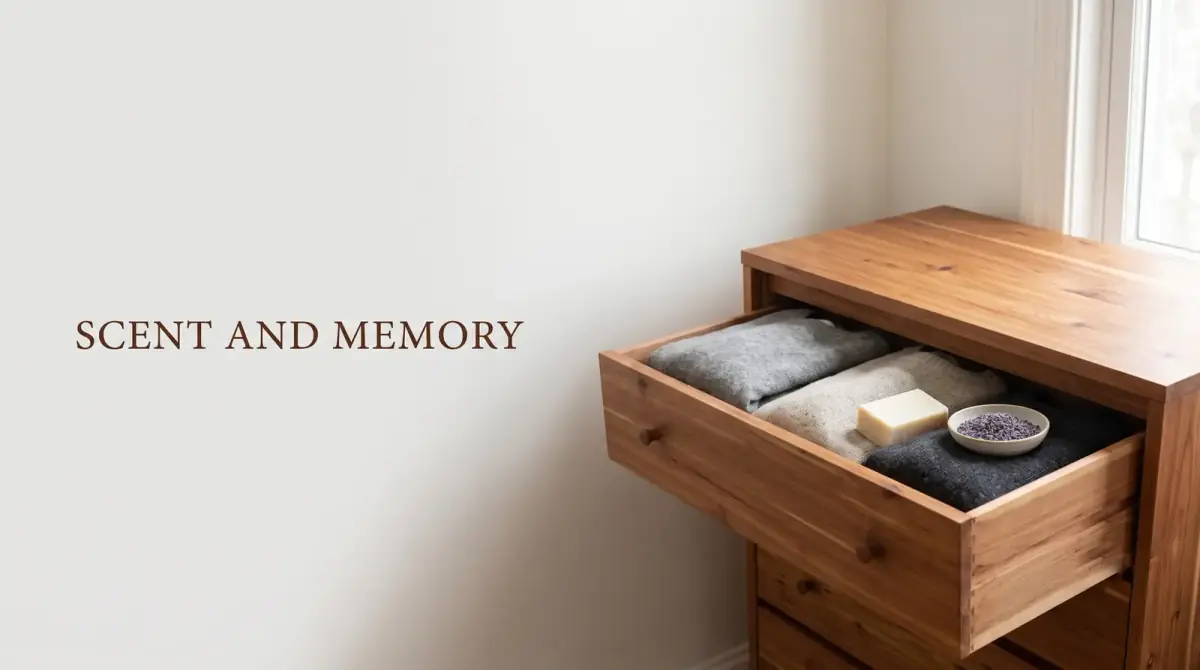
In grief it shows up in small, brutal ways. Opening a wardrobe months later. A jumper that still holds someone. Unbearable and precious in the same breath.
None of this is a disorder - it is an unusually direct system working normally. But if scent triggers regularly derail your day, raise it with a therapist. It is a recognised, workable part of trauma treatment, not something to endure quietly.
Putting the Proust effect to work
If smell binds to context that easily, you can use it deliberately. The evidence is suggestive rather than conclusive and the effects are modest - but it costs almost nothing to try.
- Anchor your studying. Use one distinctive scent - an essential oil, an unusual tea - only while revising a subject, then reintroduce it while reviewing.
- Keep it narrow. An anchor works because it is not part of your normal environment. Use it everywhere and it becomes background.
- Build a sleep cue. A consistent scent used only in the wind-down hour can become part of the signal that the day is closing.
- Bank a good smell on purpose. On a holiday you want to keep, wear something you never otherwise wear. You are writing yourself a retrieval key.
- Do not over-invest. Sleep, spacing and testing yourself will always beat a scent trick. This is a small extra handle, not a system.
Why your nose keeps quitting on you
Two everyday mysteries, one mechanism.
Ten minutes into perfume shopping, everything smells the same. That is olfactory fatigue - your receptors respond to change and damp down under continued exposure. Coffee beans are unlikely to reset anything; a few minutes of outside air is more use.
The same process stretched over months explains why you cannot smell your own home. Every house has a smell; yours is constant, so your brain filed it as background and stopped reporting it. This is olfactory adaptation, and it is a feature - a system tuned to novelty notices smoke, gas and spoiled food. Come back from two weeks away and you get one brief, uncanny sniff of your own house before it vanishes again.
Which means the person who says your home smells lovely is telling you something you are constitutionally unable to verify.
What smell loss can be telling you
Losing your sense of smell is more consequential than most people assume, and it deserves better than being filed under minor inconvenience:
- Temporary loss commonly follows colds, sinus problems, allergies and viral infections, and often recovers gradually.
- Persistent or unexplained loss is worth a medical opinion. Changes in smell can accompany a range of conditions, including some neurological ones.
- Distorted smell - familiar things smelling wrong, chemical or rotten - is worth reporting rather than waiting out.
- Safety matters too: without smell you lose an early warning for gas, smoke and spoiled food.
People who lose it often describe the emotional flattening as the worst part. Food becomes texture. And the past gets harder to reach, because a door that used to open on its own has quietly closed.
The takeaway
The reason a stranger's shampoo can knock the wind out of you is not sentiment. It is architecture. Your olfactory system was wired straight into the emotional and memory machinery, and it never got the upgrade that routes everything else through a switchboard first.
So it stays fast, wordless and old - holding a version of your history that language never got its hands on. A strange kind of gift, even when it stings.
The memories you can describe are the ones you have edited. The ones a smell returns to you have been sitting exactly where you left them.
So the next time something ordinary stops you in a supermarket aisle - you are not being sentimental. You are being reminded, by the oldest route your brain has, of who you used to be.


Comments
0 total