
The short answer
Messy notes rarely get reused. Here is how the Cornell note taking method turns them into a study tool, plus when its cue-notes-summary layout actually helps.
- The page has three parts: notes, cues, and a summary.
- You fill the notes area live, then process it soon after.
- The cue column turns notes into self-test questions.
- The summary forces you to state the main idea in your own words.
- It shines for lectures and reading, less so for messy, visual topics.
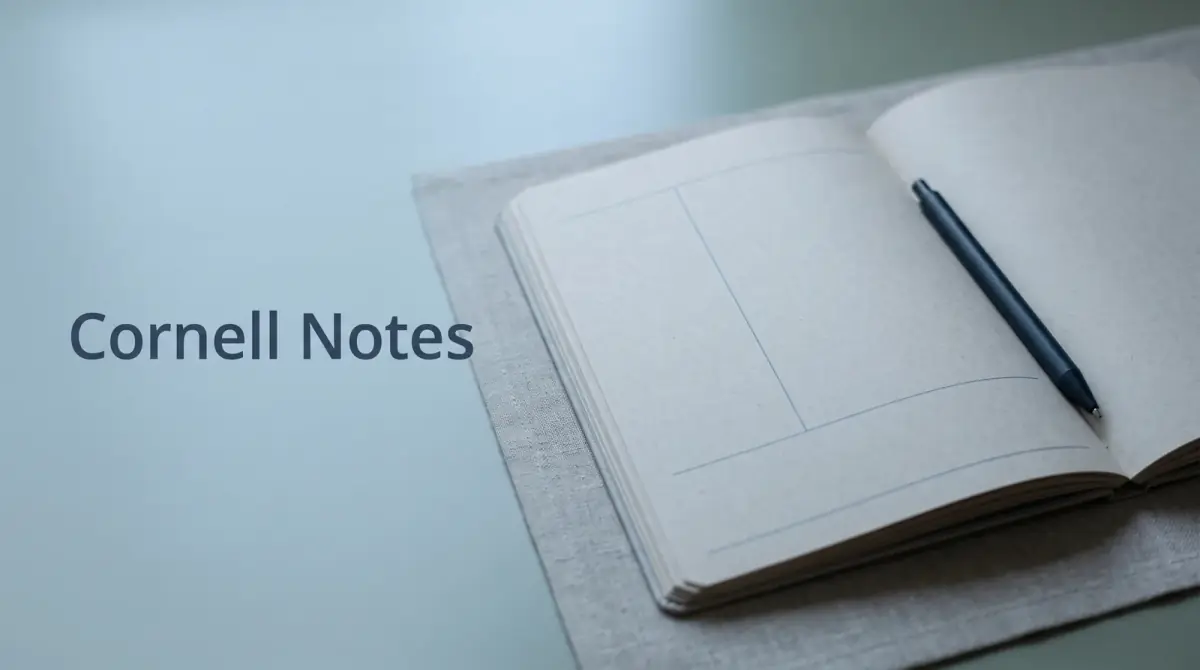
The Cornell note taking method splits your page into three areas: a wide column for notes, a narrow column for cues, and a summary strip at the bottom. You write notes during class, add cues and questions afterward, then write a short summary. That simple layout turns raw notes into a built-in study tool.
Plain notes often sit unused after class. The Cornell system fixes that by forcing you to review and question what you wrote. Here is how it works and when it actually beats ordinary linear notes.
Key takeaways
- The page has three parts: notes, cues, and a summary.
- You fill the notes area live, then process it soon after.
- The cue column turns notes into self-test questions.
- The summary forces you to state the main idea in your own words.
- It shines for lectures and reading, less so for messy, visual topics.
How the Cornell note taking layout works
Set up the page before you start. Draw a vertical line about a third of the way from the left edge, and a horizontal line a few lines up from the bottom.
That gives you three zones. The large right column is for notes. The narrow left column is for cues. The strip along the bottom is for your summary. The structure does the organizing for you.
The notes column
During the lecture or reading, you write in the big right column only. Capture main ideas, facts, and examples in short lines. Skip full sentences and use your own shorthand.
Do not worry about neatness here. The goal is to catch the important points without falling behind.
The cue column
Soon after class, reread your notes and fill the left column with cues. These are keywords or, better, questions that your notes answer.
If a note says a process has three stages, your cue might be "What are the three stages?" Later you can cover the notes, read the cue, and test yourself. This is where the method earns its keep.
The summary strip
At the bottom, write two or three sentences that sum up the page in plain words. Doing this forces you to decide what actually mattered.
If you cannot summarize it, you probably did not understand it, and that is useful to know right away.
How to practice note taking with this system
Knowing the layout is easy. Learning how to practice note taking well takes a few sessions. Start with one class and keep it simple.
- During: Write only in the notes column. Stay brief.
- Within a day: Read your notes and add cues and questions.
- Same session: Write the summary at the bottom.
- Before a test: Cover the notes, use the cues to quiz yourself, and check.
The review step is what most people skip, and it is the whole point. Notes you never revisit are just decoration.
Why note taking is important in the first place
It helps to remember why note taking is important before judging any method. Writing notes is not about creating a perfect record you file away.
The act of choosing what to write forces your brain to process the material. You decide what matters, put it in your own words, and connect ideas. That thinking is where learning happens.
Cornell notes push this further by adding a review loop right into the page. The cues and summary make sure the thinking continues after class, not just during it.
When Cornell notes work best
The method fits some situations far better than others. It is strongest when information comes in a fairly linear stream.
- Lectures: steady spoken content maps cleanly into the notes column.
- Reading textbooks: chapters break naturally into cues and summaries.
- Fact-heavy subjects: the cue questions make great flashcard fuel.
- Exam prep: the built-in self-testing is ready to use.
When to reach for something else
Cornell notes are not a fit for everything. Some material resists a neat, top-to-bottom column.
For topics full of relationships between ideas, a mind map may capture the links better. For heavy problem-solving, like math or code, worked examples and practice matter more than tidy notes. For fast brainstorming, a loose page beats a rigid template.
There is no single best way to note. The right tool depends on the subject and on how your mind works, so results vary from person to person.
Notes are only as good as the review they get. A messy page you revisit beats a beautiful one you never open again.
Common mistakes to avoid
A few habits quietly cancel out the benefits of the system.
- Writing everything down. Transcribing word for word leaves no room to think. Capture ideas, not every sentence.
- Skipping the cues. Without questions in the left column, you just have plain notes in a smaller box.
- Never testing yourself. The cues exist to quiz you. Reading them is not the same as answering them.
- Forcing the layout everywhere. Use it where it fits and switch methods where it does not.
A quick example of a Cornell page
Imagine a lecture on the water cycle. In the notes column you jot short lines: "evaporation, sun heats water, rises as vapor," then "condensation, vapor cools, forms clouds," then "precipitation, falls as rain or snow."
Afterward, you fill the cue column with questions. Next to the first block you write, "What drives evaporation?" Next to the second, "How do clouds form?" Each cue points straight at a note you can now test yourself on.
At the bottom, your summary reads something like: "Water moves between the surface and the air through three main stages, driven by heat from the sun." In two lines you have captured the whole page.
Later, you cover the notes, read each cue, and answer out loud. Anything you cannot answer becomes your review list. That single page now works as notes, flashcards, and a summary at once.
Can you use Cornell notes digitally?
Yes. Many note apps offer Cornell templates, or you can build one with a simple table. The layout works the same on a screen as on paper.
Typing is faster, which helps in quick lectures, though writing by hand may help some people remember more. Pick whichever keeps you reviewing your notes, since that habit is what makes the method pay off.
Should you use the Cornell method?
If you sit through lectures or read dense material and want your notes to double as a study tool, the Cornell note taking method is worth a real try. It builds review into your routine instead of leaving it to willpower.
Give it two or three weeks with one class before deciding. Keep the parts that help and adapt the rest. A note system only works if you keep using it, so the best version is the one that fits your daily study without a fight.



Comments
0 total