
The short answer
Rote repetition is the slow way. Here is how to memorize faster using chunking, memory palaces, and active recall, applied step by step to real study material.
- Chunking turns long, messy lists into a few memorable groups.
- A memory palace links facts to places you already know well.
- Active recall, or testing yourself, beats passive rereading every time.
- Meaning and mental pictures make information far easier to retrieve.
- Results vary, so keep the technique that works and drop the rest.
To learn how to memorize faster, stop reading things over and over. Instead, break information into small chunks, tie it to something you can picture, and test yourself from memory. Those three moves do more in twenty minutes than an hour of rereading ever will.
Speed here does not mean rushing. It means using the way your brain actually stores things, so facts stick on the first few tries instead of the tenth. Below is a practical toolkit you can apply to real study material today.
Key takeaways
- Chunking turns long, messy lists into a few memorable groups.
- A memory palace links facts to places you already know well.
- Active recall, or testing yourself, beats passive rereading every time.
- Meaning and mental pictures make information far easier to retrieve.
- Results vary, so keep the technique that works and drop the rest.
Why plain repetition is so slow
Reading a page five times feels like progress. Your eyes recognize the words, so your brain assumes the job is done. That feeling of familiarity is not the same as memory.
Real memory forms when you do something with the information. You have to squeeze it, connect it, or pull it back out. Passive input slides in one ear and out the other, which is why cramming fades fast.
How to memorize faster with chunking
Chunking means grouping small items into bigger, meaningful units. Your short-term memory can only juggle a few things at once, so grouping lets you carry more with less strain.
A phone number is the classic example. Nobody remembers ten separate digits. You remember two or three chunks, like an area code plus two short blocks.
Apply this to study material by finding natural groups. A list of twelve terms might split into three themes of four. A long definition might break into a cause, a process, and a result. Fewer, richer pieces are easier to hold.
Build a memory palace
A memory palace links what you want to remember to a place you know by heart, like your home. You mentally walk through the rooms and drop each fact somewhere along the route.
Say you need five ideas for a test. Picture the first one by your front door, the next on the kitchen table, the third on the couch, and so on. To recall them, you just take the walk again.
The trick works because your brain is excellent at remembering places and images. Make each picture vivid, odd, or a little funny. Strange images stick harder than tidy ones.
Use active recall to test yourself
Active recall is the habit of pulling information out instead of pushing it in. You close the book and try to answer, explain, or write down what you just studied.
It feels harder than rereading, and that difficulty is the point. Each time you retrieve a fact, the path to it gets stronger. Flashcards, practice questions, and blank-page summaries all count.
Pair recall with checking. Write what you remember, compare it to the source, and the gaps show you exactly what to review next.
A worked example: how to memorize the periodic table
People often ask how to memorize the periodic table, and it is a good test of these tools together. You would not try to swallow all of it in one sitting.
- Chunk it. Focus on one group or row at a time, not the whole grid.
- Make the symbols mean something. Turn odd symbols into words or images. Fe for iron might become a strong "Fe-male" lifting a bar, or a picture that ties the letters to the metal.
- Place them in order. Use a memory palace so the sequence stays fixed as you walk the route.
- Recall daily. Cover the table and write out the chunk from memory, then check.
The same steps apply to vocabulary, dates, formulas, or anatomy. Chunk, add meaning, then test.
The best memorize techniques, compared
There is no single winner among the best memorize techniques. The right pick depends on what you are learning.
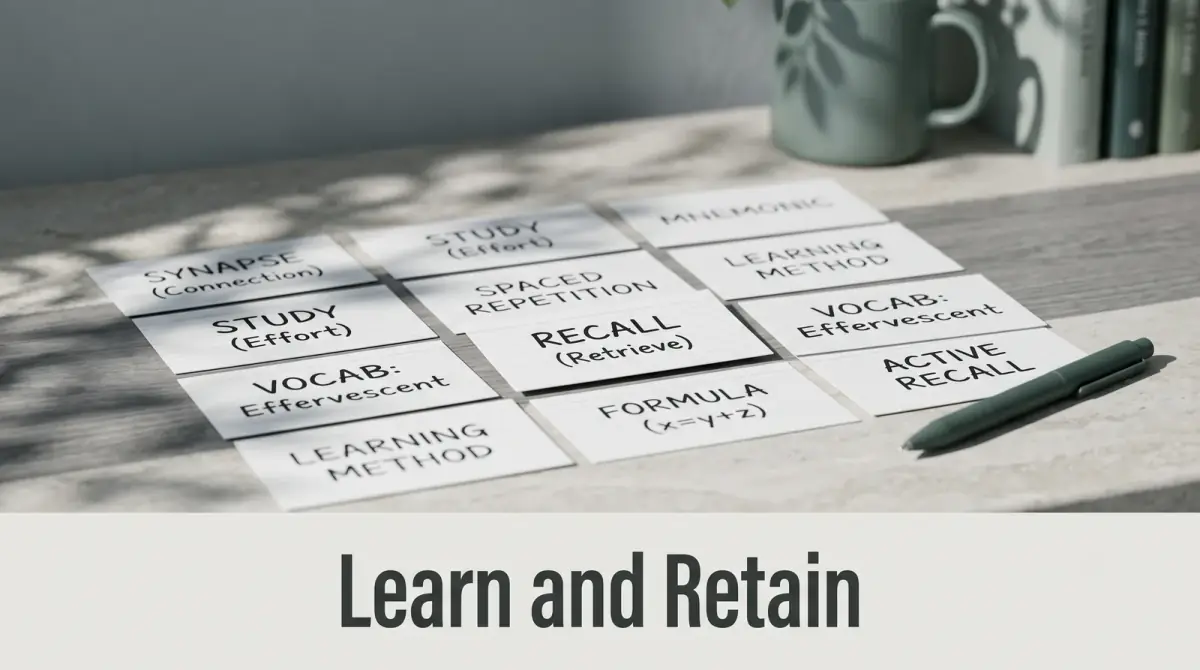
- Flashcards with spacing: best for facts, words, and symbols you need fast.
- Memory palace: best for ordered lists, speeches, or steps in a process.
- Explaining aloud: best for concepts you need to understand, not just repeat.
- Mnemonics and acronyms: best for short sets, like the colors of a spectrum.
Most strong learners mix two or three of these rather than relying on one.
How to memorize things quickly without burning out
If you want to know how to memorize things quickly and keep them, spacing matters as much as the technique. Reviewing a little across several days beats one long marathon.
Keep sessions short and focused. Twenty to thirty minutes, a real break, then another round works better than two exhausted hours. Sleep also helps memory settle, so an all-nighter often costs more than it gives.
If studying feels completely effortless, it is probably not building much. A little friction is the sign that memory is forming.
Everyday habits that keep your memory sharp
These techniques work far better when your brain is in good shape. A few daily habits quietly raise how well anything sticks, no matter which method you use.
- Sleep enough. A lot of memory settles overnight, so trading sleep for extra study often backfires.
- Move your body. Regular activity supports focus and recall for many people.
- Cut distractions. Studying with a buzzing phone splits your attention and weakens what you store.
- Stay curious. You remember what you care about, so find a reason the material matters to you.
None of this replaces the techniques above. It simply gives them a stronger base to build on. If you ever notice memory changes that genuinely worry you, it is worth speaking to a doctor rather than guessing.
Common traps to avoid
Some habits feel productive while doing the opposite. Highlighting whole pages is one, since a wall of color tells you nothing about what actually matters.
Trying to memorize everything at once is another. Your working memory has limits, and overloading it means most of the load spills straight out. Fewer items, learned well, beat a long list learned badly.
Do not confuse recognizing an answer with recalling it either. Spotting the right option on a page fades fast. Practice producing the answer from a blank page, and it holds much longer.
Putting it all together
Here is a simple loop that ties the whole toolkit into a habit you can repeat for any subject.
- Break the material into small, meaningful chunks.
- Give each chunk a vivid image or a place in your memory palace.
- Close the source and recall it from a blank page.
- Check your answer and mark what you missed.
- Review again tomorrow, then a few days later.
Start with one technique on your next study session rather than trying all of them at once. The method you actually keep using will always beat the perfect method you abandon after a day.
Comments
0 total