
The short answer
Speed and memory are not enemies. Here is how to learn faster without forgetting, using recall and spacing so new material actually sticks for the long run.
- Testing yourself beats re-reading for locking in what you learn.
- Spacing your study over days holds memory better than one long session.
- Cramming can feel fast, yet most of it fades within a week.
- Mixing topics is harder in the moment but stronger for recall later.
- Small, regular reviews beat rare marathon sessions.
Learning quickly and remembering for a long time are not opposites. The trick to how to learn faster without forgetting is to spend less time re-reading and more time recalling, then to spread that practice across several days. Do that, and speed and memory start working together instead of fighting each other.
Most people try to speed up by cramming more into one sitting. It feels productive, but it is one of the fastest ways to forget. Below is a calmer approach that helps you learn faster and remember more without adding extra hours.
Key takeaways
- Testing yourself beats re-reading for locking in what you learn.
- Spacing your study over days holds memory better than one long session.
- Cramming can feel fast, yet most of it fades within a week.
- Mixing topics is harder in the moment but stronger for recall later.
- Small, regular reviews beat rare marathon sessions.
Why cramming feels fast but fails
Cramming gives you a quick sense of mastery. You read a chapter three times, it feels familiar, and you assume it is stored. Familiarity is not the same as memory, though.
When you re-read, your brain recognizes the words but does little work. Easy input tends to leak out just as easily. A few days later the details are gone, and you are back where you started.
Real, lasting learning comes from effort. When retrieving an idea feels slightly hard, that struggle is the signal your memory is being strengthened.
The two habits that do the heavy lifting
You do not need a dozen tricks. Two well-tested habits carry most of the results, and they pair naturally.
Active recall
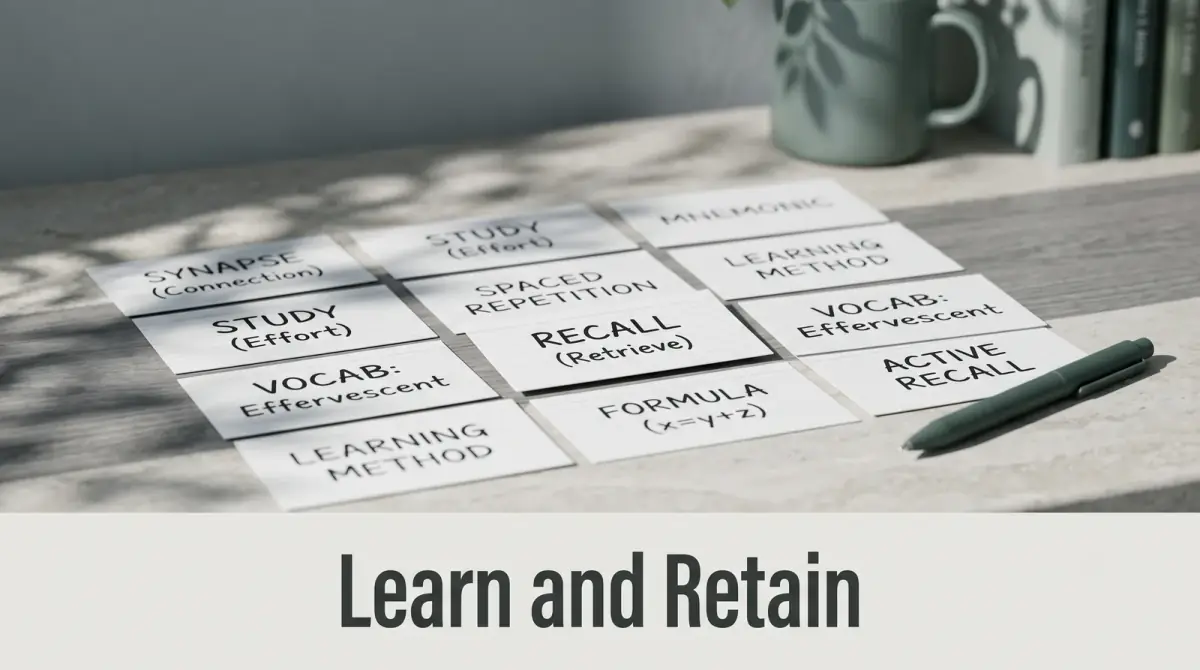
Active recall means pulling information out of your head instead of pushing it back in. Close the book and try to explain the idea, answer a question, or write down what you remember.
It feels harder than re-reading, and that is the point. Each time you dig something out, the path to it gets easier to travel next time. Flashcards, practice questions, and blank-page summaries all work.
Spaced repetition
Spaced repetition means reviewing material at growing intervals instead of all at once. You might review something tomorrow, then in a few days, then a week later.
Each review comes just as the memory starts to fade, which forces a small effort to bring it back. That effort is what makes it stick. Spreading five short reviews across two weeks usually beats one long block.
How to learn faster without forgetting: a simple routine
Here is how to learn faster without forgetting in practice. It is a loop you can run for almost any subject.
- Take in a small chunk. Read or watch one focused section. Keep it short enough to hold in your head.
- Close everything and recall. Without looking, write or say what you just learned in your own words.
- Check and fix gaps. Compare your version to the source. The parts you missed are exactly what to review.
- Space your reviews. Revisit the same material tomorrow, then a few days later, then next week.
- Repeat with the next chunk. Move on only once the last piece feels solid on recall, not just on reading.
This loop looks slow at first. In practice it saves time, because you rarely have to relearn things from scratch.
Ways to learn faster that actually help
Beyond the core two habits, a few smaller moves add real speed. These are the ways to learn faster that hold up rather than backfire.
- Teach it to someone. Explaining an idea out loud exposes the gaps you did not know you had.
- Ask why, not just what. Connecting a fact to a reason gives your memory more hooks to grab.
- Mix related topics. Switching between subjects in one session feels messy but trains you to tell them apart.
- Sleep on it. Rest is when a lot of memory settles, so an all-nighter often costs more than it gives.
- Use your own words. Copying text word for word does little; rephrasing forces understanding.
Mistakes that quietly slow you down
Some common study habits feel effective while doing the opposite. Cutting them out is often the quickest win.
Highlighting everything is one. A page drowning in color tells you nothing about what matters. Re-reading on autopilot is another, since your eyes move but your mind checks out.
Long, unbroken sessions are a third trap. Focus fades, and the last hour rarely earns its keep. Short blocks with real breaks tend to teach you more in less total time.
If your study feels effortless, it is probably not building much memory. A little friction is a good sign.
What is the best fast learning method for you?
There is no single best fast learning method that fits everyone. The right mix depends on the subject and on how you like to work.
For facts and vocabulary, flashcards with spaced reviews are hard to beat. For concepts and processes, explaining them aloud or writing them from memory works better. For skills like coding or a language, frequent short practice wins over rare long stretches.
Results vary from person to person, so treat these as starting points. Try one, notice what sticks after a week, and adjust. The method you keep using beats the perfect method you abandon.
A one-week plan to start
You do not need to overhaul everything at once. A single week is enough to feel the difference.
- Day one: Learn a small chunk, then recall it from a blank page.
- Day two: Recall yesterday's chunk before learning anything new.
- Day four: Review both earlier chunks, focusing on what you forgot.
- Day seven: Do a full recall session on everything from the week.
Keep sessions short and honest. Test yourself first, look at the answer second. Stick with this loop and you will find that learning faster and forgetting less are not a trade-off at all. They are the same habit, done well.


Comments
0 total