
The short answer
Why the quality of your choices collapses by evening, what decision fatigue really looks like, and the practical ways to stop it costing you.
- Defaulting. You take the easiest available option, not the best one. Same lunch, same route, same reply, because the alternative requires evaluating something.
- Impulse buying. The 11pm checkout page suddenly seems very reasonable. Resistance to a purchase is itself a decision, and you are out of them.
- Irritability. You snap at someone over something small. Patience is partly the work of choosing not to react, and that work has a cost.
- Scrolling. Forty minutes of browsing a streaming app and going to bed having watched nothing. Choosing a show became harder than not watching one.
- Avoidance. The purest form. You do not make a bad decision, you make none, and the email sits there for another day.
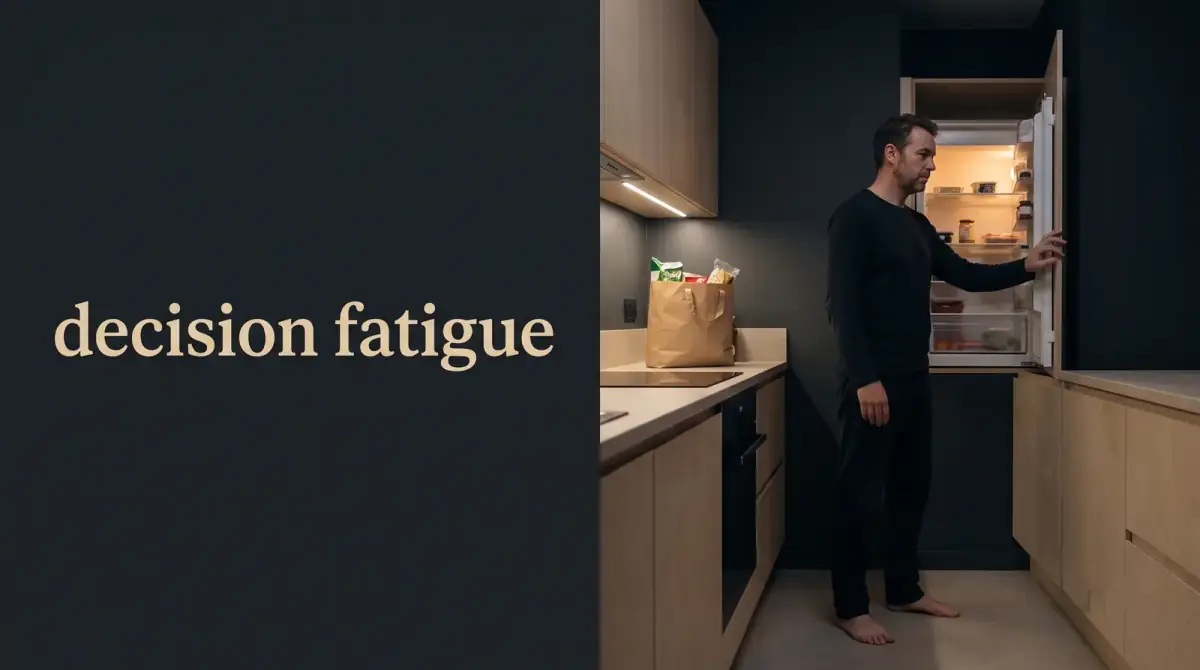
It is 6:12pm. You are standing in front of an open fridge that contains, technically, food. Your partner asks what you want for dinner, and something in you goes flat and hostile, and you say "I don't care, you pick," in a tone that makes it clear you do care and they had better pick correctly. That is not a relationship problem. That is decision fatigue.
It is the reason the last few hours of your day are where your worst choices live. The short answer to why it happens: deciding costs something, you have been paying all day without noticing, and by evening you are running on the cheapest possible option, which is usually whatever requires no thought at all.
The frustrating part is that the decisions that drain you are almost never the ones you would list if someone asked what you decided today.
What decision fatigue actually looks like
It rarely announces itself as tiredness. It shows up as behaviour, and the behaviour is oddly consistent from person to person.
- Defaulting. You take the easiest available option, not the best one. Same lunch, same route, same reply, because the alternative requires evaluating something.
- Impulse buying. The 11pm checkout page suddenly seems very reasonable. Resistance to a purchase is itself a decision, and you are out of them.
- Irritability. You snap at someone over something small. Patience is partly the work of choosing not to react, and that work has a cost.
- Scrolling. Forty minutes of browsing a streaming app and going to bed having watched nothing. Choosing a show became harder than not watching one.
- Avoidance. The purest form. You do not make a bad decision, you make none, and the email sits there for another day.
Avoidance is the one people miss, because it does not feel like a failure of judgement. It feels like being busy.
Why does decision fatigue happen?
The popular explanation is that willpower works like a fuel tank: you start the day full, every choice burns some, and eventually you are running on fumes. It is a tidy story and it matches the experience almost too well.
It is also genuinely debated. Psychologists have argued for years about whether self-control depletes like a resource at all, and attempts to pin down the effect have produced messy and inconsistent results. Treat the fuel tank as a metaphor, not a mechanism.
The more careful version is less dramatic and probably more useful. Deciding well requires attention: holding options in mind, comparing them, imagining consequences, overriding the obvious answer. Attention is limited at any given moment, and motivation to spend it drops as the day goes on. You do not run out of fuel so much as stop being willing to pay.
Which is why a person who is completely done deciding what to have for dinner will happily spend forty minutes deciding which seat to book for a concert they are excited about. The capacity is there. The willingness is not.
The hidden decision load nobody counts
Ask someone how many decisions they made today and they will say four or five. The real number is closer to uncountable, because most of them do not feel like decisions.
- Food. What to eat, when, whether that counts as lunch, whether to cook or order.
- Messages. Whether to reply now, what tone, how long, whether a thumbs up is rude, whether to leave the group chat on read.
- Attention. Which of nineteen open tabs, which notification, whether to keep reading this or check the other thing.
- Consumption. Which brand, which size, which of eleven nearly identical options on a shelf designed to make you compare them.
- Presentation. What to wear, whether it needs ironing, whether anyone will notice.
- Commitment. Whether to say yes. To the meeting, the favour, the coffee, the extra task, the weekend thing you do not want to do.
None of these are hard. That is exactly the problem. A hundred trivial choices do not feel like a hundred anything, so when your judgement collapses at 7pm you assume you are just in a mood.
Where it does real damage
Supermarkets at the end of a long day are the clearest example. You arrive with a list and leave with crisps, three things you already own, and none of the actual ingredients for anything. Every aisle is a comparison task, and you stopped comparing somewhere around the second one.
It also gets expensive at work. A manager who has spent all day in meetings signs off on something at 5:40pm that they would have pushed back on at 10am, not because they changed their mind, but because scrutiny is effortful and agreement is free. Approval is the path of least resistance, and late-day approvals are worth a second look the next morning.
And the 11pm checkout page. Nothing about that purchase improved between 3pm and 11pm. Your resistance to it did.
Is decision fatigue the same as being tired?
Related, but not identical. Physical tiredness makes everything harder. Decision fatigue is specific: you can be perfectly alert and still find yourself unable to answer a simple question about Thursday.
The tell is that it lifts when the decision becomes interesting again, or when someone else makes it for you. Real exhaustion does not care what the task is. This one does.
How to defuse decision fatigue
The goal is not to make better decisions when depleted. It is to have fewer decisions waiting for you when you get there.
Pre-decide and batch
Decide once, in bulk, at a time when deciding is cheap. Plan the week's dinners on Sunday. Pick tomorrow's clothes tonight. A decision made in advance costs nothing at the moment you need it.
Build defaults
A default is a decision you already made and no longer revisit. Same breakfast most days. A small work uniform of two or three combinations that always work. Recurring orders for anything you buy repeatedly. Defaults feel boring, which is the point: boring is cheap.
Use a shortlist rule
Cap the options before you start comparing. Three restaurants, not the whole app. Two candidates, not nine. Most of the cost is in the comparing, not the choosing.
Move important decisions early
Whatever genuinely matters this week, do it in the morning. Difficult conversations, hiring calls, contract reviews, anything with a number in it. Push the low-stakes admin to the afternoon where its badness cannot hurt you.
Set a good enough threshold
Maximising, insisting on the best available option, is enormously expensive and often produces less satisfaction than settling for the first thing that clears your bar. Decide in advance what "fine" looks like, then take the first thing that clears it. Save maximising for the two or three decisions a year that deserve it.
Close open loops
Every unresolved thing is a decision idling in the background: the unanswered invite, the thing you keep meaning to cancel, the reply you are drafting in your head. Answer them badly and quickly rather than well and eventually. Unfinished business has a way of staying loud until it is dealt with.
The one thing worth remembering
You are not a worse person after 6pm. You are a person who has been quietly making choices since the alarm went off, and has very little left for the fridge, the shelf, the checkout page, or the person asking a reasonable question in a normal tone of voice.
Protect your judgement by spending less of it on things that never deserved it.
Decide the important things early, decide the small things once, and let the rest be boring. The reward for a life with fewer choices in it is not less freedom. It is having something left over when a choice finally matters.


Comments
0 total