
The short answer
Taxes fund the services we share, from roads to schools. Learn why taxes are imposed, the main types you pay, and where all that money actually goes.
- Taxes pay for shared services no single person could fund alone.
- Pooling money lets a whole community share big costs.
- You pay several kinds of tax, often without noticing.
- Governments also use taxes to support people and shape behaviour.
- Exact rates and uses vary a lot by country.
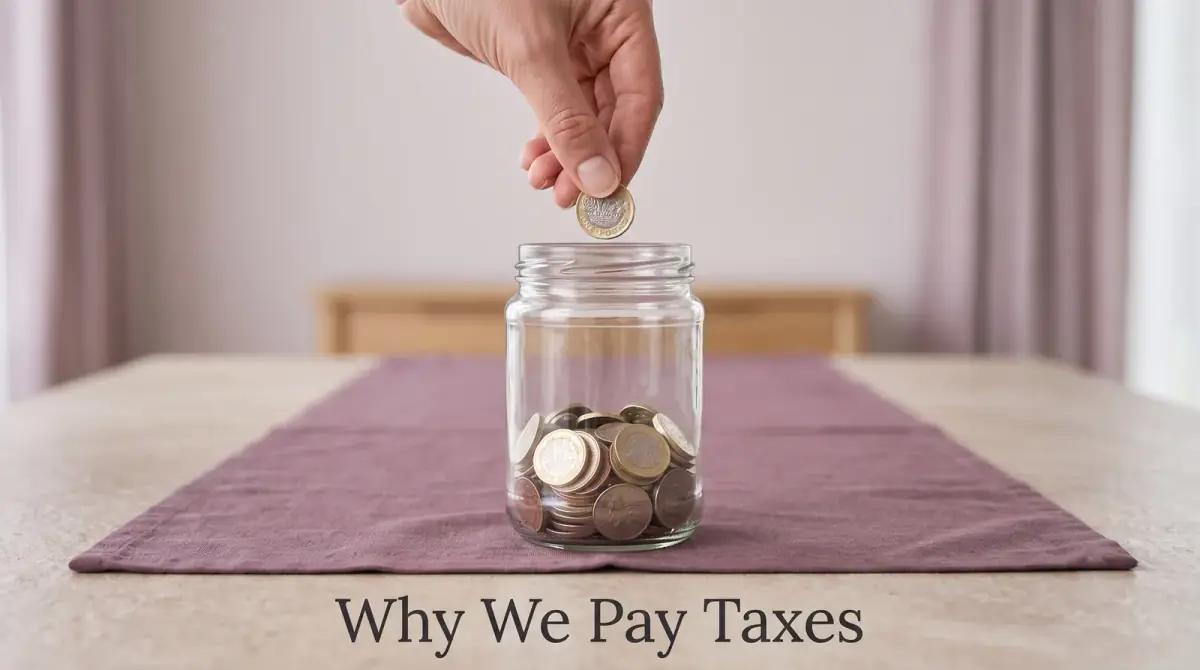
We pay taxes so that governments can fund the services we all rely on but could never buy alone, like roads, schools, hospitals, and public safety. In other words, why taxes are imposed comes down to sharing the cost of things that benefit everyone. You pay a slice, your neighbour pays a slice, and together that pool pays for the shared parts of daily life.
That is the short answer. The fuller picture is worth knowing, because it helps that deduction on your payslip feel less like a loss and more like a contribution.
Key takeaways
- Taxes pay for shared services no single person could fund alone.
- Pooling money lets a whole community share big costs.
- You pay several kinds of tax, often without noticing.
- Governments also use taxes to support people and shape behaviour.
- Exact rates and uses vary a lot by country.
Why taxes are imposed: the core reason
Imagine trying to build a road on your own, or run a hospital for just your household. It is impossible. Some things are too big and too shared for any one person to pay for.
That is the heart of the matter. By collecting a small amount from many people, a government can afford things that benefit the whole community. The cost is spread, and the service is shared. It is a bit like everyone on a street chipping in for a resource they all use, so no single household has to carry the full price alone.
This pooling is what makes public life possible. Without it, essentials like clean water, emergency services, and public schools would depend on who could personally afford them, and the things we take for granted would suddenly become fragile and uneven.
Where the money actually goes
Tax money does not vanish into a black hole. It funds a wide range of services, though the exact mix depends on your country and its priorities. Common examples include:
- Roads, bridges, public transport, and other infrastructure.
- Public schools and universities.
- Hospitals and public health programs.
- Police, fire services, and courts.
- National defence and emergency response.
- Support for people who are unemployed, elderly, or unwell.
You use many of these every day, often without a second thought. The smooth road on your commute and the streetlight on your corner are both quietly funded by taxes.
What would happen without taxes?
It is a useful thought experiment. Without a shared pot of money, every public service would have to be paid for directly by whoever used it, or it would simply not exist.
Roads might become toll-only, emergency help could depend on who could afford it, and schools or hospitals would be out of reach for many families. The services would not vanish overnight, but access would tilt heavily toward those with the most money. Part of why taxes are imposed is to prevent that outcome, spreading both the cost and the benefit across the whole community rather than leaving essentials to chance.
More than just paying for services
Funding services is the main job, but taxes do a few other things too. Understanding these makes the whole system clearer, and it explains why governments care about more than just the total collected.
Sharing the load fairly
Many tax systems ask people who earn more to contribute a larger share. The aim is to spread the cost in a way that reflects what people can afford, so essential services do not rest only on those with the least.
Supporting people in hard times
Taxes fund safety nets like unemployment support and pensions. The idea is that in a good year you contribute, and if you hit a rough patch, the same system can help you. It works because the risk is shared across many people.
Nudging behaviour
Governments sometimes use taxes to encourage or discourage certain choices. Higher taxes on things like tobacco are one example, while tax breaks for savings or clean energy try to steer people the other way.
The main types of taxes you pay
You pay tax in more ways than you might realise. Knowing how to taxes work across these types helps you see the full contribution you make. The most common include:
- Income tax, taken as a share of what you earn.
- Consumption tax, added to things you buy, such as a sales tax or value added tax.
- Property tax, based on property you own.
- Payroll tax, often used to fund specific programs like pensions or health cover.
Because these are spread out, the total you pay across a year is easy to underestimate. Some are visible on a payslip, while others hide inside the price of everyday purchases. That is one reason people feel taxed more heavily than the headline income rate suggests, since the smaller, hidden taxes quietly add up alongside it.
Why the system looks different by country
There is no single global tax system. What gets taxed, at what rate, and where the money goes are all decisions made country by country. So the details shift the moment you cross a border.
Take how taxes work in india as one example. The country funds public services through income tax with tiered slabs and a goods and services tax, or GST, on many purchases, with the specifics set by local law and revised from time to time. Other countries lean more on consumption taxes, or fund health and pensions in different ways. The shared idea is the same, but the machinery varies.
A healthier way to think about taxes
Nobody enjoys seeing money leave their paycheck. But it helps to reframe what that money does. You are not simply losing it. You are buying into a set of services and protections you would struggle to arrange alone.
You can absolutely debate whether the money is spent well, and citizens do exactly that through voting and public discussion. That debate is healthy and important, and it is how the priorities behind spending get decided in the first place. The underlying reason why taxes are imposed, though, stays steady: shared services need shared funding.
This article is general information, not tax advice. Tax systems and rates vary by country and change over time, so your official tax authority or a qualified professional is the right place to confirm anything specific to your situation.




Comments
0 total