
The short answer
Your laptop is closed but your brain is still working. A 15-minute evening shutdown routine closes the open loops so your night belongs to you.
- A short walk around the block, even a five-minute one, ideally the same route.
- Tidying the desk into a state you would be happy to find in the morning.
- A shower, or just washing your face and changing your top.
- Cooking, if cooking is a pleasure rather than another chore.
- Ten minutes of something with your hands: an instrument, a puzzle, watering plants.
It is 9:40pm. The laptop has been shut for three hours, dinner is done, the dishes are drying, and you are staring at a paused episode you have not watched a second of because you are silently rehearsing tomorrow's conversation with a client. Your body clocked off. Your brain did not get the memo. An evening shutdown routine is the fix, and it takes about fifteen minutes.
Here is the short answer. Your mind keeps chewing on work because unfinished tasks stay open in your memory until they have been written down somewhere trustworthy and given a specific next step. A shutdown routine closes those loops on purpose: you review what got done, capture every loose thread, glance at tomorrow, choose one must-do, and then mark the end with a deliberate cue. Fifteen minutes, same order, every working day.
Why does your brain keep working after you stop?
An unfinished task behaves differently in your head than a finished one. It stays slightly active, nudging for attention, resurfacing at red lights and in the shower and at 2am. Research suggests it is not the difficulty of the task that keeps it nagging, but the lack of a plan for it.
That is the useful part. You do not have to finish the work to quiet it down. You have to give it a home and a next step. "Chase the invoice" floating in your head is an alarm. "Email Priya about invoice 4471, first thing Thursday" written on tomorrow's list is a decision, and decisions stop ringing.
Think of your working memory as a desk with a few square inches of free space. Every open loop is a sticky note someone keeps slapping down. Shutdown is the act of sweeping the desk into one drawer you actually trust.
The evening shutdown routine, step by step
This is the whole thing. Do it in this order, at roughly the same time, before you leave your desk rather than after you have already drifted to the sofa.
- Review what actually got done. Two minutes. Look at your list, your sent folder, your calendar. Note what moved. This is not self-congratulation, it is evidence, and on the days that felt like failure it is usually surprising.
- Capture every loose thread. Five minutes and the most important step. Empty your head onto one list: half-finished replies, the thing your manager mentioned in passing, the file you meant to rename, the doubt you have about the timeline. If it is nagging, it goes down.
- Look at tomorrow. Two minutes. Open the calendar. Notice what is fixed, where the gaps are, what needs preparing tonight rather than discovering at 8:55am.
- Pick tomorrow's one must-do. One minute. Not five priorities. One. The task that, if it were the only thing you did, would make tomorrow count. Write it at the top of the page.
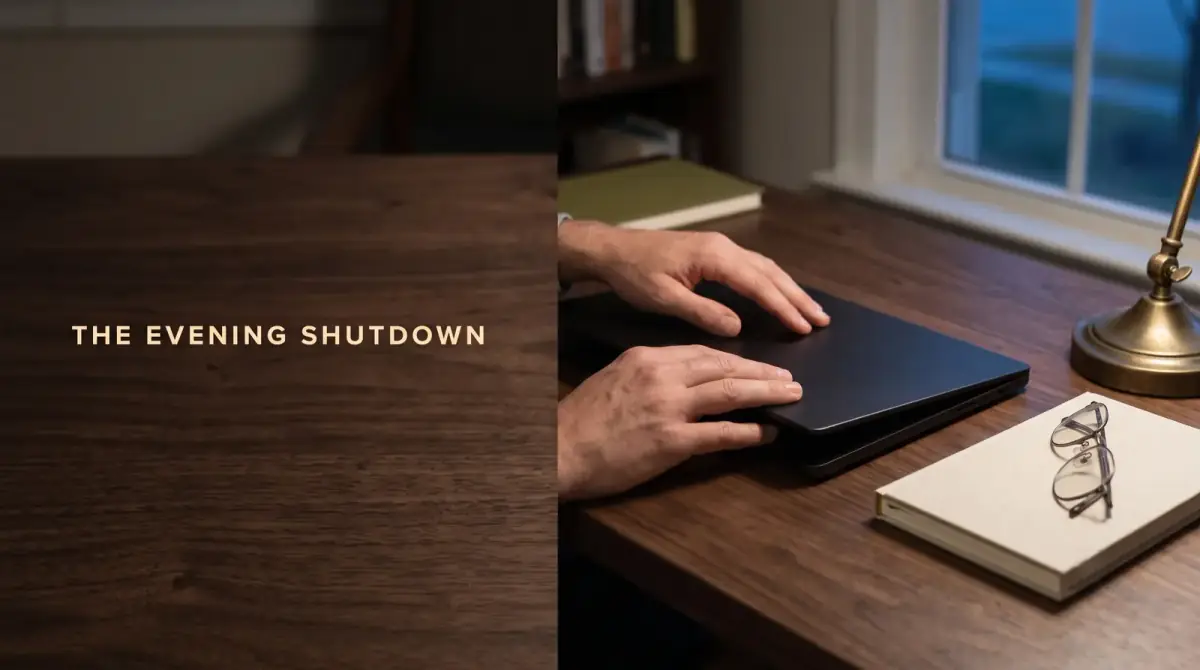
- Close it out loud. Thirty seconds. Shut the laptop, say your closing phrase, walk away.
Why one must-do and not a list
A list of nine things is not a plan, it is a wish. You will wake up, look at it, and feel behind before you have started. One clearly named task means tomorrow-you does not have to spend the first hour negotiating with yourself about where to begin.
Why the "I'm done" cue matters more than it sounds
The closing phrase feels silly until you use it for a week. Say something simple and always the same. "Shutdown complete." "That's the day." Out loud, quietly, whatever you can manage without your flatmate filing a report.
What you are doing is giving your brain a clear boundary marker. Habits attach to signals, and a signal you repeat becomes shorthand for a whole state change. Over time the phrase stops being a phrase and starts being a switch.
Pair it with something physical if the words alone feel thin. Close the laptop lid, put it in a drawer or a bag rather than leaving it open on the table, and change out of your work clothes. An open laptop is an invitation. A closed one in a cupboard is a door.
The workday does not end when the work runs out. It ends when you decide it does.
What if you work from home and there's no commute?
The commute was doing quiet work for you. Twenty minutes of nothing, a physical change of scenery, a natural gap where the day decompressed on its own. Working from home deletes that gap and nobody replaces it, which is why so many remote workers describe their evenings as slightly haunted.
You have to build the gap manually. It does not need to be twenty minutes of meditation. It needs to be a transition with a beginning and an end.
- A short walk around the block, even a five-minute one, ideally the same route.
- Tidying the desk into a state you would be happy to find in the morning.
- A shower, or just washing your face and changing your top.
- Cooking, if cooking is a pleasure rather than another chore.
- Ten minutes of something with your hands: an instrument, a puzzle, watering plants.
Consider Daniel, a developer who works from a corner of the living room. His shutdown is fifteen minutes of capture and planning, then he carries the laptop upstairs and leaves it there. The stairs are the commute. It sounds absurd. It works, because the point was never distance, it was the deliberate crossing of a line.
What about a genuine emergency at 9pm?
Sometimes the server really is down. Shutdown is a routine, not a vow, and treating it as sacred is how people abandon it entirely the first time reality intrudes.
When something real lands late, handle it. Then do a second, thirty-second shutdown: write what happened, write the next step, say the phrase again. Reclose the loop you just reopened.
The important question comes the next morning, not that night. Ask yourself honestly whether it was an emergency or a habit. If 9pm crises arrive weekly, the problem is not your evening routine, it is the expectations you have quietly agreed to.
The transition hour between shutdown and bed
Shutdown ends the workday. It does not instantly produce calm, and expecting it to is why people declare it broken after two days. The hour afterwards is where the nervous system actually comes down.
Protect that hour from the sideways version of work: scrolling industry news, "quickly checking" the team chat, reading email you have decided not to answer. Reading a message you will not act on is the worst of both worlds. You reopen the loop and you do not close it.
If a work thought surfaces during that hour, and it will, do not fight it. Write it on the capture list and go back to what you were doing. The list is the whole reason the thought is allowed to leave.
How do you keep it when your schedule falls apart?
Travel, illness, a newborn, a week where every day ends at a different time. The routine will break. What matters is that it is small enough to survive being squeezed.
Keep a minimum version you can do anywhere in ninety seconds: capture the loose threads, name tomorrow's one thing, say the phrase. On a train, in a hotel, standing in a hallway. That stripped-back version is the actual habit. The full fifteen minutes is the luxury edition.
When you miss a few days
Do not restart. Just do it tonight. A routine you return to after a gap is not a failed routine, it is a normal one. The only version that fails permanently is the one you decide you have to earn back.
The takeaway
You are not tired at 10pm because you worked too hard. You are tired because nothing ever told your brain the work was over, so it kept a dozen background processes running through dinner, through the film, through the walk you took specifically to relax.
Fifteen minutes. Review, capture, look ahead, choose one thing, say it's done. Do it tomorrow and then the day after, and notice what your evenings feel like by the end of the week.
The day has to end somewhere. Better that you choose the moment than let it leak into everything else you were hoping to enjoy.

Comments
0 total