
The short answer
New to exercise? These home workouts for beginners need no equipment. Learn a simple routine, key moves, and tips to build strength at home.
- Good form over speed or reps.
- Consistency over intensity.
- Full-body movements that work several muscles at once.
Home workouts for beginners are one of the easiest ways to get fit without a gym, expensive equipment, or any experience at all. With just your body weight and a little space, you can build strength, boost energy, and create a habit that actually sticks. The best part is that you can start today, right where you are.
This guide gives you a simple, no-equipment routine plus the tips you need to do it safely and confidently.
Why start with home workouts?
Working out at home removes the biggest barriers most beginners face: intimidation, cost, and travel time. There's no crowded gym, no waiting for machines, and no self-consciousness about doing it "wrong" in front of others.
You also build consistency faster because the workout is always available. When exercise is this convenient, showing up becomes the easy part.
What should a beginner focus on first?
The goal early on isn't to exhaust yourself. It's to learn a few key movement patterns and repeat them regularly. Focus on:
- Good form over speed or reps.
- Consistency over intensity.
- Full-body movements that work several muscles at once.
If you can move well and keep coming back, results follow naturally.
A simple full-body beginner routine
Here's a beginner-friendly circuit using only your body weight. Always warm up first with a few minutes of marching in place, arm circles, and gentle stretches.
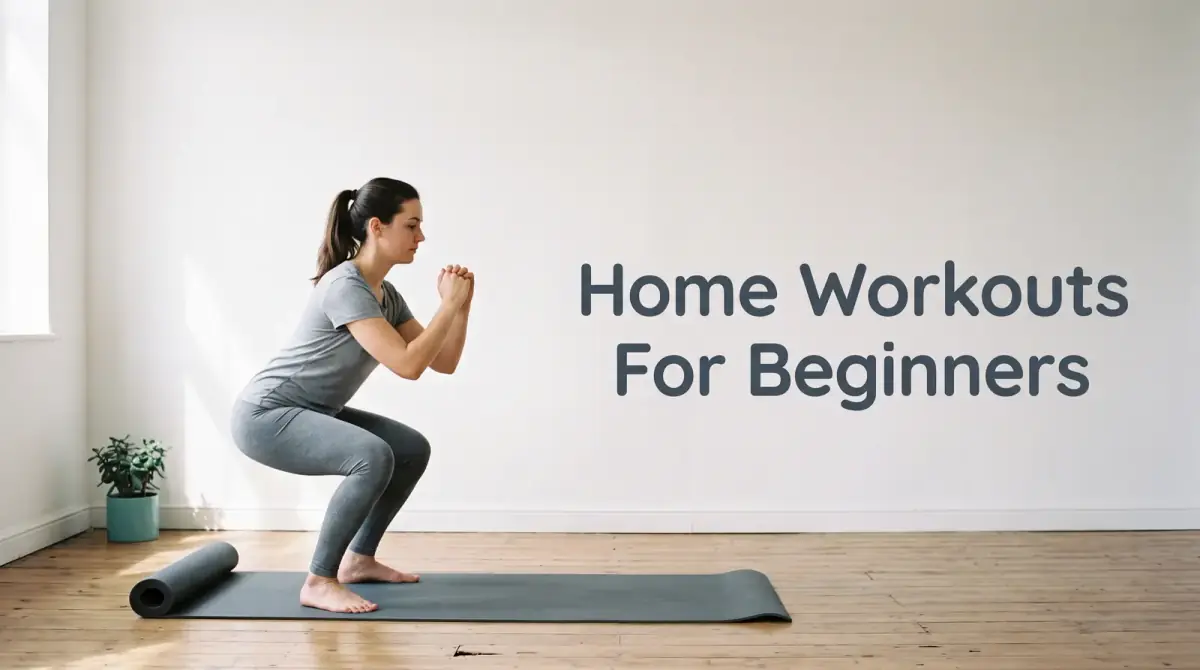
1. Bodyweight squats
Stand with feet shoulder-width apart. Push your hips back and bend your knees as if sitting into a chair, then stand tall. This builds your legs and glutes. Aim for 10 to 12 reps.
2. Wall or knee push-ups
Too hard to do a full push-up? Start against a wall or on your knees. Lower your chest toward the surface and press back up. This strengthens your chest, shoulders, and arms. Aim for 8 to 10 reps.
3. Glute bridges
Lie on your back with knees bent and feet flat. Squeeze your glutes and lift your hips toward the ceiling, then lower slowly. Great for your backside and lower back. Aim for 12 reps.
4. Standing marches or knee raises
March in place, lifting each knee toward your chest. This raises your heart rate and engages your core. Continue for 30 to 45 seconds.
5. Plank
Hold your body in a straight line on your forearms and toes (or knees to start). Keep your core tight and don't let your hips sag. Hold for 15 to 30 seconds.
Rest about 30 seconds between exercises, then repeat the whole circuit two to three times.
How often should beginners work out at home?
Start with three sessions per week on non-consecutive days, such as Monday, Wednesday, and Friday. This gives your muscles time to recover and adapt.
On off days, stay lightly active with a walk or some stretching. Rest is not laziness, it's part of getting stronger.
A sample weekly plan
- Monday: Full-body circuit (2 to 3 rounds).
- Tuesday: Rest or a relaxed walk.
- Wednesday: Full-body circuit again.
- Thursday: Rest or gentle stretching.
- Friday: Full-body circuit.
- Weekend: Light movement you enjoy, like walking, dancing, or yoga.
Tips to stay safe and consistent
A few habits will keep you injury-free and motivated for the long haul.
- Warm up and cool down every time to protect your joints and muscles.
- Move slowly and with control rather than rushing through reps.
- Breathe steadily, exhaling on the effort and never holding your breath.
- Progress gradually by adding reps or an extra round before making moves harder.
- Stop if you feel sharp pain. Mild muscle fatigue is normal; joint pain is not.
The best workout is the one you'll actually do. A short, imperfect session beats a perfect plan you skip.
How do you make the workouts harder over time?
Your body adapts, which is a good thing. Once the routine starts to feel easy, gently raise the challenge so you keep progressing.
- Add reps or rounds before anything else. Going from two rounds to three is a simple win.
- Slow down the movement, especially the lowering phase, to make each rep count more.
- Progress the exercise, such as moving from wall push-ups to knee push-ups to full push-ups.
- Shorten your rest slightly to keep your heart rate up.
Small, steady steps are far more effective and sustainable than sudden leaps that leave you sore or discouraged.
Do you need equipment for home workouts?
Not at all. Your body weight provides plenty of resistance to build real strength as a beginner. That said, a few inexpensive items can add variety once you're ready, such as resistance bands or a single set of light dumbbells.
A yoga mat also makes floor exercises more comfortable, but a towel or carpet works fine. Don't let a lack of gear be your excuse, because you already have everything you need to begin.
How do you stay motivated?
Motivation fades for everyone, so lean on structure instead. Set a regular time, keep your workout space clear, and track your sessions on a calendar. Watching those checkmarks add up is surprisingly satisfying.
Celebrate small wins too. Holding a plank five seconds longer or finishing an extra round is real progress worth noticing.
The takeaway
You don't need fancy gear or a gym membership to get stronger. With a handful of simple bodyweight moves and a little consistency, home workouts for beginners can transform how you feel in just a few weeks.
Start small, show up regularly, and let momentum do the rest. Your future self will thank you.

Comments
0 total