
The short answer
Cut through the protein hype. Clear gram-per-kilo ranges, real food portions, plant-based options, and whether you actually need a powder.
- Mostly sedentary adult: around 0.8 g/kg. Roughly 55 to 65 g for an average-sized person.
- Regularly active — walking, cycling, recreational sport: around 1.0 to 1.4 g/kg.
- Strength training to build muscle: around 1.6 to 2.0 g/kg. Pushing far beyond this rarely adds much.
- Eating in a calorie deficit: nudge higher, often towards 1.6 g/kg, because protein helps protect muscle while you are eating less.
- Older adults, roughly 65 and up: experts generally recommend more than the baseline, often in the region of 1.0 to 1.2 g/kg or above, because ageing muscle responds less readily to the protein it is given.
Walk down any supermarket aisle and protein is shouting at you from the shelves. Protein water. Protein cookies. Protein pancake mix that costs three times what pancake mix has any right to cost. Somewhere between the gym-bro corner of the internet and the marketing departments, a perfectly ordinary nutrient turned into a personality trait.
So let's answer the actual question. How much protein do you need a day depends mostly on your body weight and how much you are asking your muscles to do. As a rough guide, a sedentary adult needs somewhere around 0.8 grams of protein per kilogram of body weight — the standard baseline most public health bodies use. People who train regularly, are losing weight, or are past their mid-sixties generally do better somewhere in the 1.2 to 2.0 g/kg range. For a 70 kg person, that is roughly 56 g at the low end and 85 to 140 g if you are active.
How much protein do you need a day, really?
The 0.8 g/kg figure is worth understanding properly, because it gets misquoted in both directions. It is not an optimal target. It is closer to the amount that prevents deficiency in most healthy adults — a floor, not a ceiling.
That distinction matters. If you sit at a desk most of the day, eat enough food overall, and are not especially worried about muscle, the baseline is genuinely fine. Most people in wealthy countries clear it without trying. But the moment you ask more of your body, the floor stops being the right target.
Rough ranges by situation
- Mostly sedentary adult: around 0.8 g/kg. Roughly 55 to 65 g for an average-sized person.
- Regularly active — walking, cycling, recreational sport: around 1.0 to 1.4 g/kg.
- Strength training to build muscle: around 1.6 to 2.0 g/kg. Pushing far beyond this rarely adds much.
- Eating in a calorie deficit: nudge higher, often towards 1.6 g/kg, because protein helps protect muscle while you are eating less.
- Older adults, roughly 65 and up: experts generally recommend more than the baseline, often in the region of 1.0 to 1.2 g/kg or above, because ageing muscle responds less readily to the protein it is given.
Use your body weight in kilograms as the multiplier. If you carry a lot of excess weight, calculating from a healthy target weight gives a more sensible number than your current one.
Why spreading protein across the day beats one huge dinner
Here is a pattern that turns up constantly: toast for breakfast, a sandwich with a whisper of ham for lunch, then a chicken breast the size of a paperback at eight in the evening. The daily total might technically land in range. The distribution is doing you no favours at all.
Muscle protein synthesis — the process of actually building and repairing tissue — responds to a meaningful dose of protein in one sitting, then settles down again. Studies suggest that hitting a decent amount at several points across the day stimulates that process more often than back-loading everything into the evening.
Practically, aim for something in the region of 25 to 40 grams at each main meal rather than 10, 15 and 90. Breakfast is almost always the weak link. It is also the easiest thing to fix.
What a realistic day of eating looks like
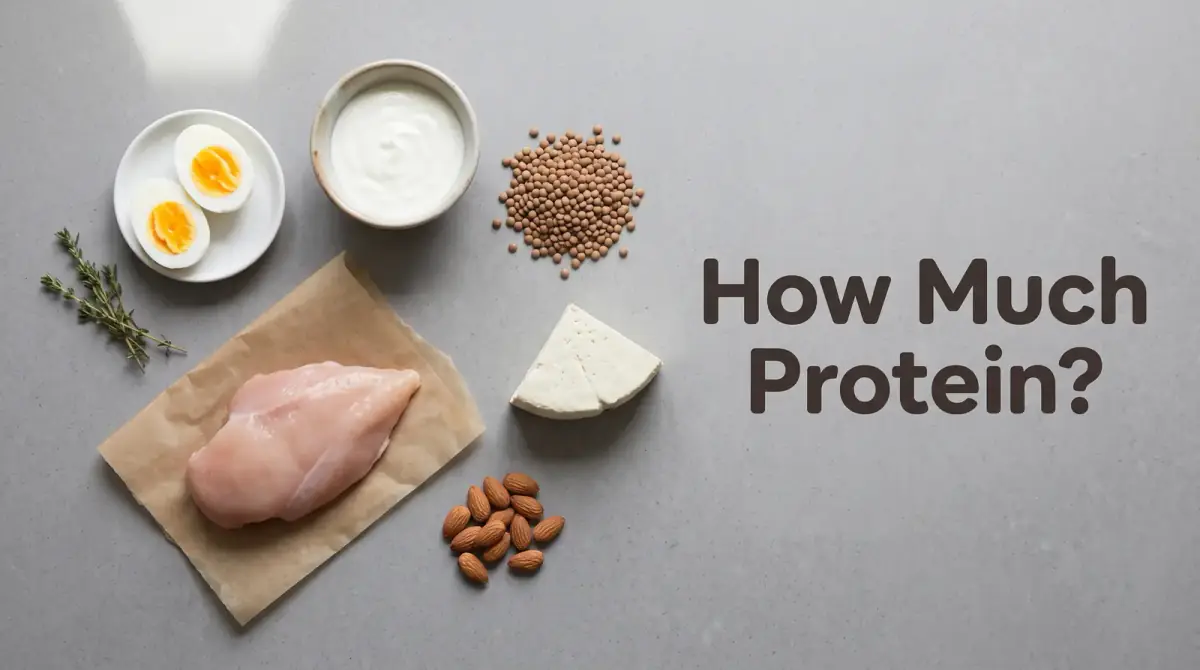
Numbers are abstract. Food is not. Here is roughly what protein looks like on a plate, with portions you can eyeball without a scale:
- Chicken breast, palm-sized (about 100 g cooked): roughly 30 g protein
- Salmon fillet: roughly 25 g
- Two large eggs: roughly 12 g
- A generous pot of Greek yoghurt: roughly 15 to 17 g
- A tin of tuna: roughly 25 g
- Cooked lentils, a mugful: roughly 18 g
- Firm tofu, a thick slab: roughly 15 to 20 g
- Cottage cheese, half a tub: roughly 14 g
Stack a few of those and a day comes together fast. Greek yoghurt with berries and a spoonful of nuts. A lunch built around tinned fish or leftover chicken instead of built around bread. Dinner with a palm-sized portion of something plus beans or lentils alongside. That is most people comfortably past 100 g without a single scoop of powder.
Plant-based protein done right
Plant eaters can absolutely hit these targets. It simply takes a little more deliberate planning, because plant proteins tend to be less concentrated and individually lower in one or another essential amino acid.
The fix is not complicated, and it is not the old rule about carefully combining proteins at every single meal — that idea has been quietly retired. Eat a decent variety of protein sources across the day and your body handles the arithmetic.
- Anchor meals around a protein source. Lentils, chickpeas, black beans, tofu, tempeh, edamame — the star of the plate, not a side dish.
- Lean on soy foods. Tofu, tempeh and edamame are the closest plant equivalents to animal protein in both quality and density.
- Add seitan if you tolerate gluten. It is exceptionally protein-dense for the volume.
- Treat nuts, seeds and wholegrains as top-ups. Real contributors across a day, but rarely enough on their own.
- Aim slightly higher overall. Plant proteins are digested a little less efficiently, so nudging your target up a touch is sensible.
Do you actually need protein powder?
No. Not in any medical sense. Protein powder is a convenience food — a fast, relatively cheap, portable way to add 20 to 25 grams without cooking anything.
That convenience is genuinely useful for some people. Someone training hard with a small appetite. Someone who skips breakfast every morning and would rather not. An older adult struggling to eat enough at all. For most people eating a normal mixed diet, it is entirely optional.
If you do use it, treat it as one ingredient among many rather than a stand-in for meals. Whole foods bring fibre, micronutrients and genuine fullness that a scoop of powder simply does not.
Can you overdo it?
For healthy people with normal kidney function, intakes across the ranges above are generally considered safe. The bigger practical risk is crowding out everything else — a plate that is all chicken and no vegetables is a poorer diet, not a better one.
There are real exceptions, though. If you have kidney disease, reduced kidney function or liver disease, your protein intake is something to work out with your doctor or a registered dietitian, not from an article. The same goes during pregnancy, or if you are managing a condition where diet forms part of the treatment. And if you are simply unsure whether your kidneys are working normally before making a big change, a short conversation with your GP is a reasonable first move.
The practical takeaway
Protein is not magic and it is not a moral test. It is one nutrient with a fairly boring, well-understood job, and getting it roughly right beats getting it precisely wrong.
- Work out your rough target: body weight in kilograms times 0.8 if sedentary, 1.2 to 2.0 if active or older.
- Split it across meals instead of hoarding it all for dinner.
- Fix breakfast first, because that is usually where the gap sits.
- Build each meal around a protein source, then add everything else around it.
- Skip the protein cookies. Buy eggs, yoghurt, lentils, beans and fish instead.
Get those five things approximately right and you can ignore the packaging entirely.



Comments
0 total