
The short answer
Ever wonder why habits form at all? See how the cue-routine-reward loop, repetition, and reward teach your brain to automate behavior, and how to build habits that stick.
- Habits are your brain saving energy by automating actions.
- They run on a loop: a cue, a routine, and a reward.
- Repetition and reward are what lock the loop in place.
- A brain region takes over so the action needs little thought.
- The same science can help you build habits that stick.
Habits form because your brain is always hunting for ways to save effort. When a behavior reliably leads to a reward, your brain files it away as an automatic routine so it no longer has to think it through each time. Understanding why habits form gives you a real edge, because the same rules that build routines by accident can help you build good ones on purpose.
None of this is magic. It is a repeatable loop your brain runs quietly in the background, thousands of times, without asking your permission.
Here is the short version first:
- Habits are your brain saving energy by automating actions.
- They run on a loop: a cue, a routine, and a reward.
- Repetition and reward are what lock the loop in place.
- A brain region takes over so the action needs little thought.
- The same science can help you build habits that stick.
What a habit actually is
A habit is a behavior you repeat so often that it becomes nearly automatic. You do it without much conscious thought, like reaching for your phone the moment you wake up or tying your shoes in the same order every time.
That automatic quality is the whole point. Your brain cannot deliberate over every small choice, so it turns frequent actions into shortcuts. Habits are those shortcuts running on autopilot.
Why habits form in the first place
Your brain is an energy saver. Thinking hard burns fuel, so anything it can hand off to autopilot frees up mental power for new or important problems.
This is the core reason why habits form. When you repeat an action that leads to something good, your brain notices the pattern and starts to automate it. Over time the thinking part steps back and the routine runs on its own.
This system is neutral. It does not care whether the habit helps you or harms you. It only cares that the loop keeps paying off in some way.
The cue-routine-reward loop
Most habits follow a simple three-part loop. Once you can spot it, you can start to work with it.
- Cue: a trigger that tells your brain to start, like a time of day, a place, a feeling, or an action that came before.
- Routine: the behavior itself, whether that is a run, a snack, or a scroll.
- Reward: the payoff that makes the loop worth repeating, like relief, pleasure, or a small hit of satisfaction.
The reward is what teaches your brain the loop is worth keeping. Over many repeats, the cue alone starts to trigger a craving for the reward, and the routine follows almost on its own.
How your brain automates behavior
Deep inside the brain sits a set of structures often called the basal ganglia, which play a major role in forming habits. As a behavior repeats, the effort involved shifts so the action needs less conscious attention to run.
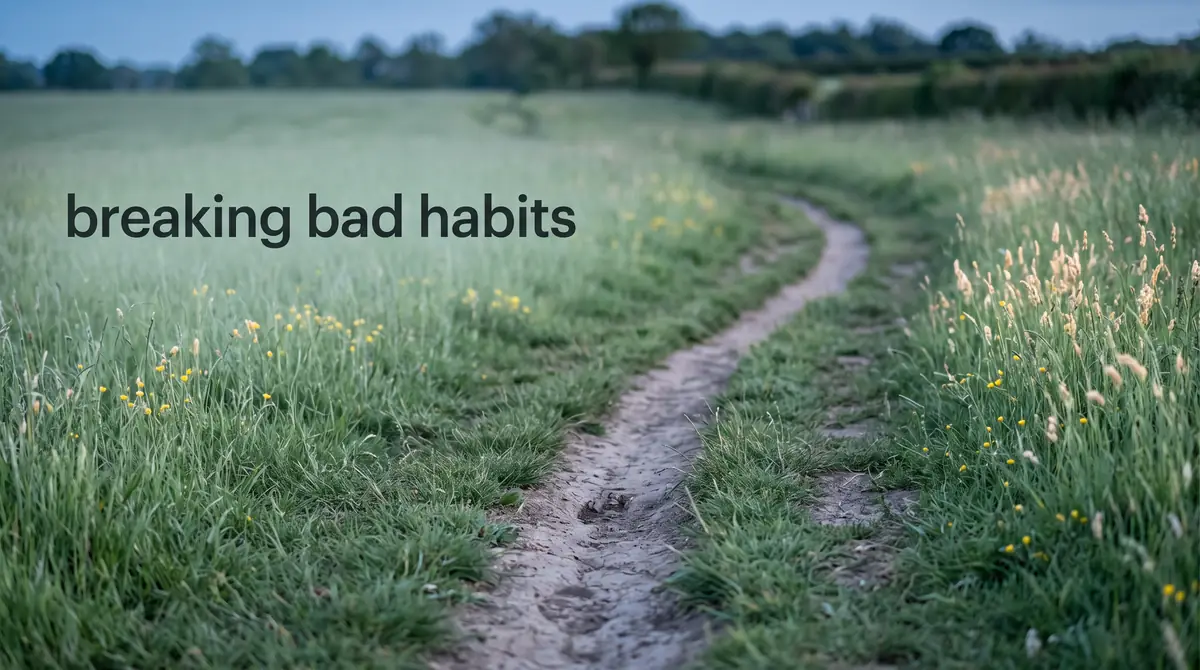
Think of it like a path worn across a field. The first crossing takes effort and attention. After hundreds of crossings, the trail is clear and you follow it without thinking. Repeated behavior wears a similar path in the brain.
This is why an old habit can feel effortless while a new one feels clumsy. The path simply is not worn in yet.
Why repetition and reward matter
Two ingredients drive habit formation more than anything else: repetition and reward. Miss either one and the loop struggles to hold.
Repetition is what wears the path. A behavior done once is just an event. Done daily, it slowly becomes automatic. There is no single number of days that works for everyone, and the time it takes varies a lot from person to person and habit to habit.
Reward is what tells your brain the loop is worth keeping. The payoff can be obvious, like a tasty treat, or subtle, like a sense of calm or progress. If a new habit gives you nothing you value, it tends to fade.
How to build habits that stick
Once you know why habits form, building good ones gets more practical. You are not fighting your brain, you are using its own rules. Here is how to build habits that stick.
- Attach the new habit to a clear, existing cue, like right after you brush your teeth.
- Start small enough that the routine feels easy to repeat.
- Give yourself an immediate reward so your brain links the action to something good.
- Repeat it in the same context until it starts to run on its own.
The trick to making habits stick is consistency over intensity. A tiny action done daily wires in faster than a big one done now and then.
Why bad habits are so hard to break
The same science explains why bad habits cling. Once the loop is worn in, the cue keeps firing and the craving keeps showing up, even when you know the habit is not good for you.
You usually cannot erase a habit loop, but you can redirect it. Keep the same cue and reward, and swap in a healthier routine in the middle. If stress cues a snack and the reward is really relief, a short walk might scratch a similar itch.
Be patient with yourself. Slips are part of the process, and one off day does not undo the path you are building.
The bottom line
Habits form because your brain automates rewarding behavior to save effort, running the cue-routine-reward loop until the action needs almost no thought. Understanding why habits form turns that process into a tool. Pick one small routine, tie it to a clear cue, reward yourself, and repeat it. Results vary, but the loop works whether you plan it or not, so you may as well aim it at something good.
Comments
0 total