
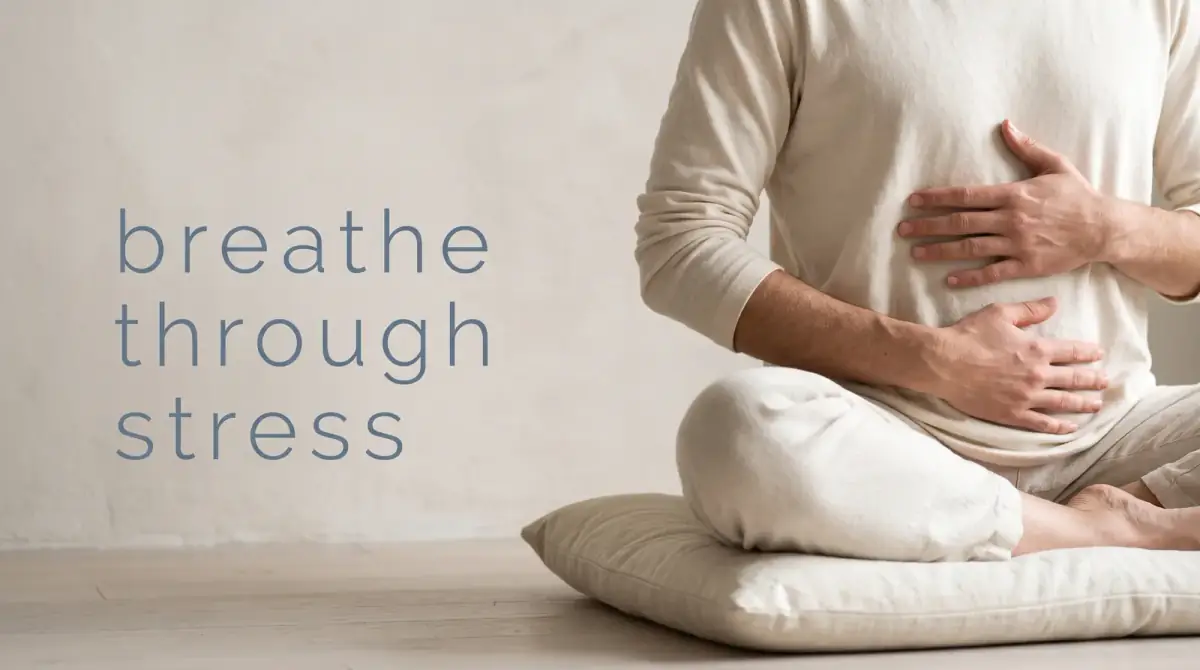
The short answer
Five breathing techniques for stress relief, taught step by step, plus when to use each one and how to build a two-minute daily habit.
- Sudden spike of stress: the physiological sigh. It works in seconds.
- Sustained pressure where you need to stay sharp: box breathing.
- General daily de-escalation: extended exhale, 4-6.
- Rebuilding a calmer baseline over weeks: diaphragmatic breathing, practised regularly.
- Cannot switch off at bedtime: the 4-7-8.
Your manager sends a message that just says “quick chat?” and your chest tightens before you have even stood up. Heart rate climbs. Breathing rises into your shoulders. Some ancient part of your brain has decided that a calendar invitation is a predator.
The useful thing about that reaction is that it runs on a two-way street. Stress changes your breathing, but deliberately changing your breathing also changes your stress. That is the entire premise behind breathing techniques for stress relief, and the most reliable lever is stunningly simple: make your exhale longer than your inhale. Do that for sixty to ninety seconds and most people feel their system come down a notch. No app, no cushion, no incense required.
Why do slow exhales calm you down?
In plain English, your nervous system has an accelerator and a brake. The accelerator is the fight-or-flight side that floods you with alertness. The brake is the rest-and-digest side, carried largely by the vagus nerve.
Your breath is wired into both. When you inhale, your heart rate ticks up slightly. When you exhale, it eases back down. Lengthen the exhale and you simply spend more of each breath cycle with a foot on the brake pedal.
It is not mystical, and it is not instant. What it is, is available. You can do it in a lift, in traffic, or halfway through a difficult conversation, and nobody watching will notice a thing.
Five breathing techniques for stress relief, step by step
1. Extended exhale, or 4-6 breathing
The workhorse. If you only ever learn one, learn this one.
- Sit or stand comfortably and let your shoulders drop away from your ears.
- Breathe in through your nose for a count of four.
- Breathe out through your nose, or through slightly pursed lips, for a count of six.
- No pause needed at either end. Repeat for one to three minutes.
If four and six feel awkward, scale them. Three in and five out works. So does five in and seven out. The ratio matters far more than the specific numbers.
2. Box breathing
Four equal sides: in, hold, out, hold. It is favoured in high-pressure professions because the rhythm is easy to hold onto even when your brain has gone foggy.
- Inhale through the nose for a count of four.
- Hold for four.
- Exhale for four.
- Hold empty for four, then repeat for four to six rounds.
Best for focused alertness under pressure — before a presentation, a hard phone call, the start of a race. It steadies you without making you sleepy.
3. The physiological sigh, or double inhale
The fastest thing on this list, and the one to reach for when stress spikes suddenly and hard.
- Inhale through your nose.
- On top of that breath, add a second, shorter sniff of air.
- Let it out as a long, slow sigh through your mouth.
- Repeat one to three times.
You already do this without thinking. It is what happens after crying, and it happens periodically while you sleep. The second inhale helps reinflate collapsed air sacs in the lungs and the long sigh clears out carbon dioxide. Many people report a noticeable drop in tension within a couple of breaths.
4. Diaphragmatic, or belly, breathing
Less a technique than a repair job. Chronically stressed people tend to breathe shallowly into the upper chest, which keeps the alarm system faintly lit all day long.
- Lie down or sit back. Put one hand on your chest and one on your belly.
- Breathe in through your nose and aim the breath low. The belly hand should rise; the chest hand should barely move.
- Exhale slowly and let the belly fall again.
- Five to ten minutes, whenever you can spare it.
Practise lying down at first. It is far easier to feel the movement that way, and the pattern gradually carries over into sitting and standing.
5. The 4-7-8 for winding down
A long exhale at a deliberately slow tempo. This one belongs at the end of the day rather than the middle of it.
- Exhale fully through your mouth.
- Inhale quietly through the nose for four.
- Hold for seven.
- Exhale through the mouth for eight.
- Four rounds is plenty when you are starting out.
Plenty of people find the seven-count hold uncomfortable at first. Shorten everything proportionally — try 2-3-4 — and build up from there.
Which technique should you use, and when?
- Sudden spike of stress: the physiological sigh. It works in seconds.
- Sustained pressure where you need to stay sharp: box breathing.
- General daily de-escalation: extended exhale, 4-6.
- Rebuilding a calmer baseline over weeks: diaphragmatic breathing, practised regularly.
- Cannot switch off at bedtime: the 4-7-8.
Common mistakes that make things worse
Over-breathing. The most frequent error is hearing “deep breathing” and interpreting it as big breathing — hauling in enormous lungfuls of air. That clears out too much carbon dioxide and can leave you lightheaded, tingly and more anxious than when you started. Slow and small beats deep and dramatic.
Forcing it. Straining to reach a count you are not ready for adds tension rather than releasing it. Every number here is adjustable. If a technique feels like effort, shorten it.
Expecting a switch. These exercises turn the volume down; they do not turn the feeling off. Judging them by whether stress vanished entirely is a reliable way to abandon something that was quietly helping.
Only using them in emergencies. Practise while you are calm and the skill is actually there when you are not.
One genuinely important caveat. If you have asthma, COPD or another respiratory condition, or if you live with panic attacks, breath holds and forceful patterns can occasionally trigger symptoms rather than ease them. Go gently, favour the plain extended exhale over anything involving holds, and talk to your clinician about what suits you. Anyone who feels faint, or whose breathlessness or chest pain is new or unexplained, should stop and have that assessed medically rather than try to breathe through it.
How to build a two-minute daily habit
Ambition kills this. Almost nobody sustains twenty minutes a day. Two minutes, on most days, does considerably more.
- Attach it to something you already do. After you park the car. Before you open your laptop. While the kettle boils.
- Pick one technique and stay with it for a fortnight. Variety is a distraction at the beginning.
- Set a two-minute timer so you are not counting rounds and glancing at the clock.
- Keep going on the days it feels pointless. Those are the days that build the habit.
- Add a second slot only once the first one is automatic.
The takeaway
Of everything sold to you as stress relief, this one is free, portable and takes less time than making a cup of tea. The mechanism is deeply unglamorous: longer exhales, gentler breaths, repeated often enough to become a reflex.
Start with 4-6 breathing for two minutes a day. Keep the physiological sigh in your back pocket for the moments that ambush you. That is genuinely enough to make a difference, and everything after it is refinement.
Comments
0 total