
The short answer
Declined because you have no credit history, and you needed credit to build it. Here is how to break the deadlock and what actually moves the needle.
- A secured credit card. You place a deposit, and that deposit becomes your limit. The lender takes almost no risk, so approval is easy, and the account still reports like a normal card. This is the single most reliable starting point where it exists.
- A credit-builder loan. The amount borrowed sits in a locked account while you make payments, and you receive it at the end. You are effectively paying to create a payment record. Odd, but it works.
- Becoming an authorised user on someone else's account. A family member adds you to their long-standing card. Their history can carry onto your file in some systems. Only do this with someone who pays reliably, because their mistakes can land on you too.
- A starter account at a bank you already use. Institutions that can see your income and account behaviour are often willing to approve a small limit when strangers will not. Ask in person.
- Accounts that report ordinary bills. In some countries, rent, utilities, or phone contracts can be added to your credit file. If that option exists where you live, it is close to free history.
You apply for your first credit card and get declined. The reason given is that you have no credit history - so you needed the card to build the history you were rejected for not having. That loop is exactly why how to build credit from zero feels like a locked door with the key sitting inside.
Almost everyone hits this wall, and most people bounce off it for years longer than they need to. The good news is that the deadlock has known exits, and none of them require luck or a wealthy relative.
One caveat before anything else: credit systems differ enormously between countries. Some score you numerically, some keep a simple record of defaults, some barely track individuals at all. The tools below exist in most places under different names, but always check what your own country actually uses.
How to build credit from zero: the core idea
Here is the answer up front. You need one small account that reports your behaviour to whoever keeps records in your country, and you need to handle it perfectly and boringly for a long time. That is genuinely the whole mechanism.
Credit history is not a measure of wealth. It is a record of whether you do what you promised, repeatedly, over time. A person on a modest income with three years of flawless payments looks far better on paper than a high earner who forgets due dates.
Which means the goal is not to prove you can afford things. It is to generate evidence, and evidence needs time more than it needs money.
Why is the chicken-and-egg problem so brutal?
Because lenders are pricing uncertainty, and a blank file is uncertainty. No record is not the same as a good record - to an automated system, an empty file and a bad file can both mean "decline".
It gets worse. Rejections often push people to apply somewhere else immediately, and in many systems a cluster of applications in a short window looks like distress. So the natural response to being refused can make the next refusal more likely.
The way out is not to apply harder. It is to apply to products designed for people with no history at all.
Which tools break the deadlock?
These are the standard entry points. Availability varies by country, so treat this as a list to ask your bank about rather than a menu you can order from anywhere.
- A secured credit card. You place a deposit, and that deposit becomes your limit. The lender takes almost no risk, so approval is easy, and the account still reports like a normal card. This is the single most reliable starting point where it exists.
- A credit-builder loan. The amount borrowed sits in a locked account while you make payments, and you receive it at the end. You are effectively paying to create a payment record. Odd, but it works.
- Becoming an authorised user on someone else's account. A family member adds you to their long-standing card. Their history can carry onto your file in some systems. Only do this with someone who pays reliably, because their mistakes can land on you too.
- A starter account at a bank you already use. Institutions that can see your income and account behaviour are often willing to approve a small limit when strangers will not. Ask in person.
- Accounts that report ordinary bills. In some countries, rent, utilities, or phone contracts can be added to your credit file. If that option exists where you live, it is close to free history.
You only need one of these. Opening several at once is a common beginner error and it works against you.
Which habits actually move the needle?
Once an account is open, a small number of behaviours do nearly all the work.
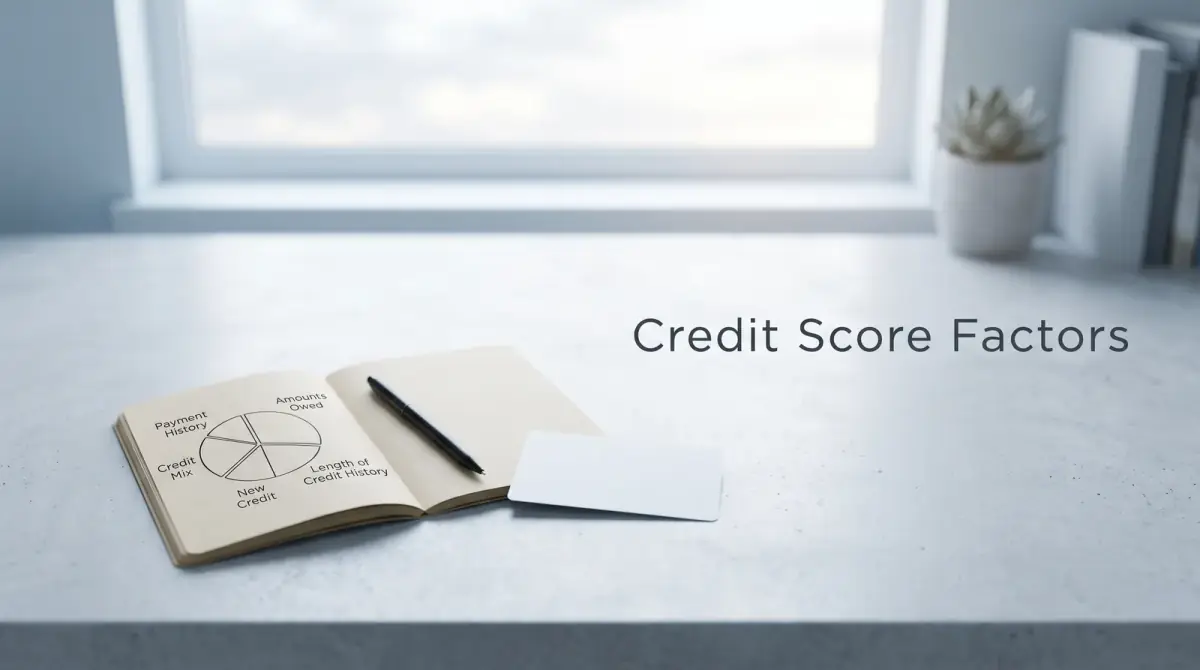
- Pay on time, every time, without exception. Payment history is the heaviest factor in essentially every system that exists. One missed payment can undo months of progress, and it lingers.
- Keep your reported balance low relative to your limit. A commonly repeated guideline is to stay under roughly a third of your limit. Whether that exact threshold matters depends on the system, but lower is reliably better everywhere.
- Let accounts get old and leave them open. The age of your history counts. Your first card is an asset that grows more valuable simply by continuing to exist.
- Apply rarely. Space applications out by many months. Each one leaves a mark in most systems, and a burst of them looks like desperation.
- Check your own file periodically. Errors are common and they are your problem to catch. Find out how to request your record in your country and actually read it.
The utilisation detail beginners get wrong
Most people assume that paying the full balance by the due date means a zero balance is reported. Often it does not. Many lenders report your balance on the statement date, which can be well before your payment lands.
So you can pay in full, never owe a penny of interest, and still have a high balance recorded. If your limit is 500 as an illustration, and you spend 400 before the statement cuts, that near-maxed figure is what gets reported.
The fix is simple: make a payment before the statement date, not just before the due date. Small habit, outsized effect.
What mistakes set beginners back?
- Closing your oldest account. It feels tidy. It shortens your history and can shrink your total available credit at the same time.
- Applying everywhere after a rejection. Wait, find out why, and fix the cause before trying again.
- Carrying a balance on purpose. You do not need to pay interest to build credit. That myth is expensive and stubbornly persistent.
- Treating the limit as money you have. A credit limit is not income. Spending it because it is there is how a credit-building tool turns into a debt problem.
- Paying for services that promise fast fixes. Nothing legitimate accelerates this meaningfully. Anyone claiming otherwise is charging you for time passing.
- Going quiet. An unused card can go dormant and stop reporting. Put one small recurring charge on it and let it run.
Credit is built by being boring on a schedule. There is no clever version of this.
How long does it actually take?
Longer than you want and less long than you fear. In most systems a file starts to look usable after several months of clean activity, and genuinely solid after a couple of years.
The curve is front-loaded in one specific way: going from nothing to something is the hardest step. Once one account is open and behaving, everything after it gets easier - better offers, higher limits, fewer questions.
What you cannot do is compress it. Time is an actual input, not an obstacle to route around, and accepting that early saves a lot of frustration.
Your starting plan
- Find out how credit reporting works in your country and who keeps the records. This takes an afternoon and everything else depends on it.
- Request your own file, even if you expect it to be empty. Knowing your starting point matters.
- Open exactly one entry-level product - secured card, credit-builder loan, or a starter account at your existing bank.
- Put one small predictable expense on it and set up an automatic full payment.
- Make an extra payment before the statement date so the reported balance stays low.
- Then leave it alone for a year. No new applications, no closures, no cleverness.
Building credit from zero is not complicated, and that is exactly what makes it frustrating - there is nothing to optimise, only something to maintain. Open the smallest door you can find, walk through it, and let time do the part you cannot.

Comments
0 total