
The short answer
Spaced repetition means reviewing things just as you are about to forget them. Here is the plain-English explanation, a simple schedule, and how to start without an app.
- Review new material briefly on the day you learn it.
- Review again the next day.
- Then after about three days.
- Then after about a week.
- Then after two to three weeks.
Spaced repetition means spreading your review of the same material across days and weeks instead of packing it into one long session, and revisiting each item shortly before you would have forgotten it. It is one of the most reliable findings in the study of learning, and it needs almost no extra effort. Just different timing.
Same total hours, better placement, far more retained. That is the whole idea, and everything below is detail.
Why forgetting is part of the plan
Memory fades on a fairly predictable curve. Learn something today and you will lose a good share of it within a day or two if you never touch it again. Most of what you learned last term is gone, not because you learned it badly, but because you never went back.
Here is the useful twist. Every time you successfully recall something that has started to fade, the memory comes back stronger and decays more slowly afterwards. A little forgetting is not the enemy. It is what makes the next review worth doing.
Reviewing something you know perfectly is nearly wasted effort. Reviewing something you have completely lost means relearning from scratch. The sweet spot is the wobble in between, where you almost remember.
Why cramming fails in a specific way
Cramming works, briefly. Six hours the night before an exam will get information into your head, and much of it will still be there in the morning. That is why the habit survives.
What it does not do is last. Material packed into one session drops away quickly, which is why students who cram often cannot answer questions on the same topic a month later, and why second-year courses can feel like starting again from nothing.
If you only need to survive a single exam and never use the material again, cramming is defensible. If your subject builds on itself, or you need the knowledge for a professional qualification or a language you genuinely want to speak, it is a bad trade.
A schedule you can actually follow
You do not need precise intervals. Roughly expanding gaps are enough. A simple version that suits most people:
- Review new material briefly on the day you learn it.
- Review again the next day.
- Then after about three days.
- Then after about a week.
- Then after two to three weeks.
- Then monthly until the exam.
Each review should be short. Five to fifteen minutes on a topic is plenty once the first pass is done. Frequency and spacing do the work, not session length.
If you miss a review, do not restart the sequence. Do it late and carry on. The schedule is a guide, not a contract, and treating it as a contract is how people quit in week two.
Spacing only works with recall
This is the part people skip. Spaced rereading is much weaker than spaced retrieval. If your review consists of looking over your notes again on a tidy schedule, you get a fraction of the benefit.
Every review should be a small test. Cover the notes, answer the question, work the problem, say the sentence, then check. Spacing decides when you practise. Recall decides whether the practice does anything.
How to run it, on paper or on screen
Without an app
Plenty of people run spaced repetition on paper, and for some subjects paper is better than software.
The simplest paper system uses index cards and five dividers or envelopes labelled daily, every three days, weekly, fortnightly, monthly. New cards start in the daily pile. Get a card right and it moves back one box. Get it wrong and it returns to the front. Each day you work whichever boxes are due.
An even lighter version needs no cards at all. Keep a running question list for each topic in your notebook, date each review, and work through the oldest questions first. Crude, but it puts roughly the right material in front of you at roughly the right time, which is most of the benefit.
With an app
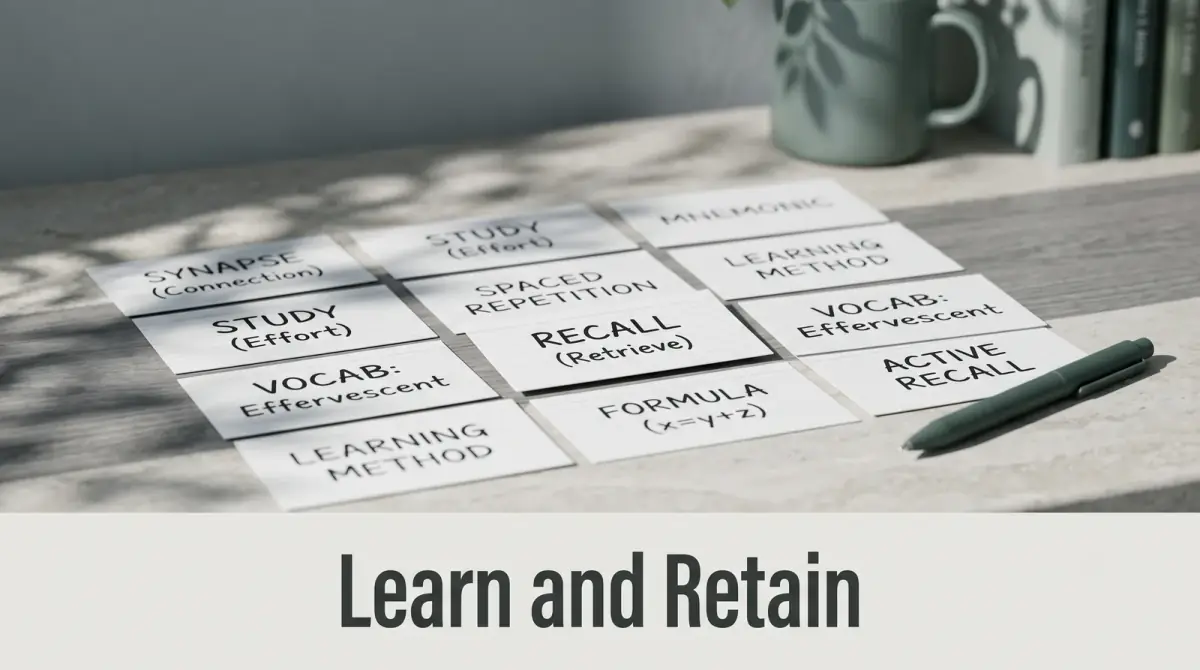
Flashcard software handles the scheduling for you, showing cards as they come due and pushing well-known cards further into the future. That is genuinely useful for large volumes of discrete facts: vocabulary, anatomy, drug names, legal definitions, characters in a new script.
Two warnings. Making cards is not studying, and it is very easy to spend a whole evening building a beautiful deck while learning almost nothing. And decks made by other people work much less well than your own, because writing the card is where you work out what the question really is.
Keep cards small. One fact per card. A card that asks you to recite an entire paragraph gets answered vaguely and marked correct, which quietly corrupts the whole system.
What spaced repetition is not good for
It suits facts, definitions, vocabulary, formulas, and procedures. It suits anything where the question has a clear answer that you either produce or do not.
It is a poor fit for skills that need a whole performance. You cannot card your way to a good essay, a working proof, or a fluent conversation. For those, space the practice instead of the facts. Write a timed essay plan every few days. Do a problem set from a topic you covered a fortnight ago. Have two short conversations a week rather than one long one a month.
The principle transfers even when the flashcards do not.
Starting this week
Pick one subject. Do not try to convert your entire course on a Sunday afternoon, because that is how these systems die.
- Take the topic you covered most recently and write ten questions on it.
- Answer them from memory today, then again tomorrow.
- Diary the next review three days out, then a week after that.
- Add ten questions from each new topic as you go.
- Keep every review under fifteen minutes.
Expect two things. The first fortnight feels like extra work with no visible payoff, because the benefit shows up as what you still know later. And the reviews get faster, not slower, as material settles.
Be realistic about fit
Study methods are not universal. Spacing is about as close to a general rule as learning research offers, but how you apply it depends on your subject, your memory, and how much control you have over your timetable. Someone on a coursework-heavy course will space differently from someone facing one large exam in June.
Adjust the intervals to whatever you will genuinely do. A rough system you keep up beats a precise system you abandon.



Comments
0 total