
The short answer
From soft love nibbles to a sudden nip mid-cuddle, cat bites carry meaning. Here is why your cat bites you and how to read the warning signs before it happens.
- Most cat bites are communication, not an attack.
- Soft love bites during grooming or cuddling are usually a sign of trust.
- Overstimulation is a very common reason for a bite mid-petting.
- Body language almost always warns you before teeth are involved.
- A sudden increase in biting or any sign of pain deserves a vet check.
If your cat drapes across your lap purring one moment and sinks in a quick nip the next, you have probably asked, why does my cat bite me? Cats bite for a whole range of reasons, from gentle love nibbles that show affection to sharper warnings that they have had enough handling. Most biting is communication rather than aggression, and once you learn to read the body language that comes before it, you can usually see a bite coming and head it off.
Below we break down the main types of cat biting, the cues that lead up to each one, and how to respond so the message does not have to be repeated. A sudden change in biting can also be about discomfort, so anything new or out of character is worth a mention to your vet.
Key takeaways
- Most cat bites are communication, not an attack.
- Soft love bites during grooming or cuddling are usually a sign of trust.
- Overstimulation is a very common reason for a bite mid-petting.
- Body language almost always warns you before teeth are involved.
- A sudden increase in biting or any sign of pain deserves a vet check.
Why does my cat bite me? The short answer
When people ask why does my cat bite me, they are usually picturing one of a few very different situations. There is the gentle nibble during a cuddle, the sharp nip after a long petting session, the playful pounce-and-bite of a bored cat, and the rare defensive bite from a cat that feels cornered or unwell. Each has its own trigger and its own solution.
The good news is that cats are honest communicators. They rarely bite out of nowhere, even if it feels that way to us. The trick is learning to notice the smaller signals they send first.
Love bites and gentle nibbles
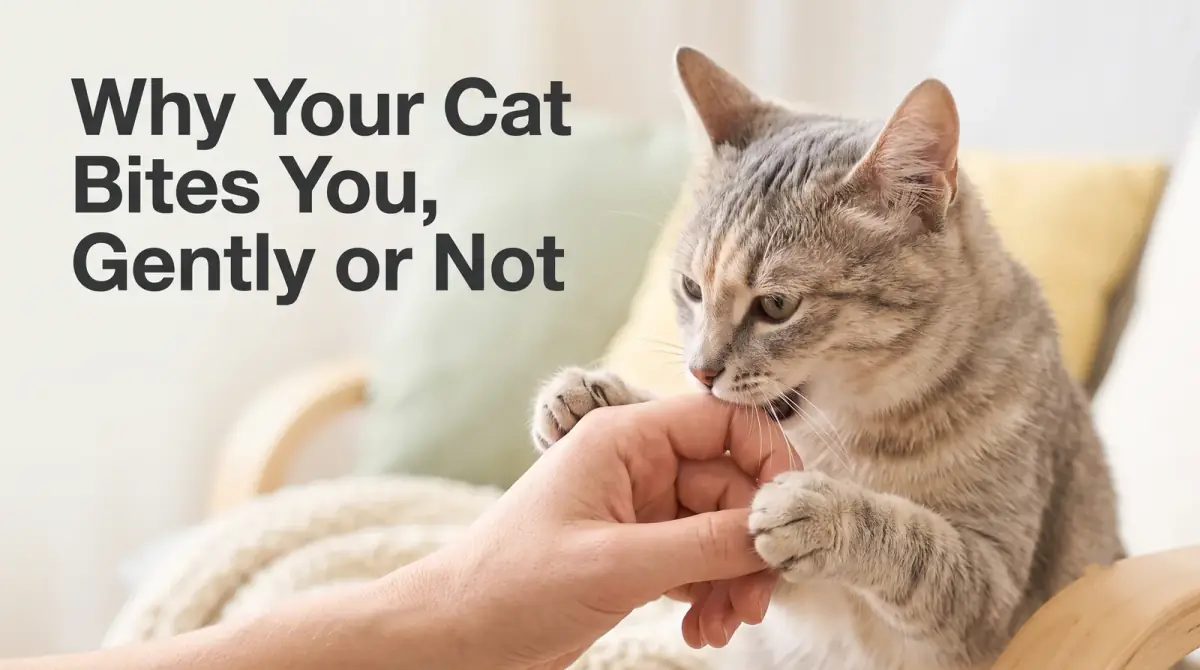
Sometimes a bite is a compliment. Love bites are soft, controlled, and do not break the skin, and they often happen while your cat is relaxed, purring, or grooming you. In the cat world, gentle nibbling can be part of social bonding, a leftover of the way cats groom one another.
You can usually tell a love bite by its context. The body is loose, the eyes may be half closed, and there is no hissing or tension. If the nibble stays gentle, there is no harm in it, though you can gently redirect your cat to a toy if you would rather not encourage teeth on skin at all.
Overstimulation: the mid-cuddle nip
One of the most common complaints is the cat that enjoys a stroke, then suddenly whips around and bites. This is usually overstimulation, sometimes called petting-induced biting. What felt pleasant at first becomes too much, and the bite is your cat saying, that is enough for now.
Cats often have favorite and off-limits zones. Many enjoy chin, cheek, and head scratches but dislike long strokes down the back or any touching near the belly and tail base. Learning your own cat's map goes a long way toward fewer surprises.
Warning signs before an overstimulation bite
- The tail starts twitching, flicking, or thumping.
- The skin along the back ripples or twitches.
- Ears rotate back or flatten.
- The body stiffens and the purring stops.
- Your cat turns its head sharply toward your hand.
When you see these cues, stop petting and give your cat space. Ending on a calm note teaches your cat that the signals work and that biting is not necessary.
Play biting and hunting instincts
Kittens learn about the world with their mouths and paws, and play biting is a natural part of that. If a kitten is allowed to wrestle with bare hands, it can grow into an adult that treats fingers and toes as toys. The bite is not angry, it is a hunting game, but it can still hurt.
The fix is to redirect that energy onto proper toys. Wand teasers, balls, and small mice let your cat chase, pounce, and bite something that is meant to take it. Never use your hands as the toy, because that teaches exactly the behavior you want to avoid. A couple of short play sessions each day also burns off the pent-up energy that fuels ambush attacks on ankles.
Fear, defense, and feeling cornered
A frightened or cornered cat may bite to defend itself, and this bite is different in character. It tends to come with clear distress signals such as flattened ears, a puffed-up tail, hissing, growling, or crouching low with wide eyes. Here the cat is not misbehaving, it is asking to be left alone.
The kindest response is to back off and remove whatever is frightening your cat, rather than trying to soothe or hold it, which can make things worse. Never punish a fearful bite. Punishment increases anxiety and can turn an occasional defensive nip into a lasting fear of hands.
When biting might be about discomfort or pain
A normally gentle cat that suddenly starts biting, especially when touched in a particular spot, may be telling you something hurts. Cats are experts at hiding pain, so a change in behavior is sometimes the first and only clue. Sore joints, dental trouble, or an injury you cannot see can all make handling uncomfortable.
This is general guidance, not a diagnosis, so trust the pattern rather than guessing at a cause. If your cat flinches, bites when touched in one area, or shows a clear jump in biting alongside changes in eating, grooming, or mood, a vet visit is the right next step to rule out a medical reason.
How to reduce biting for good
Once you understand the reason behind the bites, the response becomes simple. A few consistent habits make the biggest difference over time.
- Watch the body language and stop petting at the first warning sign.
- Learn and respect your cat's preferred petting zones.
- Give plenty of interactive play so hunting energy has an outlet.
- Never use hands or feet as toys, even with kittens.
- If a bite happens, calmly disengage rather than shouting or pulling away sharply, which can excite a playful cat further.
In short, biting is your cat's way of talking, and it is usually saying something reasonable. Read the signals, respect the limits, and reach out to your vet if the biting is sudden, painful, or out of character. With patience, most cats and their people find a rhythm where teeth rarely come into it at all.




Comments
0 total