
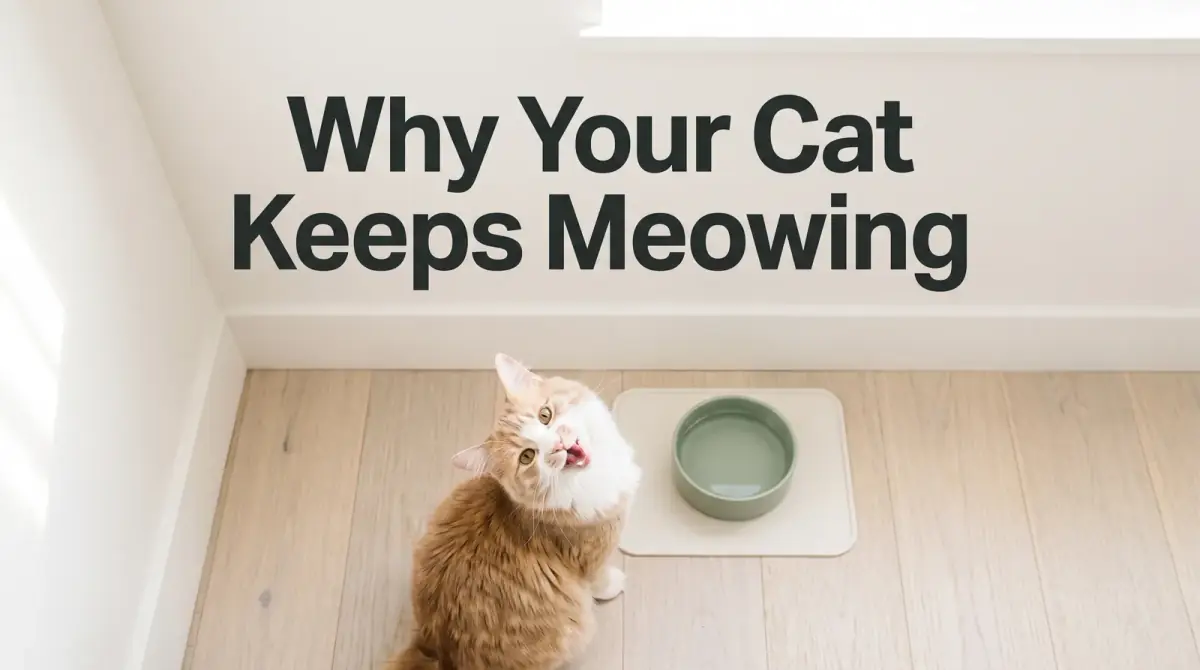
The short answer
Cats meow at people on purpose, so constant meowing is your cat telling you something. Here is why your cat keeps meowing and when the change is worth a vet visit.
- Cats mostly meow to communicate with humans, not other cats.
- Common reasons include hunger, greetings, and wanting attention.
- Boredom and stress can turn up the volume, especially in indoor cats.
- Some breeds are naturally far more talkative than others.
- A sudden change in meowing can signal discomfort and deserves a vet visit.
If your cat follows you from room to room with a running commentary, you have probably wondered, why does my cat keep meowing? Adult cats rarely meow at each other, so a cat that keeps meowing is almost always talking to you on purpose. The reasons cover everything from hunger, greetings, and attention-seeking to boredom, stress, and, in some cases, a health issue that needs a vet's eye.
The key is to look at what your cat is meowing about and whether the pattern has changed. This article covers the usual causes of a chatty cat and the signs that mean the meowing is worth a professional check rather than just a response at home.
Key takeaways
- Cats mostly meow to communicate with humans, not other cats.
- Common reasons include hunger, greetings, and wanting attention.
- Boredom and stress can turn up the volume, especially in indoor cats.
- Some breeds are naturally far more talkative than others.
- A sudden change in meowing can signal discomfort and deserves a vet visit.
Why does my cat keep meowing at me?
People often ask why does my cat keep meowing when nothing seems wrong, and the honest answer is that your cat has learned it works. Somewhere along the way, a meow got a meal, an open door, or a bit of fuss, and a smart cat repeats what pays off. Meowing is a direct line to you, and cats use it because we respond.
That said, not all meows mean the same thing. Cats vary the pitch, length, and urgency to send different messages, and over time most owners can tell a hungry cry from a friendly chirp. The context around the sound tells you most of what you need to know.
The everyday reasons cats meow
Most meowing is ordinary and easy to explain once you look at the timing. A few reasons cover the bulk of it.
Hunger and routine
Many cats become vocal around feeding times, and they quickly learn to remind you when a meal is due. If the meowing clusters near breakfast or dinner, food is the obvious motive.
Greeting and attention
A short, bright meow when you walk in the door is often just a hello. Longer, more insistent meowing usually means your cat wants attention, play, or simply your company for a while.
Wanting something specific
Cats meow to ask for things: a closed door opened, a favorite toy fetched from under the sofa, fresh water, or a clean litter box. If you follow the sound, your cat will often lead you straight to the request.
Boredom, loneliness, and stress
An under-stimulated cat is frequently a noisy one. Cats left alone for long hours, or those living in a home with little to do, may meow out of boredom or loneliness. The meowing is a bid for interaction and a hint that the day needs more variety.
Stress can raise the volume too. Changes such as a house move, a new pet or baby, rearranged furniture, or a shift in your schedule can all leave a cat unsettled and more vocal. In these cases the meowing tends to appear alongside other signs of unease, like hiding, over-grooming, or changes in appetite. Adding play, climbing space, and predictable routines often helps more than anything else.
Attention-seeking and learned habits
Here is a gentle truth: sometimes we accidentally train our cats to be loud. If meowing reliably earns food, petting, or even a scolding, your cat learns that noise gets a reaction, and any reaction can be rewarding to a bored cat.
Breaking the cycle takes consistency. The usual advice is to reward the quiet and avoid responding at the exact moment your cat is demanding, so long as its real needs are already met. This is not about ignoring your cat, but about giving attention on a schedule you choose rather than on demand. Offering play and affection before the meowing starts can take the pressure off entirely.
Do some cats just meow more?
Absolutely. Talkativeness varies a lot from cat to cat and breed to breed. Some breeds, such as Siamese and other Oriental types, are famous for holding long, loud conversations, while other cats stay almost silent their whole lives.
Personality plays a big part as well. A confident, social cat may narrate the whole day, while a shy one keeps quiet. If your cat has always been chatty and seems happy and healthy, that steady baseline is probably just who your cat is. What matters most is not the volume itself but any change from your cat's normal.
When meowing could mean a health problem
A clear change in how much or how your cat meows is the signal to pay closer attention. Because cats hide discomfort so well, a shift in vocalizing is sometimes an early clue that something is off. This is general information rather than a diagnosis, so the aim is to notice the change and let a vet interpret it.
Reasons to book a vet visit include meowing that is sudden, constant, or unusually loud and mournful, night-time yowling in an older cat, or meowing paired with changes in eating, drinking, litter box habits, weight, or activity. Very vocal restlessness, straining, or crying while using the litter box should be treated as urgent. When in doubt, a check-up is the safest way to rule out a medical cause.
Does age change how much a cat meows?
A cat's stage of life shapes how vocal it is. Kittens meow a great deal because, in their early weeks, calling out to their mother is how they get warmth, food, and comfort. That instinct fades as they grow, but the lesson that a cry brings help often carries over to life with humans.
Older cats can become more vocal again, sometimes noticeably so. Senior cats may meow more at night or seem confused and restless, which can be linked to changes that come with age. Because this overlaps with several health-related possibilities, increased night-time yowling in an older cat is a good reason to arrange a vet check rather than to guess at the cause. Meeting your cat's changing needs at each stage keeps both the meowing and your cat more comfortable.
How to respond to a chatty cat
Once you have ruled out anything worrying, a few steady habits keep the peace and meet your cat's needs.
- Keep feeding, play, and rest on a predictable daily routine.
- Set aside time for interactive play so your cat is genuinely tired and content.
- Enrich the space with scratching posts, high perches, and puzzle feeders.
- Reward calm, quiet moments with attention instead of only responding to noise.
- Track any change in the meowing so you can describe it to your vet if needed.
In short, a meowing cat is a communicating cat, and most of the time the message is simple. Listen to the pattern, meet the real needs behind it, and stay alert to sudden changes, because those are the ones your vet will want to hear about.
Comments
0 total