
The short answer
That unblinking gaze is usually affection or curiosity, not a threat. Learn why your cat stares at you, what the slow blink means, and how to answer it kindly.
- A cat's stare is usually curiosity or affection, not aggression.
- The slow blink is your cat's way of saying it feels safe with you.
- Context and the rest of the body language change what a stare means.
- You can answer a friendly stare with a slow blink of your own.
- A sudden change in staring or other behavior is worth a vet's attention.
If you glance up and catch two round eyes locked onto you, it is natural to wonder why does my cat stare at me. In most cases a cat's stare is not a challenge or a warning but a quiet form of attention, because cats learn a great deal about the people they love simply by watching them. That steady gaze can carry affection, curiosity, hunger, or the plain fact that you are the most interesting thing in the room.
A stare feels intense to us because humans treat long eye contact as a big deal. For your cat, however, it is often just one part of an ongoing, wordless conversation.
Key takeaways
- A cat's stare is usually curiosity or affection, not aggression.
- The slow blink is your cat's way of saying it feels safe with you.
- Context and the rest of the body language change what a stare means.
- You can answer a friendly stare with a slow blink of your own.
- A sudden change in staring or other behavior is worth a vet's attention.
Why does my cat stare at me? The short answer
Cats are visual, observant animals, and watching is how they gather information. Your face, your hands, and your daily habits are all things worth studying, especially for a companion who has learned that you control the food bowl and the warm lap.
So when your cat fixes its eyes on you, it is often reading you. It may be checking whether you are about to get up, waiting for a familiar routine, or simply keeping tabs on its favorite person. For example, many cats stare hardest right before a meal or right before their human usually heads to bed. In short, the answer to why does my cat stare at me usually begins with attention rather than any hint of aggression.
Cat staring as a quiet conversation
Cats communicate far more through body language than through sound. A great deal of that language happens with the eyes, the ears, and the set of the whiskers rather than with meows. Because of this, a long look can be your cat's version of talking to you.
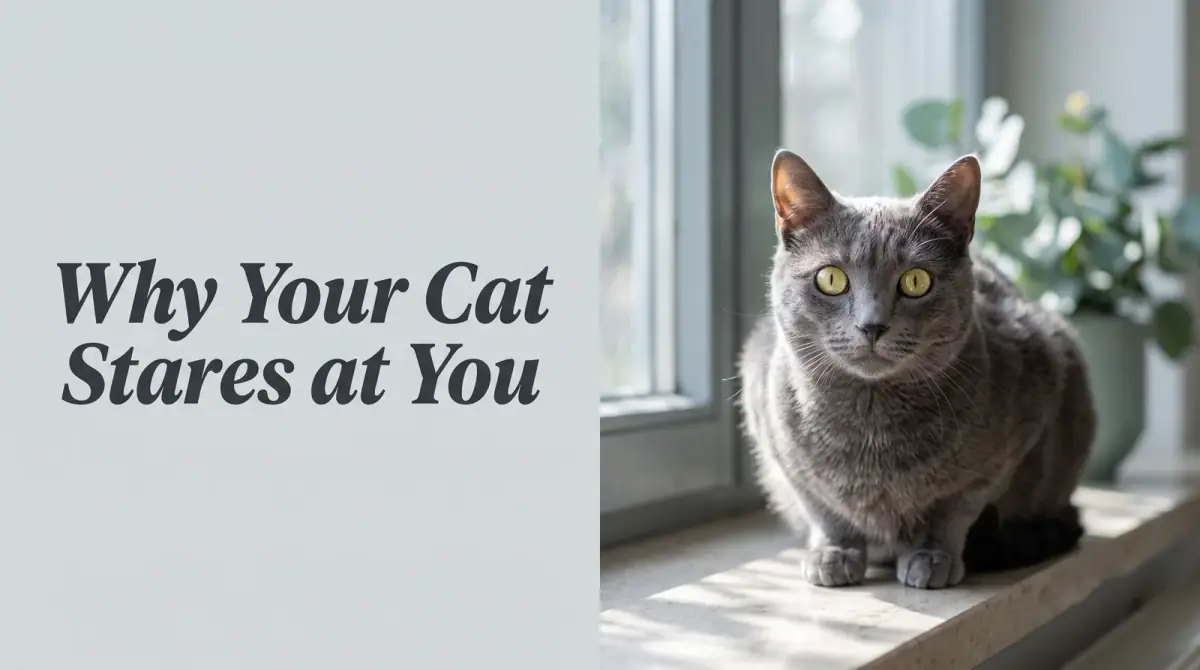
Cat staring in a relaxed body usually means comfort and mild interest. The cat is engaged with you but calm, the way a friend might sit across the table and hold a soft gaze during a chat. There is no hidden hostility in it, just presence.
Staring becomes something different only when the body tenses. A hard, wide-eyed stare paired with a stiff posture, flattened ears, or a lashing tail is a signal to give the cat some space rather than a friendly greeting.
What the cat slow blink means
If your cat looks at you and then slowly closes and opens its eyes, pay attention, because the cat slow blink is one of the sweetest signals in the feline world. Many people call it a cat kiss. A cat that slow blinks at you is showing that it feels relaxed and safe in your company.
Closing the eyes near another creature is an act of trust, since a cat with its eyes shut cannot watch for danger. When your cat offers that soft, drowsy blink, it is telling you that it does not see you as a threat at all. In short, the slow blink is a small, silent compliment.
The lovely part is that you can send the message back. Meet your cat's gaze gently, then close your eyes for a moment and open them slowly. Do not stare hard while you do it. Over time, many cats will begin to slow blink first, starting the conversation themselves.
Why do cats stare? The common reasons
There is rarely a single answer to why do cats stare, since the same behavior can mean several things depending on the moment. A few reasons come up again and again.
Hunger and routine
Cats are creatures of habit and excellent clock-watchers. A pointed stare near feeding time is often a polite, or not so polite, request for dinner. The same goes for the hour you usually offer treats or open the door.
Affection and bonding
When the stare is soft and the body is loose, your cat may just be enjoying your company. Gazing at you, sometimes with a purr or a slow blink, is a way of staying close without needing to touch.
Curiosity
Sudden movements, new sounds, or an unfamiliar object in your hands can all draw a fixed, studying look. Your cat is trying to work out what you are doing and whether it matters to them.
Seeking attention
Some cats learn that staring gets a reaction. If a long look has ever earned a chat, a cuddle, or a snack in the past, your clever companion may repeat it on purpose.
How to read the rest of your cat's body language
A stare never tells the whole story on its own. To understand what your cat means, look at the rest of the body at the same time. The eyes are only one word in a longer sentence.
- Ears: Forward or gently swiveling ears suggest interest and calm, while flattened ears suggest fear or irritation.
- Tail: A still or softly curved tail reads as relaxed, while a thrashing or puffed tail signals agitation.
- Pupils: Wide, round pupils can mean excitement or unease, and narrow slits often appear in bright, calm moments.
- Posture: A loose, settled body means comfort, while a crouched, tense body means the cat is on guard.
Put these clues together and the meaning of a stare usually becomes clear. A soft-eyed cat with forward ears and a still tail is content. A wide-eyed cat with a rigid body and a swishing tail would rather be left alone for now.
How to answer your cat's stare
Once you can tell a friendly stare from a tense one, you can respond in a way your cat understands. For a relaxed, affectionate gaze, the best reply is that gentle slow blink, perhaps with a soft word or a quiet moment together.
Avoid meeting a hard, direct stare with your own intense stare, since in cat language a fixed glare can feel confrontational. If your cat looks tense, glance away, soften your body, and let it decide whether to come closer. Respecting that choice is one of the fastest ways to build trust.
When a cat's stare is worth a closer look
Most staring is perfectly normal and even endearing. Now and then, though, changes in a cat's behavior can hint at discomfort or a health issue, and eyes are involved in some of those changes. This is general guidance rather than a diagnosis.
It is reasonable to keep an eye out if the staring seems different from your cat's usual habits. For example, blank staring at walls, appearing disoriented, pressing the head against surfaces, cloudy or uneven eyes, or a stare that comes with hiding, appetite changes, or lethargy are all worth noting. These signs do not confirm anything on their own, but they are the kind of thing best discussed with a professional. If your cat's staring or behavior changes suddenly, seems out of character, or persists in a way that concerns you, consult your vet.
Building trust with your cat
The more you learn to read your cat, the more that steady gaze becomes a source of connection rather than a mystery. Answer soft stares with slow blinks, give space when the body says to, and keep the routines your cat relies on.
Over weeks and months, this back and forth deepens the bond between you. Your cat watches you because you matter to it, and once you learn to watch back with the same gentleness, those long looks turn into one of the quiet pleasures of living with a cat.
Comments
0 total